Linkage, Recombination, and Independent Assortment in Genetics
Explore the principles of Mendelian genetics, including independent assortment and genetic linkage. Learn how crossing over during meiosis leads to recombination, and how to analyze linkage using testcrosses and statistical methods like the Chi-square test.
In classical Mendelian genetics, the Principle of Independent Assortment suggests that the alleles of two different genes get sorted into gametes independently of one another. However, this principle only holds true if the genes are located on different chromosomes or are very far apart on the same chromosome. When genes are located close together on the same chromosome, they are said to be "linked". Because they are physically part of the same DNA molecule, they tend to be inherited together, a phenomenon that challenges the expected phenotypic ratios of a standard dihybrid cross.
Independent Assortment vs. Complete Linkage
To understand linkage, we must first look at the baseline: independent assortment. In a typical dihybrid cross involving two genes that assort independently, a heterozygote parent can produce four types of gametes in equal proportions (25% each). This results in a predictable 9:3:3:1 phenotypic ratio in the F2 generation.
In contrast, complete linkage occurs when no crossing over happens between two loci. In this scenario, the genes are so close together that they are essentially passed down as a single unit.
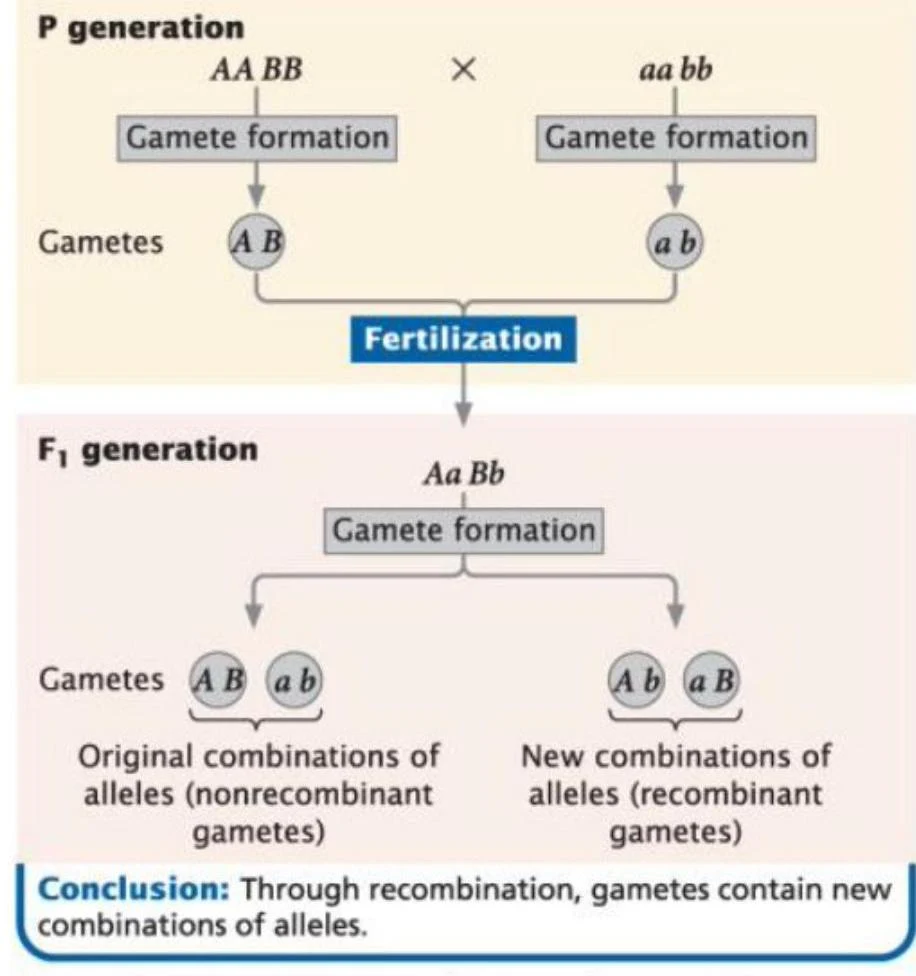
This diagram illustrates Mendelian genetics, showing the process of gamete formation and fertilization across two generations (P and F1) to demonstrate the concept of allele recombination.
Under complete linkage, the heterozygote parent produces only two types of gametes (the parental types) instead of four. Consequently, all offspring will exhibit nonrecombinant progeny (or parental phenotypes).
Exam Tip: If a dihybrid cross results in only two phenotypic classes instead of the expected four, or if the ratios deviate significantly from 9:3:3:1, suspect genetic linkage.
The Role of Recombination
While linked genes tend to stay together, they do not always do so. During Prophase I of meiosis, homologous chromosomes pair up and undergo crossing over. This process allows segments of DNA to be exchanged between non-sister chromatids, creating new combinations of alleles.
The resulting gametes that carry these new combinations are called recombinant gametes. The offspring produced from these gametes are known as recombinant progeny. The frequency of these events is a direct reflection of the physical distance between the genes: the further apart two genes are on a chromosome, the more likely a crossover event will occur between them.
Diagram illustrating the stages of meiosis I and meiosis II, including crossing over and the formation of gametes.
Coupling and Repulsion Configurations
When analyzing linked genes, it is not enough to know the genotypes; you must also know the physical arrangement of the alleles on the homologous chromosomes. This arrangement is described using two specific terms:
Coupling (Cis) Configuration: This occurs when the two wild-type alleles are on one chromosome and the two mutant alleles are on the other homologous chromosome.
Repulsion (Trans) Configuration: This occurs when each chromosome carries one wild-type allele and one mutant allele.
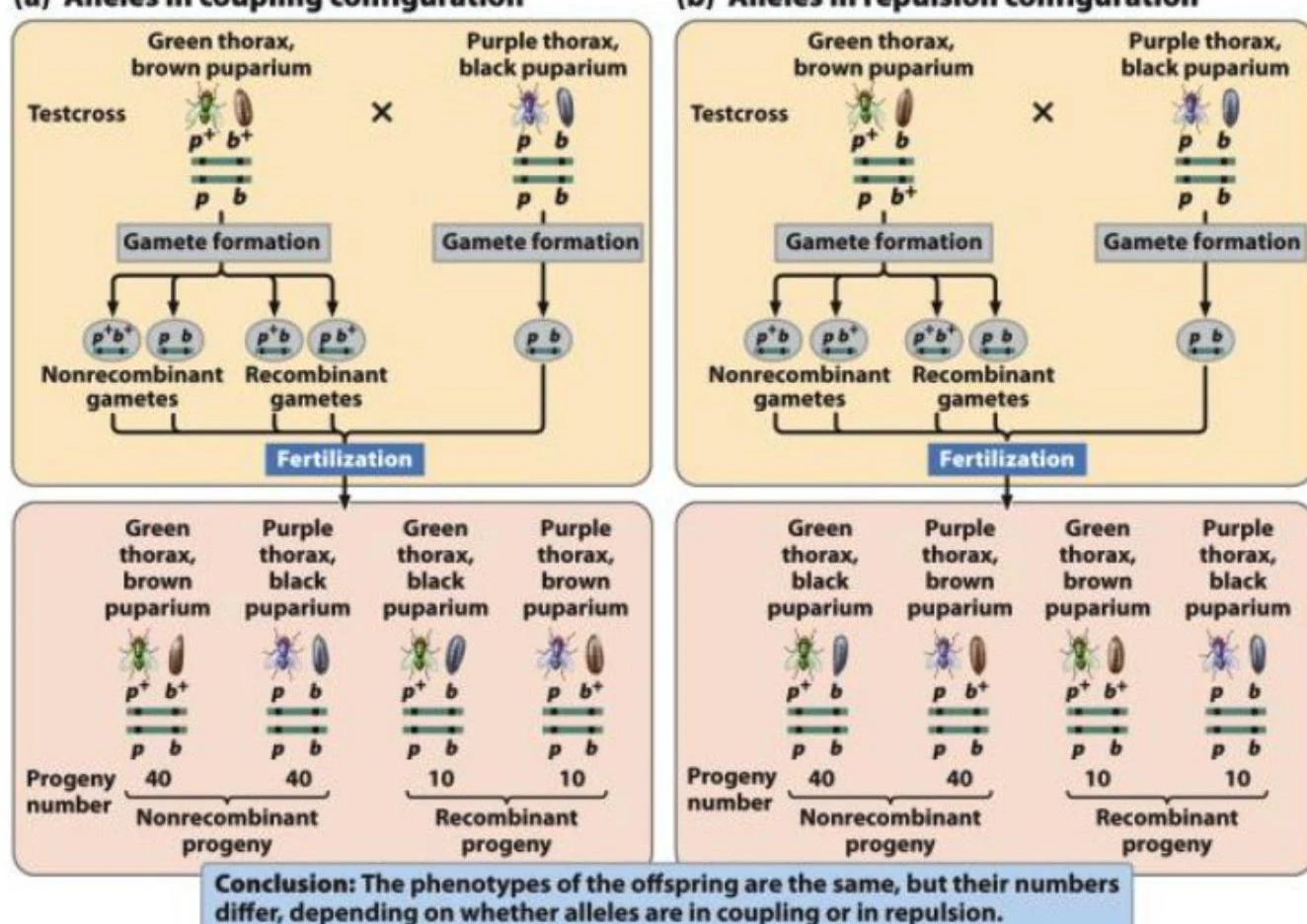
This diagram illustrates genetic linkage and recombination in fruit flies. It shows two scenarios: alleles in coupling configuration and alleles in repulsion configuration. The testcross results in different proportions of nonrecombinant and recombinant progeny depending on the initial arrangement of alleles, demonstrating how linkage affects inheritance patterns.
The configuration determines which phenotypes will appear as "parental" (nonrecombinant) and which will appear as "recombinant" in the offspring.
Analyzing Linkage: The Two-Point Testcross
A common method to study linkage is the two-point testcross. In this setup, a heterozygote is crossed with a homozygous recessive individual. This is particularly useful because the testcross allows researchers to examine the recombination rates of the heterozygous parent directly, as the recessive parent only contributes recessive alleles to the phenotype.
Calculating Recombination Frequency
The recombination frequency is the percentage of recombinant progeny produced in a cross. It is calculated using the following formula:
recombination frequency=total number of progenynumber of recombinant progeny×100%
Worked Example:
In a study of tomato plants, a researcher observes 123 total progeny. Among them, 55 show one parental type, 53 show the other parental type, 8 show a new combination, and 7 show another new combination.
To find the recombination frequency:
Identify the recombinants: $8 + 7 = 15$
Identify the total: $123$
Apply the formula:
recombination frequency=12315×100%=12.2%
Statistical Testing for Independence
Sometimes, the deviation from independent assortment is subtle. To determine if the observed results are due to actual linkage or merely random chance, scientists use the Chi-square (χ2) Test of Independence.
Unlike a standard goodness-of-fit test, the Chi-square test of independence uses a contingency table to compare observed values against expected values. This method tests whether the segregation of alleles at one locus is independent of the segregation of alleles at another locus.
The formula for the Chi-square value is:
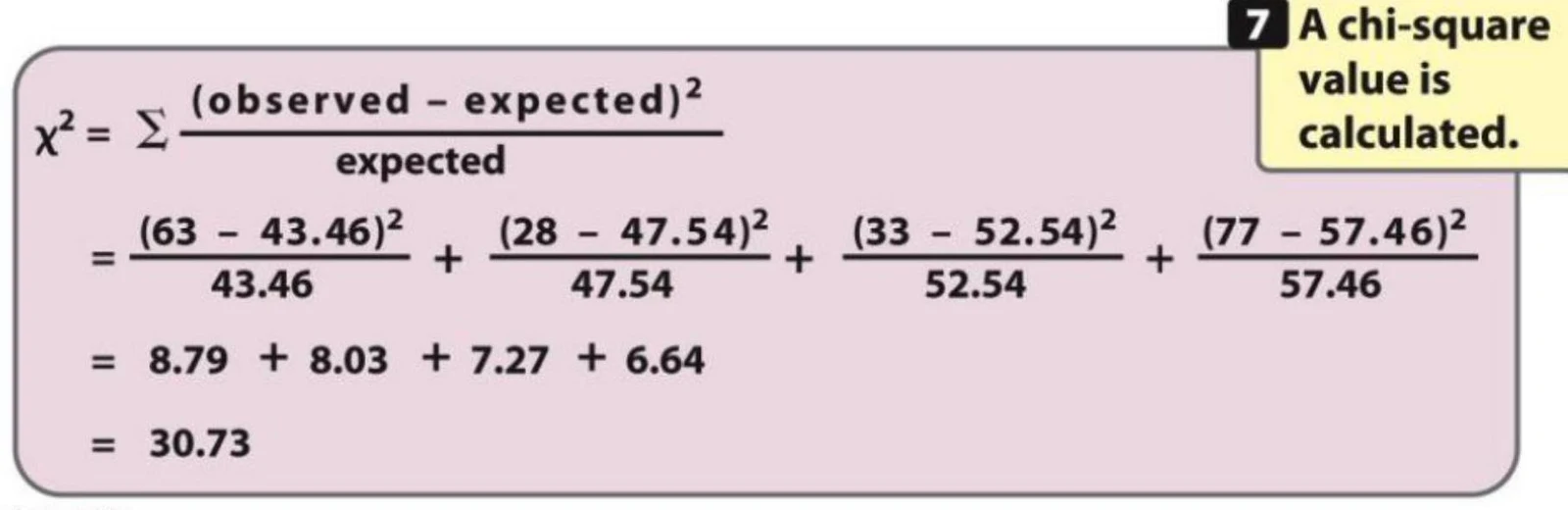
χ2=∑expected(observed−expected)2
If the calculated χ2 value is greater than the critical value found in a distribution table (based on the degrees of freedom), the null hypothesis of independent assortment is rejected, confirming that the genes are linked.
The calculation of a chi-square value involves summing the squared differences between observed and expected values, divided by the expected values.
Note on Degrees of Freedom: For a contingency table, the degrees of freedom (df) are calculated as:
df=(number of rows−1)×(number of columns−1).
By combining these mathematical tools with observations of recombination, geneticists can map the relative positions of genes along a chromosome.
Keep reading for free.
Create an account to finish this reading and make it part of your study routine.