Explores the developmental process of speech acquisition in children, from prelinguistic vocalizations to the emergence of true words and the patterns of phonological development.
The journey from the first sounds of infancy to the complex communication of childhood is a structured developmental process. While much of early vocalization is considered prelinguistic, there is a distinct transition where sounds begin to carry specific, consistent meanings. This article explores the linguistic stages of development, beginning with the bridge between babbling and true speech, and moving through the acquisition of words and the complex patterns of phonological development.
The Bridge: The Integrative Stage
Before a child produces their first meaningful words, they pass through a critical period known as the Integrative Stage. Proposed by Oller, this stage occurs between approximately 10 and 18 months of age.
Unlike earlier stages of babbling, which may be purely motoric or repetitive, the integrative stage represents a transition where speech begins to take on the "flavor" of the child's native language. During this period, children produce a variety of Consonant-Vowel (CV) sequences that exhibit adult-like intonation and prosody. They may use these sounds to mimic the rhythm of questions, exclamations, or statements.
Commonly used sounds during this stage include:
Consonants: /h, d, t, b, m, w, j/
Vowels: /ʌ, ɛ, ʊ, a/
Syllable Shapes: V, CV, VCV, and CVCV
The Emergence of First True Words
The formal linguistic phase begins around 12 months of age and continues until roughly 6 years. This phase is marked by the appearance of "true words," which coexist with leftover babbling and jargon during a period of developmental overlap.
To distinguish a meaningful word from mere vocalization, researchers use specific criteria. A production is considered a true word only if it meets three requirements:
It has a relatively stable phonetic form.
It is produced consistently by the child within a specific context.
It is recognizably related to the adult-like version of the word.
For example, if a child consistently says /ba/ to refer to a "ball," this is a true word. However, if a child uses invented sounds like /gaga/ for "water" or /gJ/ for "dog," these are classified as proto-words, quasi-words, or invented words.
Exam Tip: When distinguishing between a proto-word and a true word, look for consistency and phonetic stability. An invented word might be used frequently, but if it does not resemble the adult target or lacks a stable form, it is not a "true" linguistic word.
Item Learning vs. System Learning
Early word acquisition follows a specific cognitive path. Initially, children engage in item learning, where words are treated as unanalyzed, individual units. They learn "this sound = that object" without yet understanding the underlying rules of the language.
It is only after the child has acquired approximately 50 words that they transition into system learning. At this stage, the child begins to acquire the principles of the phonological system, allowing them to understand how sounds relate to one another within the language.
Segmental Speech Development
Segmental development refers to the acquisition of individual speech sounds (phonemes). Generally, vowels are acquired earlier than consonants. Most vowels are mastered by age 3, while more complex rhotic vowels (r-colored vowels) may not be mastered until between 48 and 53 months.
Consonant Acquisition and Markedness
The acquisition of consonants follows a predictable, though variable, timeline. This progression can often be explained by the concept of markedness.
Unmarked elements: These are "natural" speech elements that are linguistic universals. They are less complex and tend to develop earlier.
Marked elements: These are more complex, rarer across the world's languages, and tend to develop later.
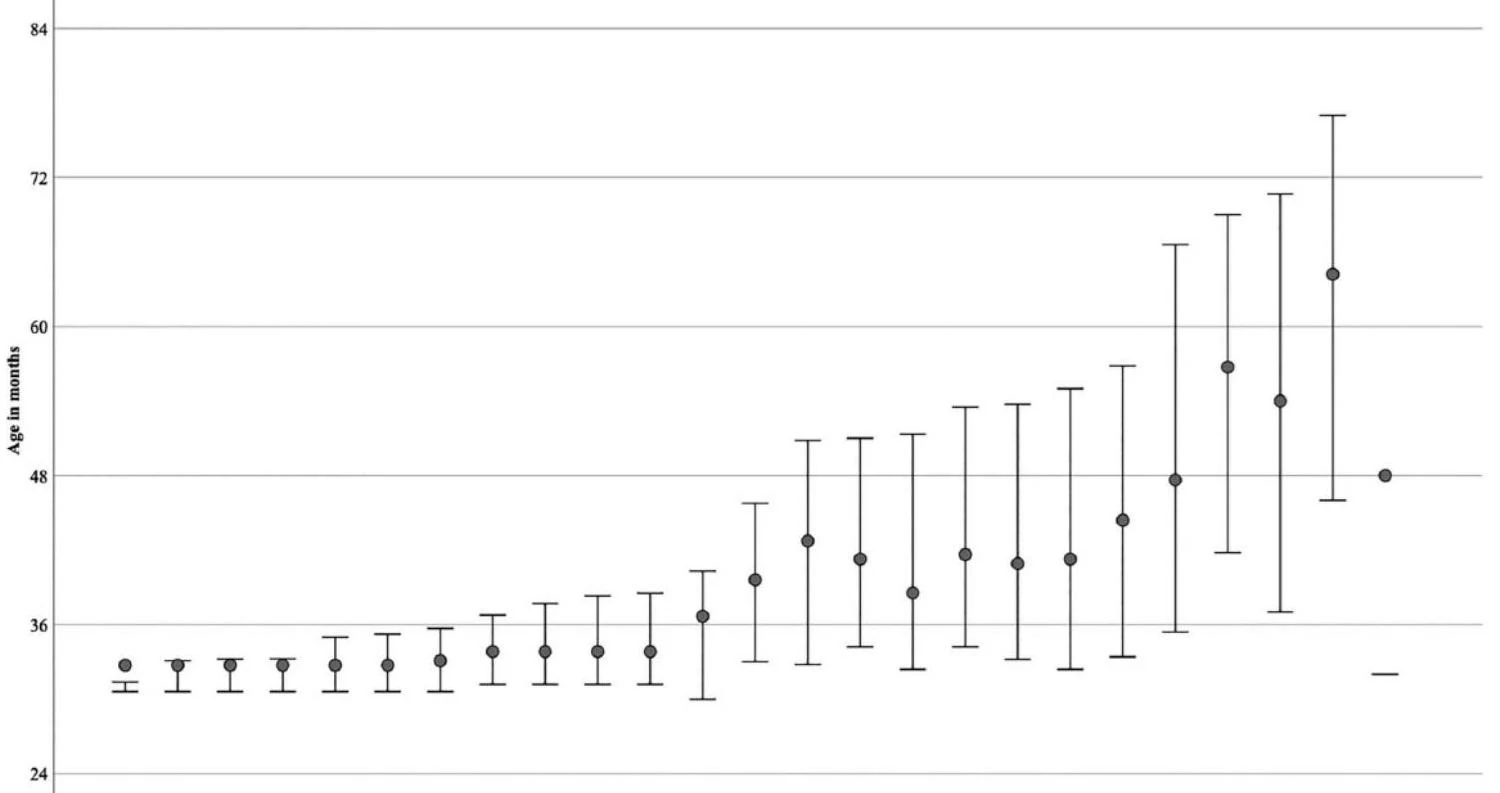
The following table summarizes the typical age of acquisition for English-speaking children based on the 90% criterion:
Age Range
Consonants Acquired
2:0 – 2:11
/b, n, m, p, h, w, d/
3:0 – 3:11
/g, k, f, t, ŋ, j/
4:0 – 4:11
/v, dʒ, s, t, l, z/
5:0 – 5:11
/ʃ, ð, ʒ/
6:0 – 6:11
/θ/
A scatter plot showing age in months with error bars.Figure 1: Mean age of acquisition of consonant phonemes.
Phonological Error Patterns
As children learn to navigate the phonological system, they often simplify their speech to make it easier to produce. These simplifications are known as phonological error patterns. These patterns can be categorized into several types:
1. Syllable Structure Patterns
These patterns change the shape of a syllable by adding, removing, or repeating sounds:
Reduplication: Repeating an entire syllable (total) or part of a syllable (partial). This typically disappears by age 3.
Diminutization: Adding the vowel /i/ to the end of a word. This also disappears by age 3.
Weak Syllable Deletion: Removing an unstressed syllable in a multisyllabic word.
Final Consonant Deletion: Removing the final consonant, leaving an open syllable (e.g., "cat" → /kæ/).
Cluster Reduction: Reducing a consonant cluster to a single consonant (e.g., "play" → /peɪ/).
Epenthesis: Adding a vowel (often a schwa) into a word.
2. Substitution and Assimilation
Children may substitute one sound for another or allow one sound to influence another:
Substitution: Patterns like velar fronting (replacing /k/ with /t/), stopping (replacing a fricative with a stop), or gliding (replacing /r/ or /l/ with /w/ or /j/).
Assimilation: A process where one sound becomes more like a neighboring sound (e.g., nasal assimilation).
3. Physiological Constraints and Strategies
Early speech is heavily constrained by the child's physical physiology and the sounds available in their ambient language. To manage these constraints, children often employ two primary strategies:
Salience: Choosing sounds that are easy to produce and clearly audible.
Avoidance: Omitting sounds that are difficult to articulate.
Furthermore, voicing patterns often follow specific rules in early development: in the beginning of words, voiced stops (like /b/) usually emerge before voiceless stops (like /p/); however, at the end of words, the pattern reverses, and voiceless stops emerge before voiced ones.
Keep reading for free.
Create an account to finish this reading and make it part of your study routine.