Explore the fundamental concepts of linear independence, span, and the criteria for forming a basis in three-dimensional space (R^3). This guide covers vector operations, linear combinations, and the determinant shortcut for analysis.
In linear algebra, understanding how vectors interact is fundamental to navigating higher-dimensional spaces. When we work in R3, we are dealing with three-dimensional space where every point can be represented by a triplet of coordinates. To describe this space efficiently, we need to know which sets of vectors can "reach" every part of the space and which vectors are redundant. This article explores the concepts of linear independence, span, and the criteria required for a set of vectors to form a basis for R3.
The Building Blocks: Vectors and Linear Combinations
At the core of our study are vectors, which in R3 are represented as ordered triples (x,y,z). We can manipulate these vectors through two primary operations: vector addition and scalar multiplication.
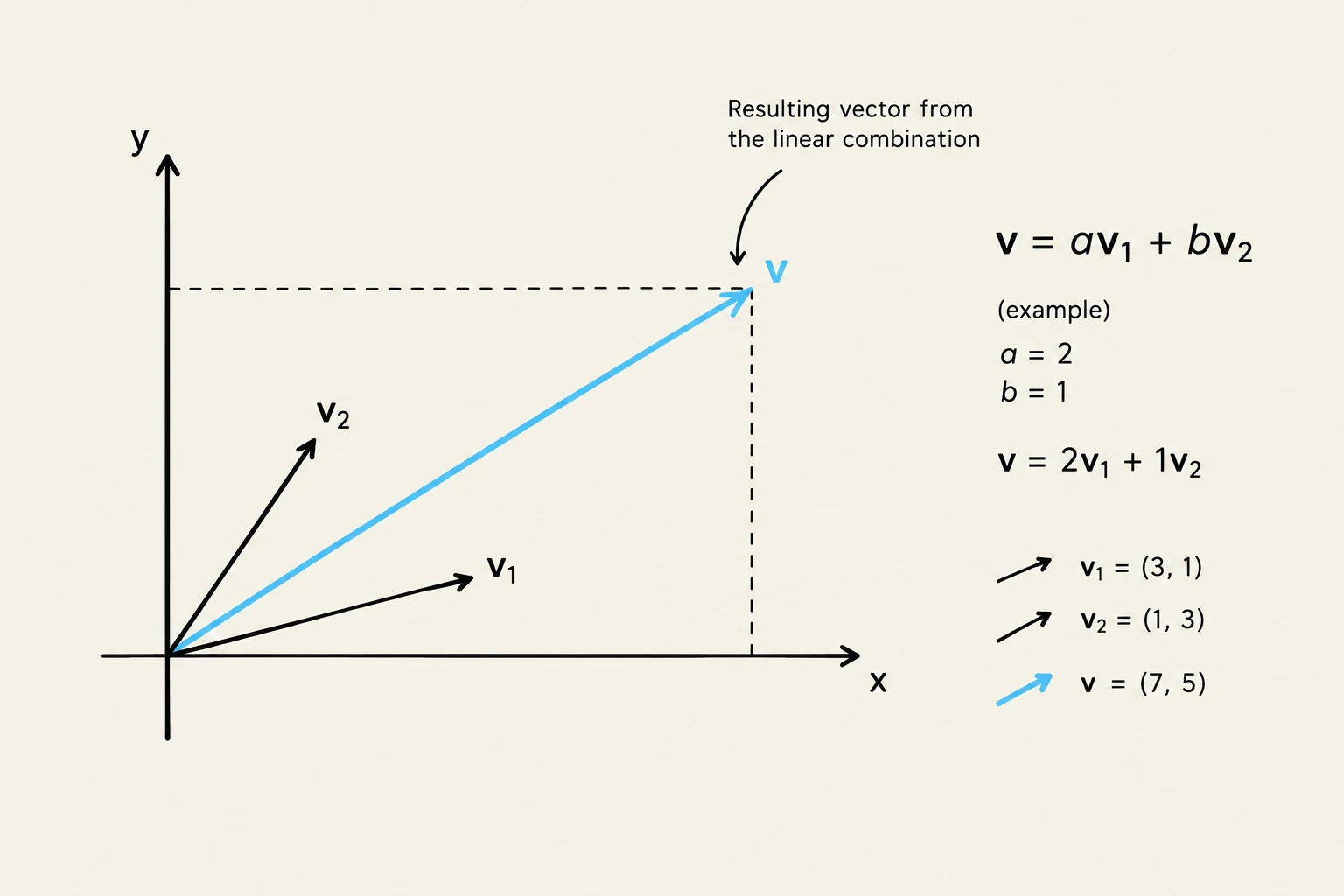
A crucial concept is the linear combination. A linear combination of a set of vectors y1,y2,…,yn is formed by multiplying each vector by a scalar and adding the results together:
C1y1+C2y2+…+Cnyn
where C1,C2,…,Cn are scalars. For example, if we have y1=(−1,2) and y2=(4,−6), we can check if a target vector like (−12,20) is a linear combination of them by solving for the scalars C1 and C2.
This diagram illustrates the concept of vector addition and scalar multiplication in a 2D Cartesian coordinate system. It shows how a resultant vector 'v' can be formed by a linear combination of two other vectors, v1 and v2, with scalar coefficients 'a' and 'b'. An example is provided with specific values for the vectors and coefficients, demonstrating the calculation of the resultant vector.
Understanding Span
The span of a set of vectors is the collection of all possible linear combinations that can be created from them. If you imagine two vectors in R3 that are not pointing in the same direction, their span is typically a 2D plane passing through the origin. If you have three vectors, their span might be the entire 3D space (R3).
To determine if a specific vector is in the span of a set, we attempt to solve the equation:
C1y1+C2y2+…+Cnyn=target vector
If we can find scalars Ci that make this equation true, the target vector is in the span. If the system of equations has a solution for any arbitrary (x,y,z), then the set of vectors spansR3.
Linear Independence vs. Dependence
Not all sets of vectors are created equal. Some vectors provide "new" directions, while others are redundant. This is the distinction between linearly independent and linearly dependent sets.
A set of vectors {y1,y2,…,yn} is linearly independent if the only way to satisfy the equation:
C1y1+C2y2+…+Cnyn=0
is by setting all scalars to zero (C1=C2=…=Cn=0). This is known as the trivial solution. If there is any other solution where at least one scalar is non-zero, the vectors are linearly dependent.
Exam Tip: If you have more vectors than there are dimensions (for example, 4 vectors in R3), the set is automatically linearly dependent because there will always be more unknowns than equations, leading to infinitely many solutions.
The Determinant Shortcut
When dealing with a square set of vectors (e.g., three vectors in R3), we can use the determinant of the coefficient matrix to quickly check both span and independence.
If det(A)=0, the vectors are linearly independent and they span the space.
If det(A)=0, the vectors are linearly dependent and they do not span the space.
Worked Example: Using the Determinant
Consider the vectors y1=(2,0,1),y2=(−1,3,4),y3=(1,1,−2). To see if they span R3, we set up the matrix:
Since detA=0, these vectors are linearly independent and span R3.
Defining a Basis
A basis is the "gold standard" for describing a vector space. A set of vectors S is a basis for a vector space V if it satisfies two specific conditions:
The vectors in S are linearly independent.
The vectors in SspanV.
In R3, any basis must contain exactly three vectors. If you have only two vectors, they might be independent, but they can only span a plane, not the whole of R3. If you have four vectors, they might span R3, but they cannot be a basis because they will be linearly dependent.
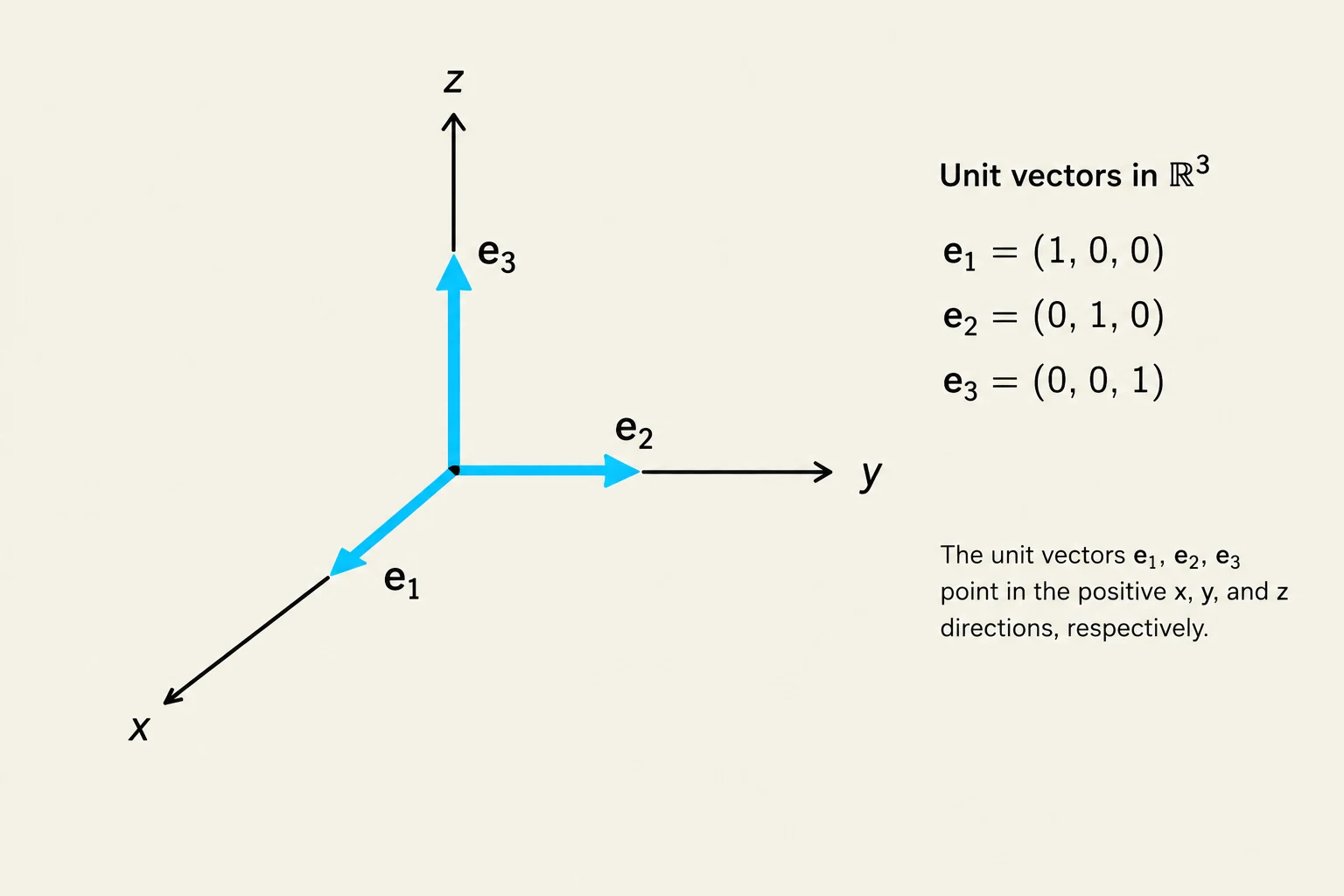
The number of vectors in a basis is called the dimension of the vector space. For R3, the dimension is 3. The most common example is the standard unit vectors:
e1=(1,0,0),e2=(0,1,0),e3=(0,0,1)
These vectors are linearly independent and span R3, making them a basis.
This diagram illustrates the unit vectors e1, e2, and e3 in a 3-dimensional Cartesian coordinate system, representing the positive x, y, and z directions, respectively.
Keep reading for free.
Create an account to finish this reading and make it part of your study routine.