Explore the hierarchical structure of life, from the chemical level of atoms and molecules to the complexity of cells, tissues, organs, organ systems, and the complete organism.
In the study of biology and anatomy, complexity does not appear all at once. Instead, life is built through a systematic, hierarchical progression. This structure allows for specialized functions to emerge from simple building blocks, moving from the microscopic world of subatomic particles to the macroscopic reality of a living, breathing human being. Understanding these levels is fundamental to grasping how the human body maintains homeostasis and functions as a unified whole.
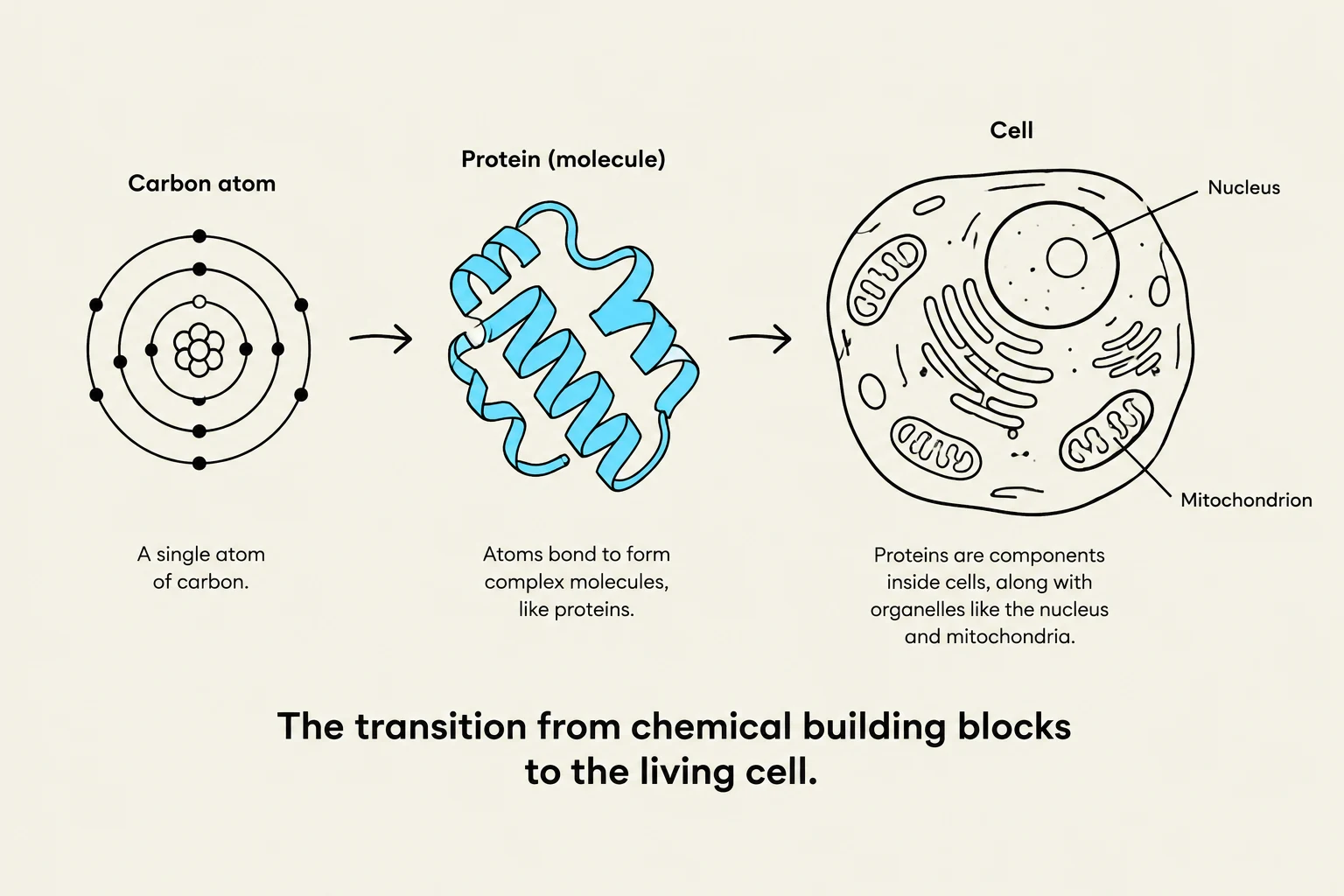
This illustration depicts the transition from a single carbon atom to a protein molecule, and finally to a cell, highlighting proteins as essential components within cells alongside organelles like the nucleus and mitochondria.
The Chemical Level: The Foundation of Life
At the very base of the hierarchy lies the chemical level. This level is divided into two main components: atoms and molecules.
Atoms are the smallest units of matter that retain the properties of an element, such as oxygen, carbon, or hydrogen. When two or more atoms bond together through chemical reactions, they form molecules. These molecules can be simple, like water (H2O), or highly complex, such as the organic macromolecules (proteins, carbohydrates, lipids, and nucleic acids) that serve as the structural and functional backbone of all living cells.
Exam Tip: Remember that the chemical level is the only level that includes non-living matter. While atoms and molecules are essential for life, they do not possess the characteristics of "living" on their own.
The Cellular Level: The Unit of Life
As we move up the hierarchy, molecules begin to organize into cells. The cell is the smallest unit of a living organism that can be considered "alive."
At the cellular level, the chemical building blocks are organized into organelles—specialized structures like the nucleus, mitochondria, and ribosomes—that perform specific tasks. For example, the mitochondria utilize chemical energy to power cellular processes. The transition from the chemical level to the cellular level represents a massive leap in complexity, as the cell is the first level where the characteristics of life (such as metabolism and reproduction) become apparent.
The Tissue Level: Groups with a Common Purpose
Cells rarely work in isolation. When a group of similar cells works together to perform a specific, unified function, they form tissue.
In the human body, there are four primary types of tissue:
Epithelial Tissue: Covers body surfaces and lines cavities.
Connective Tissue: Supports, protects, and binds other tissues together.
Muscle Tissue: Specialized for contraction and movement.
Nervous Tissue: Responsible for communication and control via electrical impulses.
By grouping cells into tissues, the body can perform much more complex tasks than a single cell could achieve alone, such as the coordinated contraction of a muscle fiber.
The Organ Level: Functional Integration
Diagram illustrating the integration of different tissue types within the stomach organ, including epithelial, muscle, connective, and nervous tissues.
An organ is a structure composed of two or more different types of tissues that work together to perform a specific, complex function.
Because organs are made of multiple tissue types, they represent a higher level of integration. For example, the stomach is an organ that includes:
Epithelial tissue to secrete digestive enzymes.
Muscle tissue to churn food.
Connective tissue to provide structural support.
Nervous tissue to signal when the stomach is full.
This integration allows the organ to serve as a functional unit within the larger body system.
The Organ System Level: Coordination of Organs
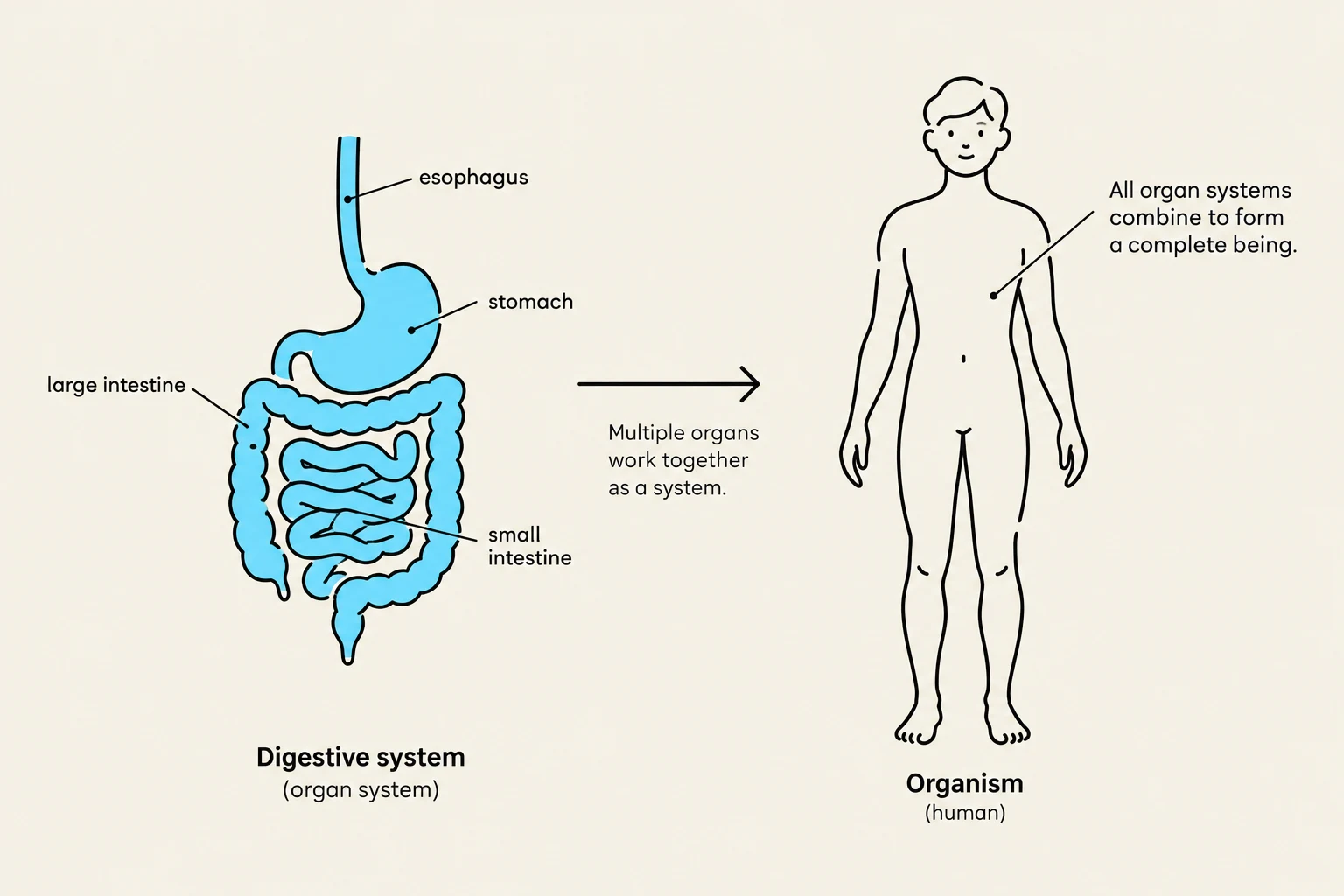
Diagram illustrating the human digestive system and its relation to the organism as a whole.
The body is not just a collection of independent organs; it is a highly coordinated network. An organ system consists of a group of organs that work together to accomplish a common goal.
Common examples include:
The Digestive System: Includes the mouth, esophagus, stomach, intestines, liver, and pancreas, all working to break down food and absorb nutrients.
The Circulatory System: Includes the heart and blood vessels, working to transport oxygen and nutrients throughout the body.
The Nervous System: Includes the brain, spinal cord, and nerves, working to process information and coordinate responses.
At this level, the focus shifts from individual structures to the physiological processes that sustain life, such as digestion, respiration, and circulation.
The Organismal Level: The Complete Being
The highest level of organization is the organismal level. This is the sum total of all structural levels working in perfect harmony. An organism is a single living individual—such as a human—comprised of all its organ systems functioning together to maintain life and stability.
The organismal level is where we observe the most complex biological phenomena, including growth, response to stimuli, and the maintenance of homeostasis (the stable internal environment required for survival).
Summary Table of Organization
To help visualize this progression, the following table summarizes the hierarchy from simplest to most complex:
Level
Description
Example
Chemical
Atoms and molecules
DNA, Glucose, H2O
Cellular
The basic unit of life
Muscle cell, Neuron
Tissue
Groups of similar cells
Muscle tissue, Nervous tissue
Organ
Different tissues working together
Heart, Stomach, Brain
Organ System
Group of organs working together
Digestive system, Circulatory system
Organism
The complete living individual
A Human Being
Study Strategy: When studying anatomy, always ask yourself: "What level of organization am I looking at?" If you are studying the heart, you are at the organ level. If you are studying how the heart's cells contract, you are looking at the cellular and tissue levels. This perspective will help you connect structure to function.
Keep reading for free.
Create an account to finish this reading and make it part of your study routine.