


Ecology is the scientific study of how organisms—including animals, plants, and microbes—interact with one another and with their natural environment. To understand these complex interactions, ecologists do not look at the world through a single lens. Instead, they view nature as a nested hierarchy of organized levels, ranging from a single living being to the entire planet.
The Scale of Approach
When studying nature, ecologists must consider the scale of approach. Scale refers to the dimension of perception in both space and time. A phenomenon might be invisible if you are looking at a single leaf, but obvious if you are looking at an entire forest. Similarly, some processes happen in seconds (like a predator striking), while others take millennia (like evolutionary change).
The appropriate scale depends entirely on the question being asked. Because ecological phenomena often operate across multiple levels, a multi-scaled approach is frequently necessary to understand how an event at one level translates into effects on another.
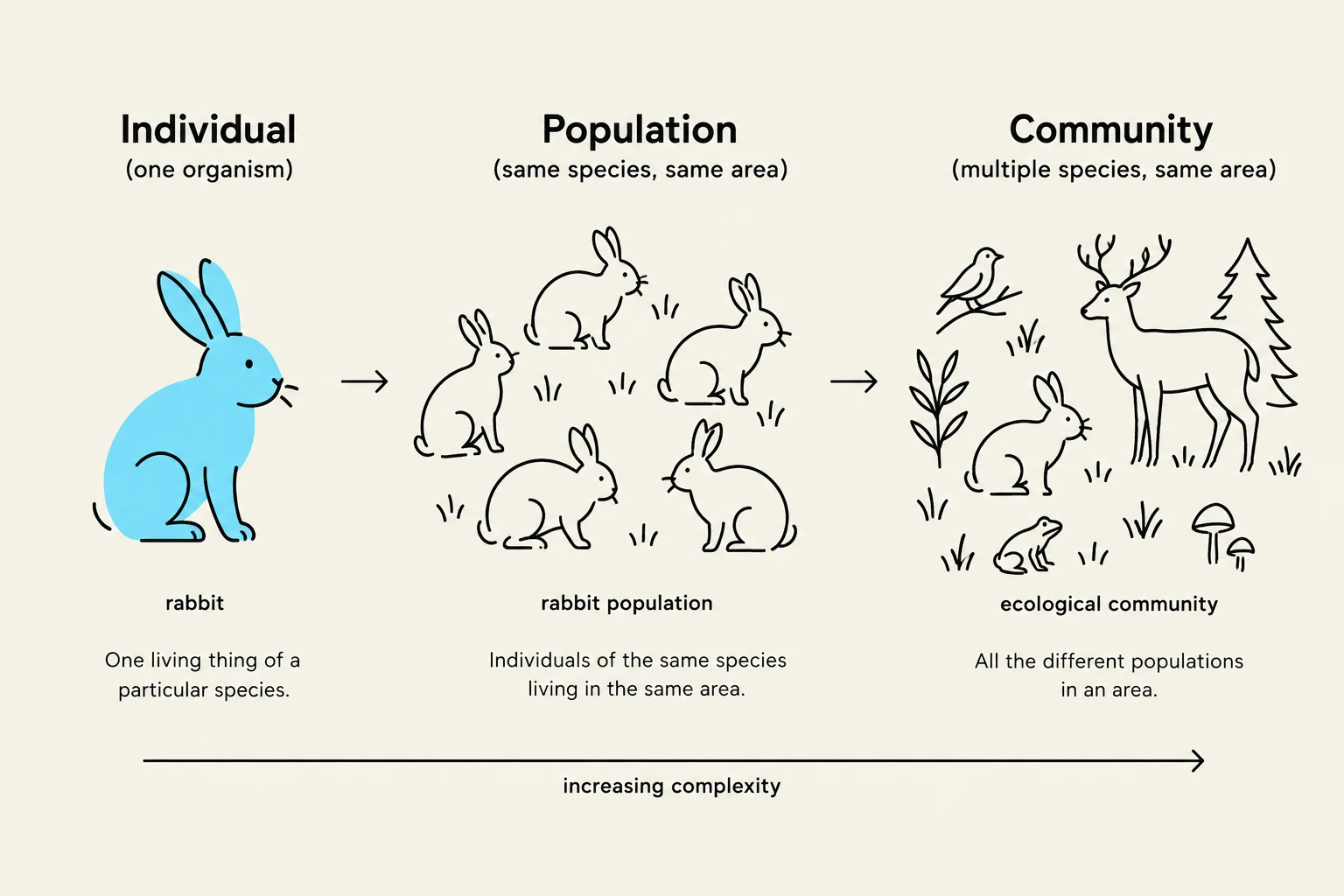
The Hierarchy of Ecological Organization
Ecological systems are organized into five primary levels of increasing complexity:
- Organism: The fundamental unit of biology. It is the smallest unit that possesses a separate life in the environment; no smaller unit can function independently in the natural world.
- Population: A group of many organisms of the same species living together in a specific area.
- Community: An assemblage of various populations of different species living in the same place.
- Ecosystem: The combination of biological assemblages (the community) interacting with their physical, non-living environment.
- Biosphere: The global ecosystem, encompassing all organisms and every environment on Earth.
Keep reading for free.
Create an account to finish this reading and make it part of your study routine.
Continue reading freeAlready have an account? Log in
Updated