This guide explains key legal concepts for nursing professionals in Canada, including unintentional torts (negligence) and intentional torts (assault, battery, false imprisonment), emphasizing the importance of duty of care, breach of standard, causation, actual harm, and informed consent. It also covers professional d
Navigating the legal landscape is a fundamental requirement for nursing professionals within the Canadian healthcare system. For students preparing for licensure exams, understanding the distinction between different types of legal liabilities is not just about passing a test—it is about ensuring patient safety and protecting your professional license. Legal implications in nursing generally fall into two broad categories: unintentional torts and intentional torts.
Unintentional Torts: Understanding Negligence
The four essential elements required to prove legal negligence: Duty of Care, Breach of Standard, Causation, and Actual Harm.
An unintentional tort occurs when a nurse fails to exercise the level of care that a reasonable, prudent nurse would provide in a similar situation, resulting in unintended harm to a patient. This specific type of tort is known as Negligence.
To successfully prove negligence in a legal proceeding, four specific elements must be established. If any one of these elements is missing, the legal claim for negligence cannot be sustained:
Duty of Care: The nurse must have had a professional and legal obligation to provide care to the specific patient in question.
Breach of Standard: The nurse’s actions (or failure to act) must have fallen below the established professional Standard of Care.
Causation: There must be a direct, demonstrable link between the nurse's breach of duty and the injury sustained by the patient.
Actual Harm: The patient must have suffered measurable physical or psychological damage as a result of the breach.
Exam Tip: The Four Elements of Negligence
When reviewing case studies, always look for the "link." It is not enough that a mistake was made; you must prove that the mistake directly caused the specific harm documented.
Case Study Application: Medication Errors
Consider a scenario where a student nurse administers medication without proper verification or supervision. If this error leads to a patient injury, it constitutes an unintentional breach of the standard of care, categorized as negligence. In such cases, liability may be shared among the student, the preceptor, and the healthcare facility.
Intentional Torts: Deliberate Violations
Unlike negligence, Intentional Torts involve deliberate actions that violate a patient's rights or bodily autonomy. Even if the nurse did not intend to cause "harm" in the sense of an injury, the act itself is considered a violation of the law because the action was performed on purpose.
Key examples include:
Assault: This is the threat of harm or an action that causes a person to fear imminent bodily harm. For example, threatening to restrain a patient if they do not comply with a procedure can be considered assault.
Battery: This involves any non-consensual physical contact or performing a medical treatment without the patient's permission. Even if the procedure is medically necessary, performing it without consent can constitute battery.
False Imprisonment: This is the unlawful restraint or restriction of a patient's movement without proper legal authorization. This can include using physical restraints or chemical restraints inappropriately.
Protecting Patient Rights: Informed Consent
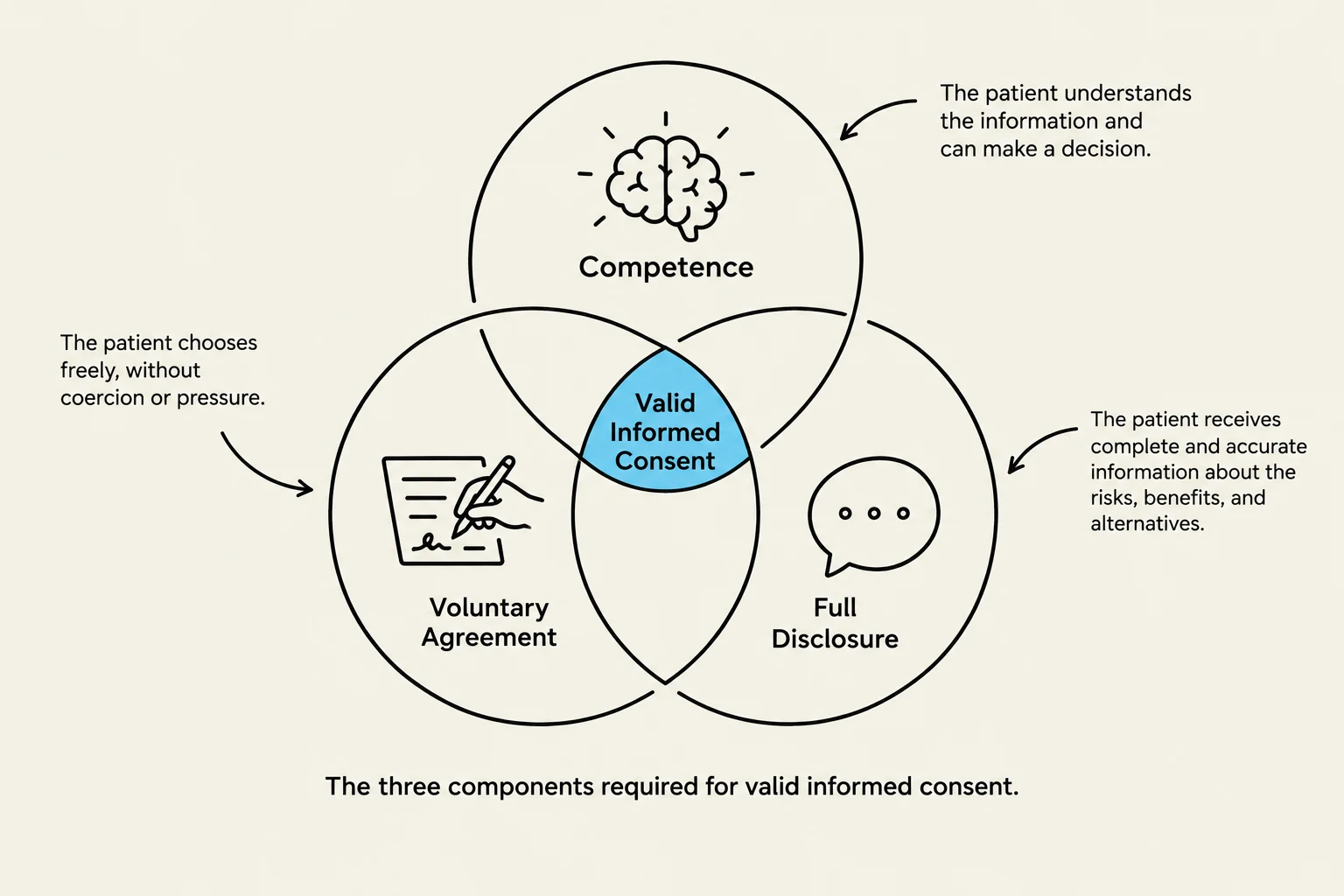
The three components required for valid informed consent: Competence, Voluntary Agreement, and Full Disclosure.
To mitigate the risk of intentional torts like battery, nurses must uphold the principle of Informed Consent. Informed consent is not merely a signature on a form; it is a process that ensures a patient is making a truly autonomous decision.
For consent to be valid, the following criteria must be met:
Competence: The patient must be mentally capable of understanding the information provided.
Voluntary Agreement: The decision must be made freely, without coercion or pressure.
Full Disclosure: The patient must be informed of the nature of the treatment, the potential risks, the expected benefits, and any available alternatives.
Professional Defense: Documentation and Incident Reporting
In the eyes of the law, "if it wasn't documented, it wasn't done." Proper Documentation is your most critical tool for legal defense. Accurate, timely, and objective charting serves as evidence of the care provided and demonstrates that you adhered to the professional standard of care.
Managing Incidents and "Near-Misses"
Despite best efforts, unexpected harm or "near-misses" (errors that did not reach the patient) can occur. These must be documented via Incident Reports for the purpose of institutional quality management.
CRITICAL RULE: The Documentation Golden Rule
An incident report is an internal quality improvement tool. Therefore, an incident report should NEVER be documented within the patient's formal medical record. You should document the clinical facts of what happened in the patient's chart, but the existence of the incident report itself stays in the administrative file.
Legal Concepts and Practice PrinciplesTable 1: Summary of Legal Concepts and Practice Principles.
Summary of Practice Principles
Concept
Key Practice Principle
Negligence
Avoid breaches of standard; ensure all 4 elements of liability are mitigated.
Informed Consent
Ensure patient understands risks, benefits, and alternatives before proceeding.
Documentation
Use accurate charting as evidence; keep incident reports out of medical records.
Conscientious Objection
If objecting to procedures like MAID, notify leadership immediately to ensure safe transfer of care.
By mastering these distinctions, you protect not only your patients from harm but also your professional standing within the healthcare system.
Keep reading for free.
Create an account to finish this reading and make it part of your study routine.