Leaf Structure, Composition, and Function in Plants
Explores the anatomy, cellular organization, tissue systems, and metabolic processes of plant leaves, including photosynthesis, gas exchange, and translocation.
Leaves are the specialized organs of a plant designed primarily to capture light energy and facilitate gas exchange. While they may appear simple, they are complex biological machines that integrate all three plant tissue systems—dermal, ground, and vascular—to drive the processes of photosynthesis and nutrient transport.
Anatomy of a Leaf
A typical leaf is composed of three distinct morphological parts:
The Blade: This is the flat, expanded portion of the leaf. Its wide surface area is an evolutionary adaptation to maximize the capture of sunlight for photosynthesis.
The Petiole: Often referred to as the leaf stalk, the petiole connects the blade to the stem.
The Node: This is the specific point on the stem where the petiole is attached.
Stipules: These are small, paired appendages located at the base of the petiole. Depending on the species, they may be leaflike or even thornlike.
Diagram illustrating the parts of a leaf, including the stem, node, petiole, and blade.
Leaf Composition and Arrangement
Plants exhibit incredible diversity in how their leaves are structured and how they are positioned on the stem.
Composition: Simple vs. Compound
The way a leaf emerges from the axillary bud (the bud located in the angle between the stem and the leaf) determines its composition:
Simple Leaves: A single, undivided leaf emerges from the axillary bud.
Compound Leaves: The leaf is divided into multiple distinct units called leaflets. These are categorized by their attachment patterns:
Palmately Compound: All leaflets radiate from a single, common attachment point, similar to fingers from a palm.
Pinnately Compound: The leaflets are arranged along a central axis, creating a feather-like appearance.
Arrangement on the Stem
Botanists also classify plants by how leaves are distributed around the stem at each node:
Alternate: Only one leaf is present per node, creating a staggered appearance along the stem.
Opposite: Two leaves emerge from the same node, positioned directly across from one another.
Whorled: Three or more leaves are arranged in a circle around a single node.
Cellular Organization and Plastids
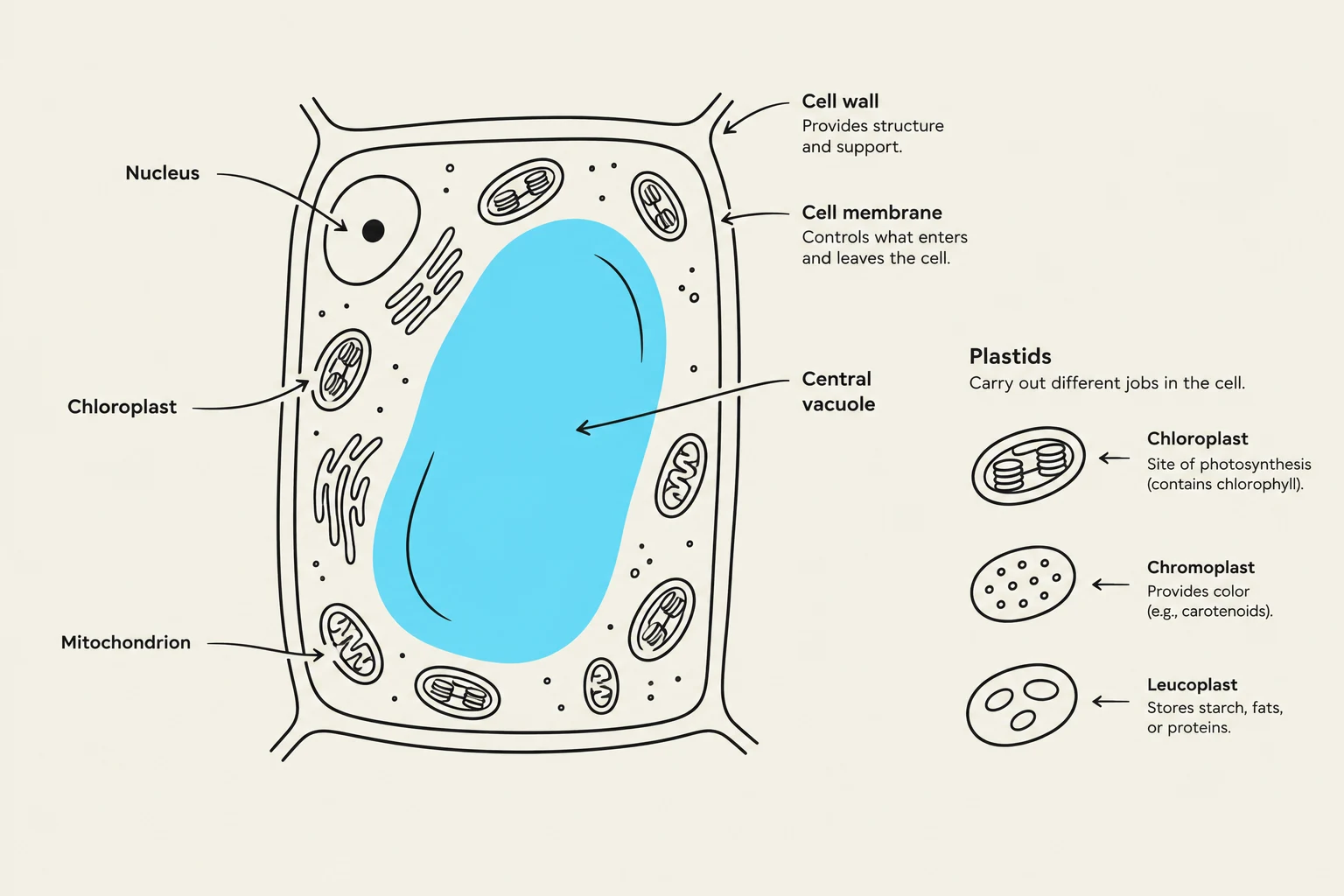
At the microscopic level, leaf cells are highly specialized. The cell wall, composed of cellulose fibrils, provides structural support, while the plasma membrane acts as a selective barrier. A defining feature of plant cells is the central vacuole, which can occupy up to 90% of the cell's volume. Bound by a membrane called the tonoplast, this vacuole stores cell sap—a mixture of sugars, salts, and proteins—and maintains turgor pressure, which keeps the plant upright.
The most critical organelles for leaf function are the plastids, which are unique to plants and algae:
Chloroplasts: The sites of photosynthesis. They contain double membranes, a fluid called stroma, and stacks of membrane-bound sacs called thylakoids (arranged into grana). They house pigments like chlorophyll, which absorbs blue-violet and orange-red light while reflecting green.
Chromoplasts: These contain carotenoid pigments that provide color to various plant organs.
Leucoplasts: Colorless organelles used primarily for the storage of materials, such as starch.
Diagram illustrating the components of a plant cell, including the nucleus, cell wall, cell membrane, central vacuole, mitochondria, and various types of plastids like chloroplasts, chromoplasts, and leucoplasts.
Tissue Systems and Gas Exchange
A leaf integrates three tissue systems to function as a single unit:
Dermal Tissue: The "skin" of the leaf, consisting of the upper and lower epidermis. The epidermis is often covered by a waxy cuticle to prevent water loss.
Ground Tissue: This makes up the mesophyll, the primary site of photosynthesis. The mesophyll is divided into the palisade mesophyll (densely packed cells that capture light) and the spongy mesophyll (cells with air spaces to facilitate gas diffusion).
Vascular Tissue: The "veins" of the leaf, which consist of xylem and phloem.
Gas Exchange and Transpiration
To perform photosynthesis, leaves must intake carbon dioxide (CO2) while minimizing the loss of water. This balance is managed by stomata—microscopic pores typically found on the lower epidermis. Each stoma is flanked by a pair of guard cells that regulate the opening and closing of the pore in response to environmental changes.
When stomata open, CO2 enters, but water vapour also escapes. This loss of water vapour is known as transpiration. Transpiration is vital because it creates a "pull" or tension that draws water upward from the roots through the xylem.
Translocation
While xylem moves water and minerals upward, the phloem is responsible for translocation—the movement of organic products (sugars) from the "source" (the leaves) to "sinks" (roots or fruits where they are used or stored).
Exam Tip: Remember the distinction between Xylem and Phloem. Xylem carries "drinks" (water/minerals) upward and consists mostly of dead cells at maturity. Phloem carries "snacks" (sugars) in both directions and is composed of living cells, such as sieve tube members and companion cells.
Energy Metabolism: Photosynthesis and Respiration
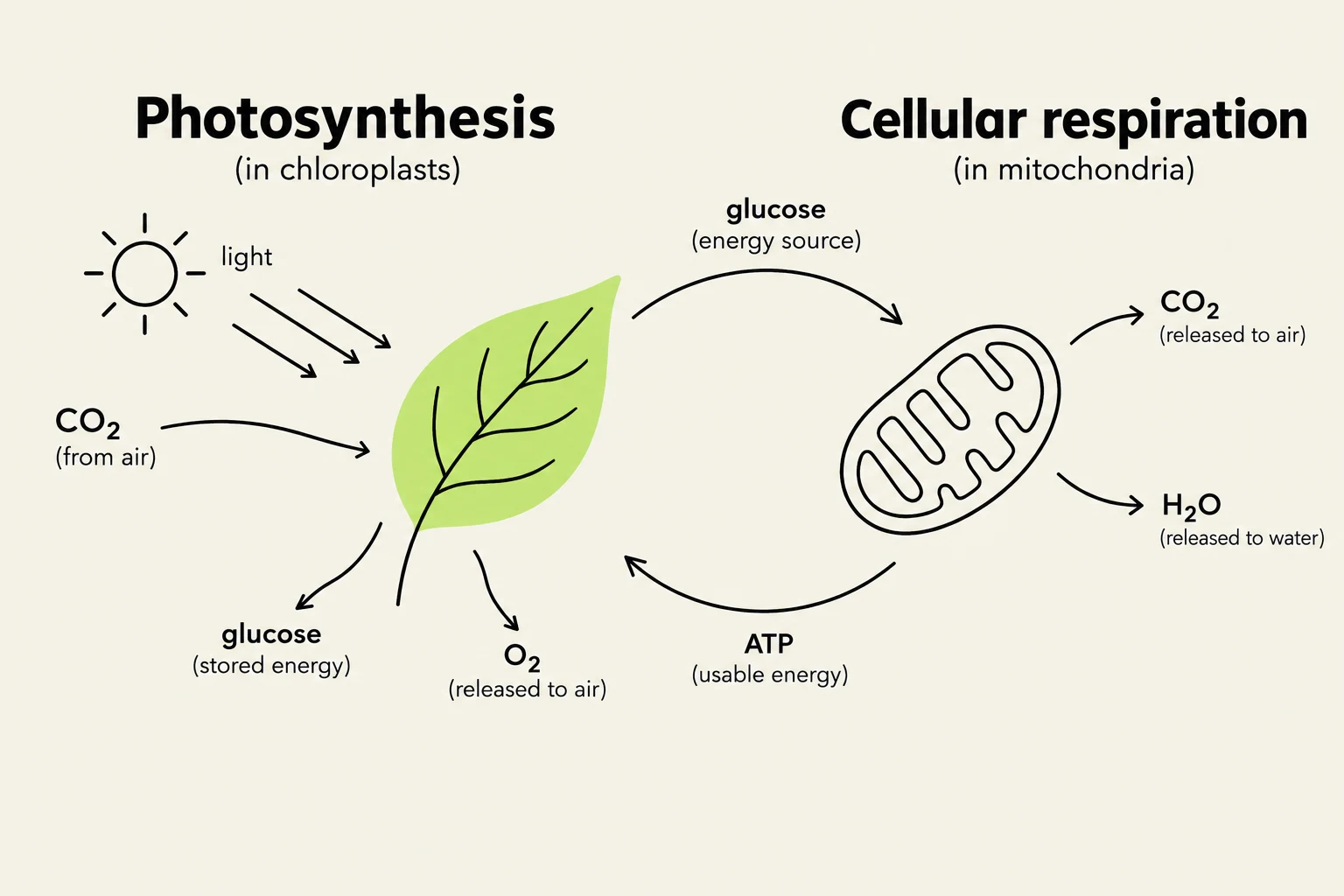
The ultimate goal of the leaf is to convert light energy into chemical energy through photosynthesis:
6CO2+6H2O+light energy→C6H12O6+6O2
This process occurs in two phases:
Light Reactions: Occur on the thylakoid membranes and harness solar energy.
Calvin Cycle: Occurs in the stroma and uses the energy from the light reactions to produce sugars.
To use this energy, the plant performs cellular respiration within the mitochondria. This process breaks down glucose into CO2, H2O, and ATP (the cell's energy currency) through three stages: glycolysis, the Krebs Cycle, and the electron transport system. According to the endosymbiont theory, both mitochondria and chloroplasts likely originated from prokaryotes that were engulfed by a host cell.
Diagram illustrating the processes of photosynthesis and cellular respiration, showing the inputs and outputs of each.
Keep reading for free.
Create an account to finish this reading and make it part of your study routine.