


In many chemical reactions, the process does not simply go from start to finish. Instead, as reactants are consumed to create products, those products may begin to react with one another to reform the original reactants. This creates a dynamic state known as chemical equilibrium. Understanding how to manipulate this state is essential for industrial chemistry, where scientists often need to "force" a reaction to produce more of a desired product.
Chemical Equilibrium and the Equilibrium Constant
Chemical equilibrium is a state in which there are no observable changes over time. This occurs when the rate of the forward reaction (reactants products) is exactly equal to the rate of the reverse reaction (products reactants). It is a common misconception that at equilibrium, the concentrations of reactants and products are equal; in reality, they simply remain constant.
The relationship between these concentrations is defined by the Law of Mass Action, which gives us the equilibrium constant, . For a general reaction:
The equilibrium constant expression is:
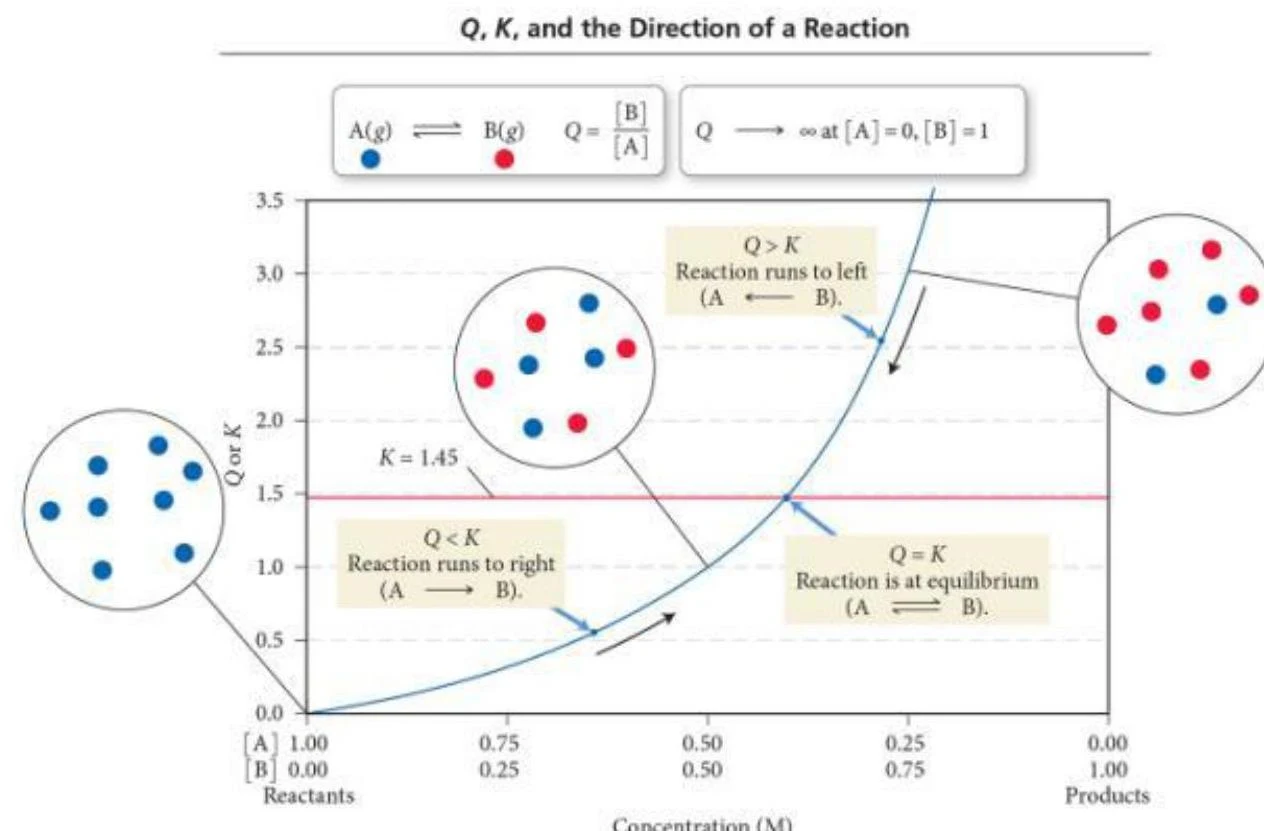
The value of tells us about the "position" of the equilibrium:
- If : The forward reaction is favored, and there are many more products than reactants at equilibrium.
- If : The reverse reaction is favored, and there are many more reactants than products at equilibrium.
- If : Neither direction is strongly favored.
Important Note: When writing expressions, concentrations of pure solids and pure liquids are excluded because their concentrations do not change during the reaction.
Keep reading for free.
Create an account to finish this reading and make it part of your study routine.
Continue reading freeAlready have an account? Log in
Updated