Examines how law-and-order policing serves as a strategic tool to promote neoliberalism by expanding market relations and enforcing the wage relation as the primary means of subsistence, often targeting behaviors associated with indigence rather than poverty itself.
In recent decades, many advanced capitalist nations, including Canada, have seen a significant rise in "law-and-order" policing. While supporters often frame this trend as a necessary response to rising crime rates or a way to maintain public safety, many critics argue that these policies serve a much deeper structural purpose. Rather than being a simple reaction to criminal activity, law-and-order policing functions as a strategic tool to promote neoliberalism—an economic and political project aimed at expanding market relations and ensuring that the "wage relation" remains the primary way for individuals to survive.
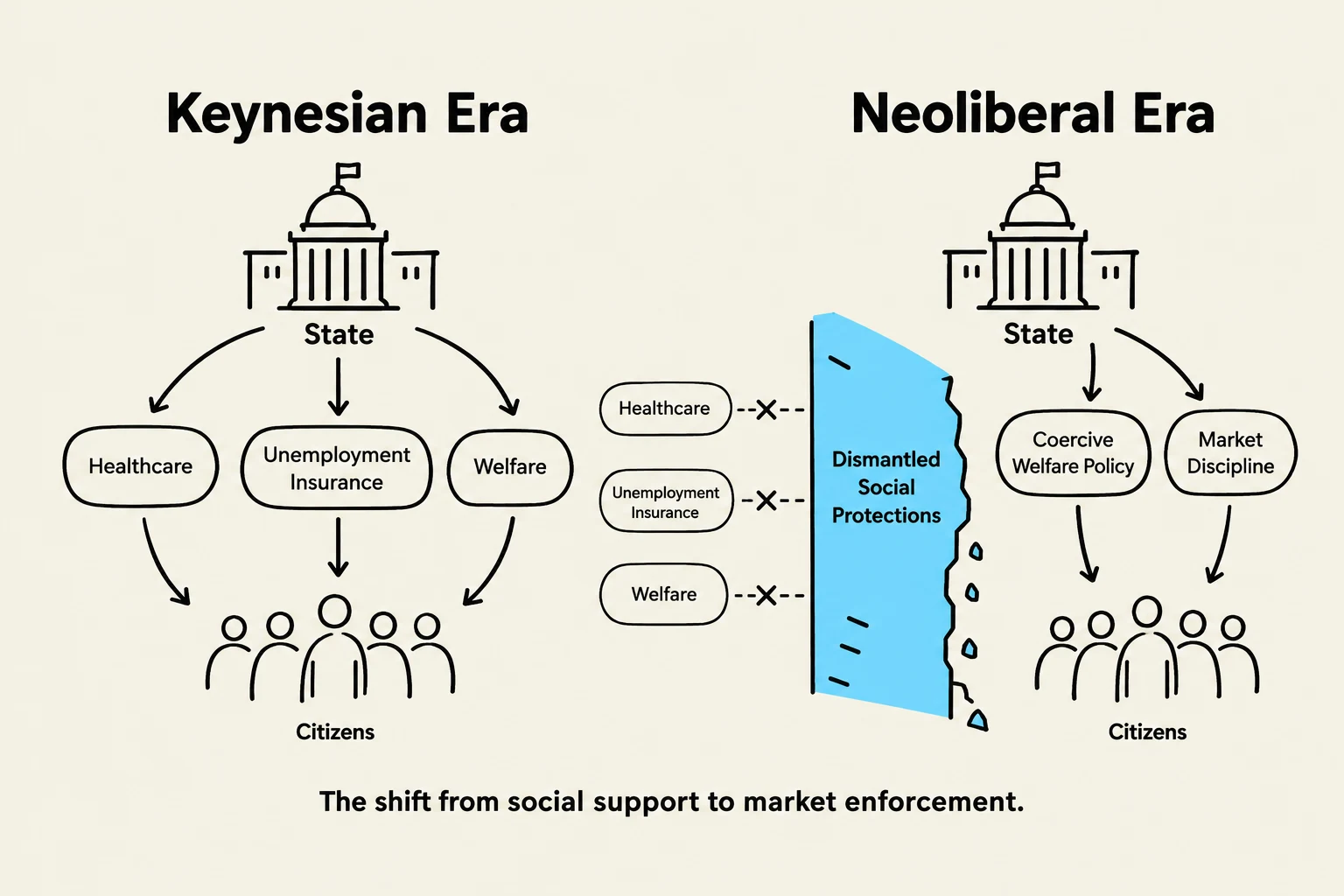
A diagram illustrating the shift from the Keynesian Era, characterized by state-provided social support like healthcare, unemployment insurance, and welfare for citizens, to the Neoliberal Era, where social protections are dismantled and replaced by coercive welfare policy and market discipline.
Beyond Gentrification and the "Fear of the Other"
When discussing the policing of urban spaces, two common arguments often emerge in social activism. First, that policing is a tool for gentrification, used by wealthy residents and business associations to remove "undesirable" people from newly developing high-income neighborhoods. Second, that it is driven by a "fear of the Other," where the poor are targeted simply because they serve as an unsettling reminder of economic inequality.
While these perspectives have merit, they are incomplete. If policing were merely about gentrification, we would not see these aggressive tactics in non-gentrified, working-class communities. To understand why law-and-order policing is so widespread, we must look past the symptoms of urban change and toward the core of the neoliberal project: the re-imposition of the market on all aspects of human life.
Neoliberalism and the Re-imposition of the Wage Relation
Neoliberalism represents a fundamental shift away from the Keynesian welfare state of the mid-20th century. In the Keynesian era, the state provided social security through mechanisms like unemployment insurance, welfare benefits, and healthcare. Neoliberalism, however, seeks to dismantle these protections to create a "cheaper and more flexible workforce".
This is achieved through several interconnected strategies:
Cuts to Social Programs: Reducing employment insurance and welfare to force individuals into the bottom end of the labor market.
Coercive Welfare Policy: Instead of the state retreating, it actually expands its coercive role through policies that mandate specific behaviors or punish those who do not conform to market expectations.
The Wage Relation: The ultimate goal is to ensure that the wage relation—working for a set amount of money provided by an employer—is the only viable means of subsistence.
Study Tip: When analyzing neoliberalism, do not assume the state is "shrinking." In many ways, the state becomes more active, but its role shifts from providing social support to enforcing market discipline through coercive measures.
Indigence vs. Poverty: Targeting Behavior
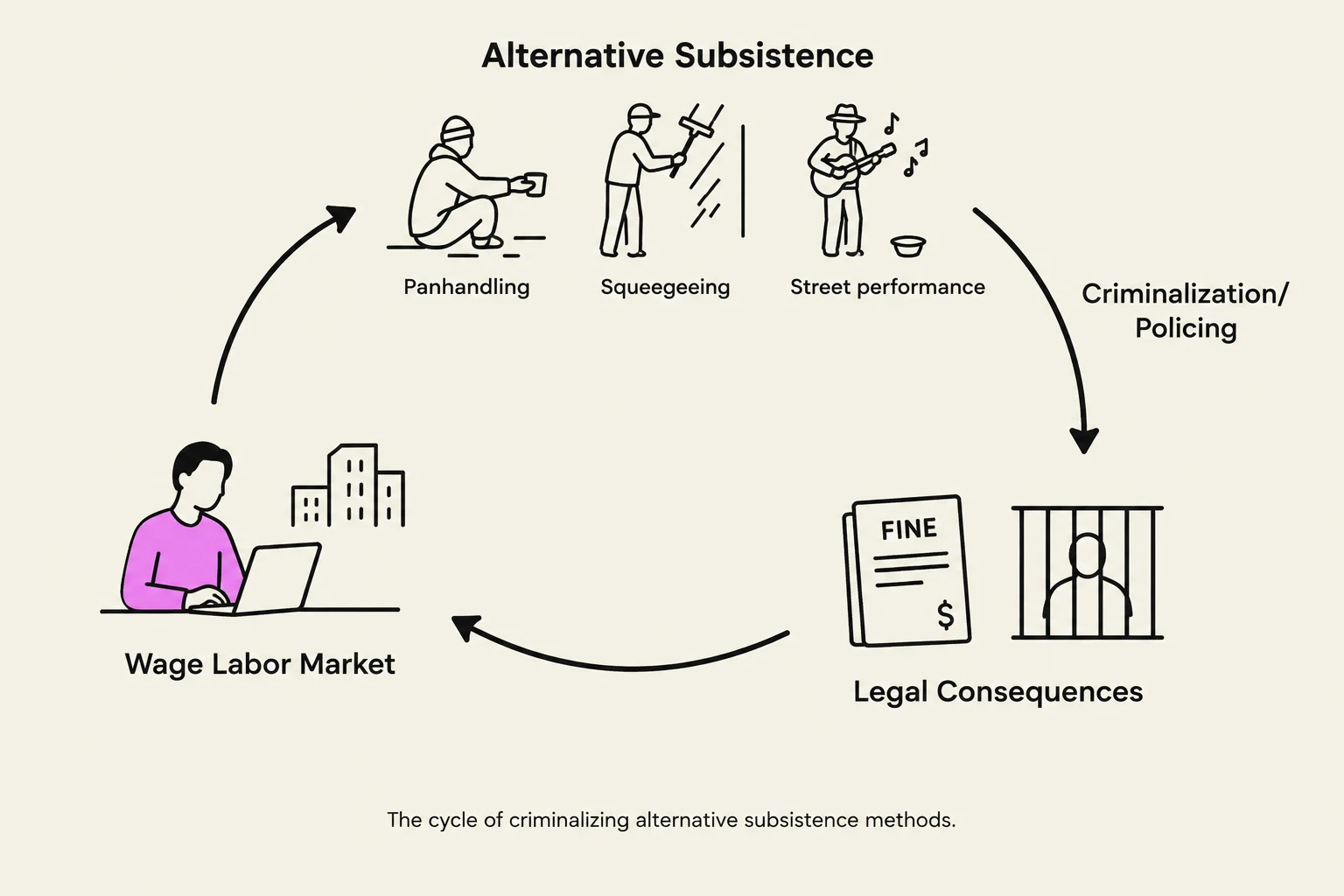
This diagram illustrates the cycle of criminalizing alternative subsistence methods, showing how activities like panhandling, squeegeeing, and street performance can lead to criminalization, legal consequences such as fines and imprisonment, and ultimately a return to the wage labor market.
A crucial distinction in this study is the difference between "poverty" and "indigence." Law-and-order policing does not necessarily target the socio-economic condition of poverty itself; rather, it targets the specific behaviors associated with indigence.
Indigence is defined as the condition of the able-bodied poor who refuse or are unable to participate in the formal wage labor market. Historically, this mirrors 19th-century British policies where vagrancy laws were used to criminalize activities like begging or vending—activities that provided an alternative way to survive outside of a formal employer-employee relationship.
In a modern context, this manifests as the policing of:
Panhandling and Begging: Seeking income in public spaces.
Squeegeeing: A form of street-based labor often used by youth to avoid low-wage, "dead-end" jobs.
Street-based "Play": Creative or recreational activities (like break-dancing or street performance) that might be used to generate income outside the formal market.
By criminalizing these behaviors, the state effectively removes "alternatives for subsistence," leaving individuals with little choice but to accept the terms of the neoliberal labor market.
Tactics of Control: Zero-Tolerance and Stop-and-Search
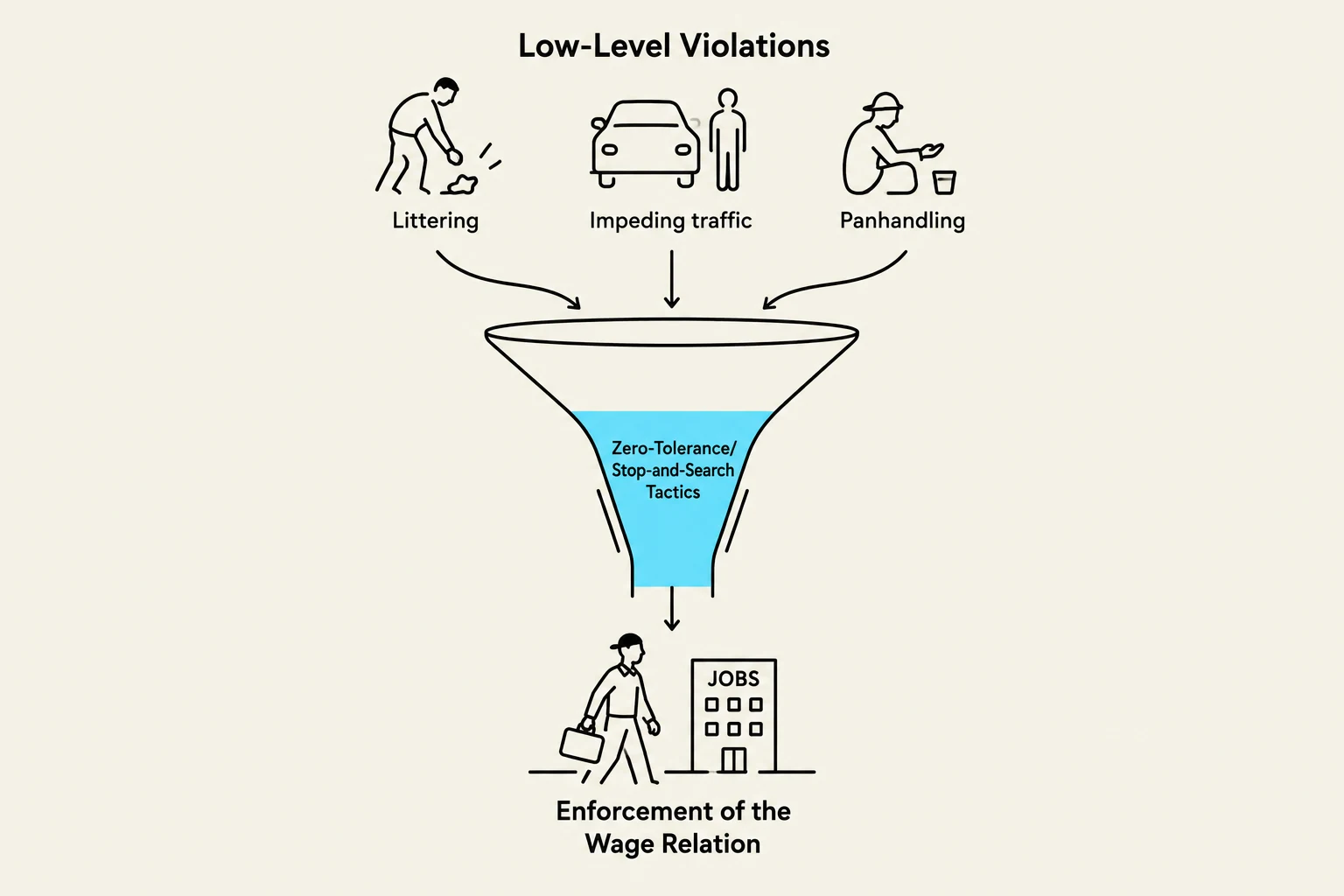
This diagram illustrates how low-level violations like littering, impeding traffic, and panhandling can lead to zero-tolerance tactics, ultimately resulting in the enforcement of the wage relation, depicted by a person walking towards a building labeled "JOBS."
To enforce these market norms, police departments have adopted specific tactical frameworks. One of the most prominent is zero-tolerance policing. This strategy is often based on the "Broken Windows" theory, which suggests that ignoring low-level signs of disorder (like panhandling) leads to more serious crime.
In practice, zero-tolerance policing involves:
Aggressive Targeting: Deploying large numbers of police to poor, often racialized or immigrant neighborhoods.
Stop-and-Search: Using broad discretionary power to stop individuals on the "pretense" that they may be engaging in illegal behavior.
Low-Level Violations: Using municipal by-laws to issue heavy fines or jail sentences for minor offenses like "impeding traffic" or "littering" to target those working on the streets.
A notable example is the Ontario Safe Streets Act (OSSA), which was designed to remove "squeegeers" from the streets. Rather than addressing the underlying economic causes, the act provided police with the tools to target the visible signs of those refusing the "lean person" ethos of modern capitalism.
Conclusion: Policing as Economic Discipline
Ultimately, law-and-order policing is not a separate issue from economic policy; it is an integral part of it. As the state restructures the economy to favor capital, it uses the police to ensure that the working class is recomposed into a disciplined, flexible, and dependent workforce.
By targeting the "indigent" who seek to live outside the formal market, the state reinforces the moral and economic necessity of the wage relation. In this light, the police act as the front line of the neoliberal project, ensuring that the "order of capital" remains unchallenged.
Summary Table: The Neoliberal Policing Framework
Concept
Traditional View
Neoliberal Reality
Role of the State
Providing social safety nets
Enforcing market discipline
Target of Policing
Violent criminals
"Indigent" behaviors (panhandling, etc.)
Goal of Policy
Public safety/Order
Re-imposition of the wage relation
View of the Poor
Victims of circumstance
"Undeserving" or resisting the market
Keep reading for free.
Create an account to finish this reading and make it part of your study routine.