Examines the historical context, Federalist and Anti-Federalist debates, and the implementation of the Land Ordinance of 1785 and the Northwest Ordinance of 1787 in shaping early American westward expansion and governance.
Following the American Revolution, the newly independent United States faced a monumental task: how to manage and govern approximately 1.2 billion acres of new territory. This vast expanse of land was not merely a geographic asset; it was the central battleground for the nation's economic and political identity. The debate over how to divide, sell, and govern this land would shape the American landscape for centuries, influencing everything from the structure of local schools to the fierce sectional conflicts over slavery.
The Great Debate: Federalists vs. Anti-Federalists
As the government looked westward, two distinct political philosophies emerged regarding the distribution of public land. This was not just a technical disagreement about surveying; it was a fundamental clash over the future of American democracy and the role of the central government.
The Federalist Vision
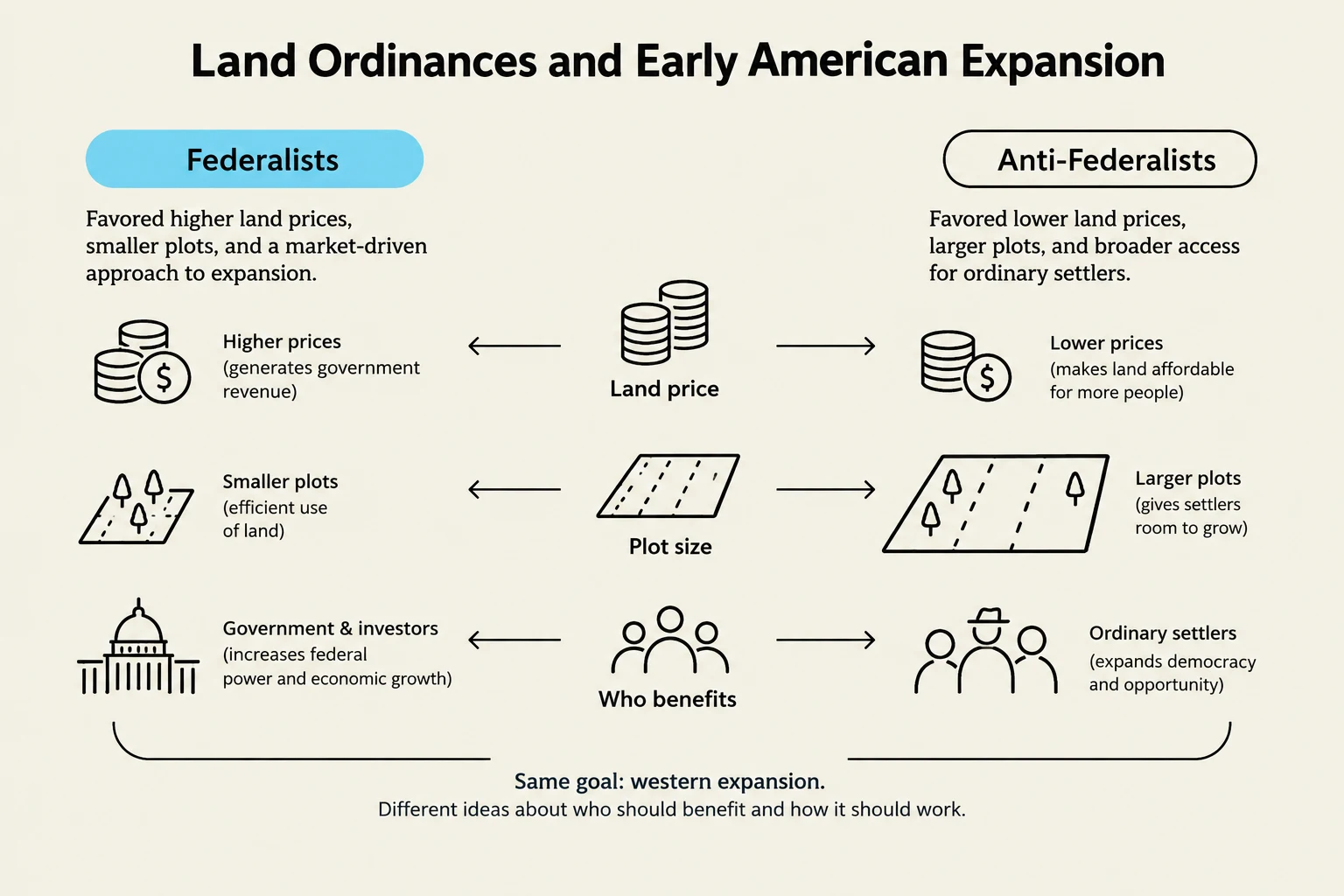
Led by Alexander Hamilton, the Federalists viewed the new land as a tool to strengthen the central government and foster industrial growth. Their strategy was to sell large plots of land at high prices (full market value). By doing so, they aimed to:
Raise significant revenue for the federal government.
Support the development of manufacturing.
Maintain high land prices, which benefited existing landowners.
The Anti-Federalist Vision
In contrast, the Anti-Federalists, led by Thomas Jefferson, envisioned a nation of "small-handed" farmers. They believed that widespread land ownership was the bedrock of democracy and a way to reduce income inequality. Their proposal included:
Selling small lots of land at low prices.
Offering land on credit to make it accessible to more people.
Promoting a decentralized, agrarian society where citizens had a direct "right to labor the earth".
Study Tip: On exams, look for the connection between political ideology and economic policy. Federalists = Centralization/Manufacturing/High Prices. Anti-Federalists = Decentralization/Agriculture/Low Prices/Credit.
This diagram illustrates the differing approaches of Federalists and Anti-Federalists regarding land ordinances and early American expansion, focusing on land price, plot size, and who benefits.
The Land Ordinance of 1785: Organizing the Wilderness
To move from theoretical debate to practical administration, the government implemented the Land Ordinance of 1785. This legislation focused on the orderly settlement of the territory through a standardized surveying system.
Instead of the irregular, metes-and-bounds surveying used in the original colonies, the government utilized a system of rectangular plot townships. The territory was divided into townships that were 6 miles square. These townships were then sold in specific patterns:
640-acre settlements: Some townships were sold as large, individual plots.
Auction System: Sales were conducted via auctions with a minimum starting price of $1 per acre.
Cash Requirements: Unlike the Anti-Federalist preference for credit, this ordinance required cash sales, meaning no loans were provided to settlers.
A crucial social component of this ordinance was the mandate that one section of every township be set aside specifically to fund public schools. This established an early precedent for federally supported education in the expanding West.
The Northwest Ordinance of 1787: The Path to Statehood
While the Land Ordinance of 1785 addressed how to divide the land, the Northwest Ordinance of 1787 addressed how to govern the people living on it and how they could eventually join the Union.
The ordinance established a clear, three-stage progression for territorial development:
Appointed Governance: Initially, a territory was managed by a governor appointed by Congress.
Territorial Legislature: Once the population reached 5,000 eligible voters (specifically white men), the territory could elect its own territorial legislature.
Statehood: Once the population reached 60,000 people, the territory could apply to become a full state.
Beyond administrative structure, the Northwest Ordinance contained significant social and moral provisions. It guaranteed civic and religious liberty to settlers. Most importantly, it included a prohibition of slavery within the territory. While this was partly because slavery was less profitable in the North, it represented an early, significant attempt to limit the expansion of the institution.
The Road to Manifest Destiny
The systems established by these ordinances laid the groundwork for the massive westward expansions of the 19th century. As the American population grew—from 5 million in 1800 to 23 million by 1850—the drive for more land became an unstoppable force.
This momentum eventually coalesced into the concept of Manifest Destiny in the 1840s. This ideology suggested that it was the "destiny" of the United States to expand across the continent to spread American ideals of democracy. This belief fueled major acquisitions, including:
The Louisiana Purchase (1803), which doubled the size of the nation.
The Texas Annexation (1845), which led to conflict with Mexico.
The Mexican Cession (1848) following the Mexican-American War.
This illustration depicts the territorial expansion of the United States from the original 13 colonies to the Louisiana Purchase, highlighting key acquisitions like Florida and Texas with their respective dates.
Exam Review Question: How did the terms of the Land Ordinance of 1785 reflect the political goals of the Federalists?
Answer: By requiring cash sales and selling large plots, it favored those with existing wealth and aimed to raise revenue for the central government, aligning with Federalist economic priorities.
Keep reading for free.
Create an account to finish this reading and make it part of your study routine.