An overview of the Kingdom Animalia, covering its characteristics, the advantages of multicellularity, body plans including symmetry and germ layers, embryology, and a detailed exploration of various invertebrate phyla.
The Kingdom Animalia, also known as Metazoa, represents one of the most diverse groups of living organisms on Earth. Unlike plants, which are autotrophic, animals are multicellular, heterotrophic eukaryotes that lack cell walls. This fundamental biological framework allows for a wide array of specialized lifestyles, ranging from the stationary existence of a sponge to the high-speed predatory behavior of an octopus.
The Advantages of Multicellularity
The transition from single-celled organisms to multicellularity was a pivotal evolutionary step. By grouping cells together, animals gained several critical advantages:
Increased Size: Larger bodies allow for better protection and more efficient resource acquisition.
Mobility: Specialized tissues enable complex movement, allowing animals to hunt or escape predators.
Homeostasis: Multicellularity allows for the maintenance of a stable internal environment, providing relative independence from external fluctuations.
Specialization: Different cells can take on specific roles (e.g., digestion, sensation, or movement), increasing overall efficiency.
Body Plans: Symmetry and Germ Layers
To categorize the vast diversity of animals, biologists look at their fundamental body plans, starting with how their bodies are organized in space.
Symmetry
Symmetry describes how an animal's body parts are arranged around a central axis:
Radial Symmetry: Body parts are arranged around a central axis, similar to a wheel (e.g., a hydra or jellyfish).
Bilateral Symmetry: The body can be divided into distinct left and right halves, with defined anterior (front), posterior (back), dorsal (top), and ventral (bottom) sides (e.g., a lobster).
Germ Layers and Triploblastic Development
During embryonic development, the single-layered blastula undergoes gastrulation to form specialized tissue layers called germ layers:
Ectoderm: The outermost layer, which develops into the skin and nervous system.
Endoderm: The innermost layer, forming the lining of the gut.
Mesoderm: The middle layer, found in more complex animals, which develops into muscles and internal organs.
Animals possessing all three layers are referred to as triploblastic.
Diagram illustrating the three germ layers (ectoderm, mesoderm, and endoderm) of an early embryo and the tissues and organs that develop from each layer.
Embryology and Body Cavities
The way an animal develops from a zygote determines its classification into major evolutionary lineages.
Cleavage and the Blastopore
As the zygote divides during the cleavage stage, the pattern of division (radial vs. spiral) and the fate of the blastopore (the first opening in the developing embryo) are decisive:
Protostomes: The blastopore becomes the mouth.
Deuterostomes: The blastopore becomes the anus.
Coelom Formation and Body Cavities
The coelom is a fluid-filled body cavity located between the gut and the outer body wall. The presence and type of cavity are key diagnostic features:
Acoelomates: Lack a body cavity entirely; the space is filled with solid tissue (e.g., flatworms).
Pseudocoelomates: Possess a "false" cavity that is only partially lined by mesoderm (e.g., roundworms).
Coelomates: Possess a "true" cavity entirely lined by mesoderm.
The coelom can form through two distinct processes: schizocoely (the splitting of mesoderm) or enterocoely (the outpocketing of the gut wall).
Exam Tip: If a question asks about the difference between a pseudocoelomate and a coelomate, focus on the mesoderm. A coelomate's cavity is completely wrapped in mesoderm, whereas a pseudocoelomate's cavity is not.
The Invertebrate Phyla
The animal kingdom is organized into phyla that show a progression of increasing biological complexity.
Primitive Phyla: Placozoa and Porifera
The most primitive metazoans lack true tissues.
Phylum Placozoa: Considered the most primitive metazoans, characterized by "poorly defined tissues".
Phylum Porifera (Sponges): These are sessile (stationary) animals that filter water through canal systems. They use specialized choanocytes (collar cells) to trap food particles.
Radiata: Cnidaria and Ctenophora
These animals exhibit radial symmetry and are generally diploblastic (two germ layers).
Phylum Cnidaria: Includes jellyfish, corals, and anemones. They use stinging cells called cnidae (such as nematocysts) for defense and hunting. Many undergo metagenesis, alternating between a sessile polyp stage and a free-swimming medusa stage.
Classes: Hydrozoa (colonial forms like the Portuguese man-o-war), Scyphozoa (true jellyfish), and Anthozoa (corals and anemones, which exist only as polyps).
Phylum Ctenophora (Comb Jellies): Unlike cnidarians, they lack nematocysts. Instead, they use eight ciliated rows called ctenes for movement and sticky colloblasts to capture prey.
Bilateral Worms: Platyhelminthes, Nematoda, Rotifera, and Nemertea
As we move into bilateral animals, we encounter various "worm-like" phyla with different levels of complexity.
Phylum Platyhelminthes (Flatworms): Bilateral, triploblastic, and acoelomate. They use protonephridia (flame cells) for excretion. Classes include Turbellaria (free-living), Trematoda (parasitic flukes), and Cestoda (tapeworms, which lack a digestive tract entirely).
Phylum Nematoda (Roundworms): Unsegmented pseudocoelomates with a complete digestive tract and longitudinal muscles that produce a whip-like motion.
Phylum Rotifera: Microscopic, ciliated animals with a "crown" called a corona.
Phylum Nemertea (Ribbon Worms): Unsegmented protostomes that possess a unique proboscis housed in a cavity called a rhynchocoel.
Phylum Mollusca: Complexity and Intelligence
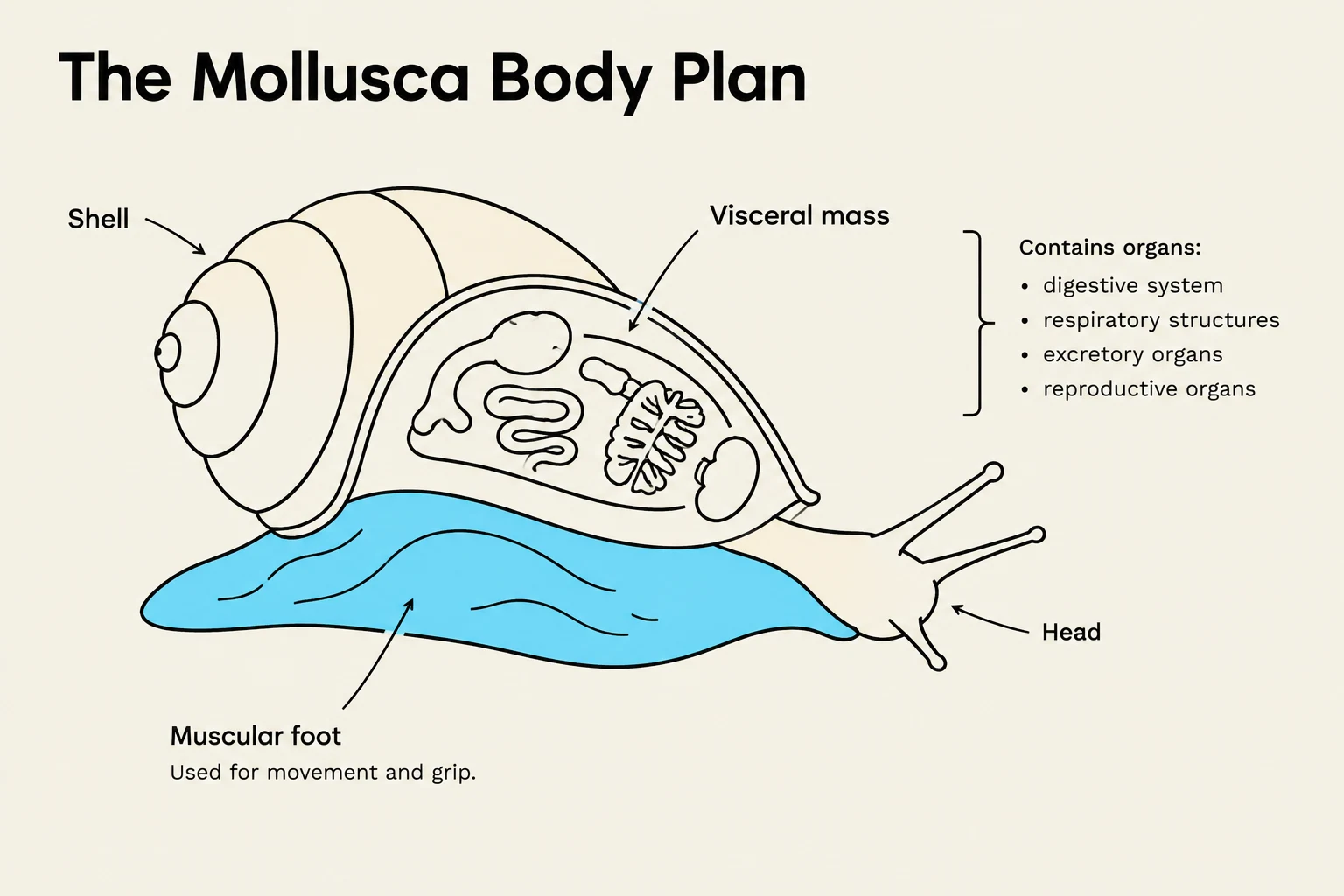
Mollusks represent a highly successful group of coelomates with a distinct body plan: a head/foot, a visceral mass, and a mantle (which often secretes a calcium carbonate shell).
Gastropoda: Snails and slugs; some undergo shell torsion.
Bivalvia: Clams and mussels; they lack a distinct head and use siphons for feeding.
Cephalopoda: The most advanced mollusks (squid, octopus). They feature closed circulation, highly developed camera-like eyes, and chromatophores for rapid color change.
Diagram illustrating the body plan of a mollusk, highlighting its shell, visceral mass, muscular foot, and head, along with the internal organs it contains.
Keep reading for free.
Create an account to finish this reading and make it part of your study routine.