Explains the Kinetic Molecular Theory (KMT) as a microscopic model for understanding gas behavior, covering its postulates, derivation of pressure, relationship between temperature and kinetic energy, and deviations of real gases from ideal behavior.
While we often describe gases using macroscopic variables like pressure, volume, and temperature, these numbers only tell part of the story. To truly understand why a gas behaves the way it does, we must look at the microscopic level—the individual atoms and molecules zipping around in space. The Kinetic Molecular Theory (KMT) provides this microscopic model, bridging the gap between the tiny movements of particles and the measurable properties of the gas as a whole.
The Postulates of Kinetic Molecular Theory
The KMT is built upon a set of fundamental assumptions, or postulates, that describe an "ideal" gas. By assuming these conditions, scientists can create mathematical models that predict gas behavior with remarkable accuracy under many common conditions.
The core postulates are:
Tiny Particles: Gases consist of particles (atoms or molecules) that are extremely small compared to the distances between them. Because of this, the actual volume of the particles themselves is considered negligible relative to the total volume of the container (Vparticles≈0).
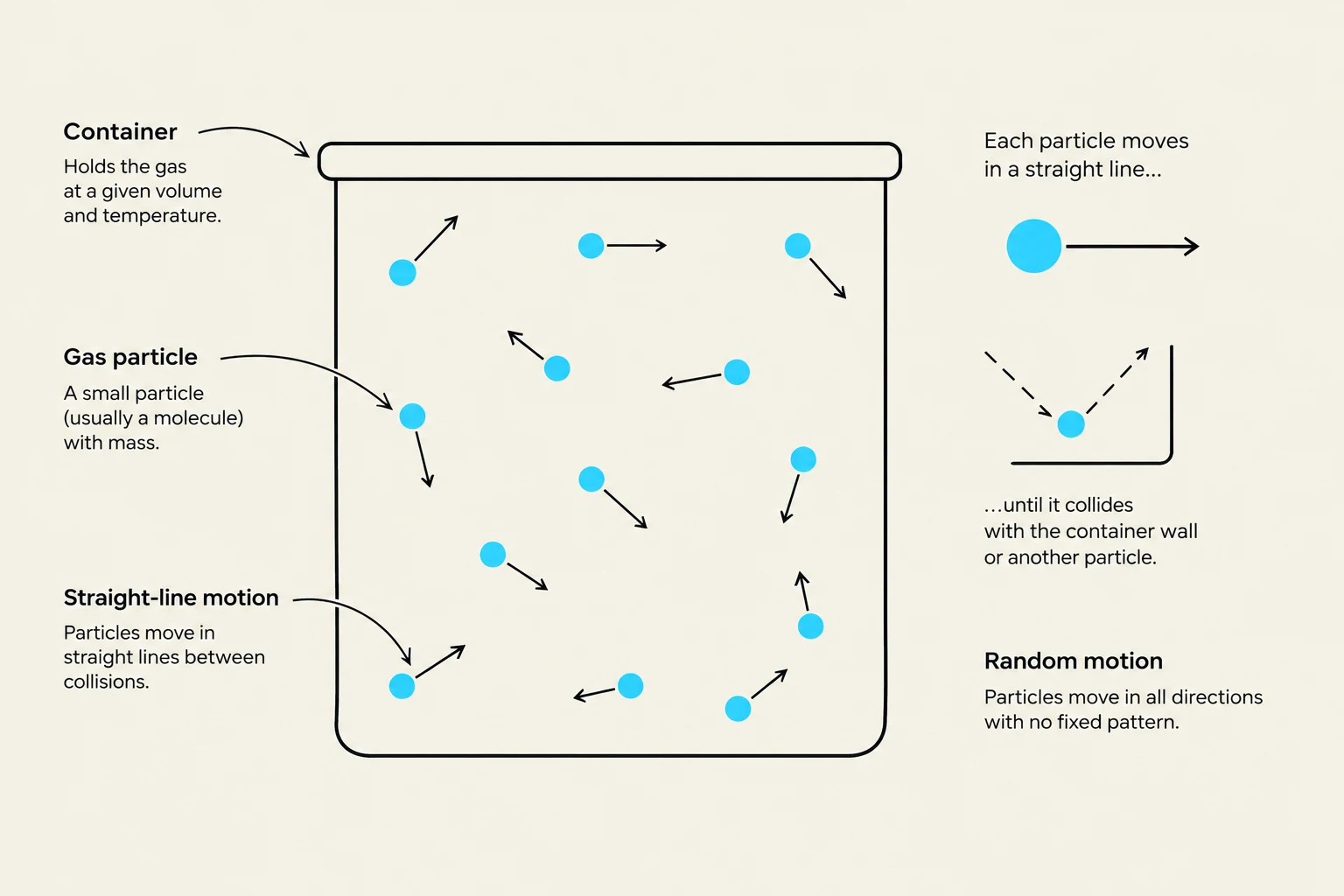
Constant, Random Motion: Particles move in continuous, straight-line paths until they collide with something.
Elastic Collisions: All collisions between particles, or between particles and the container walls, are perfectly elastic. This means no kinetic energy is lost to heat or internal deformation during a collision; the total kinetic energy of the system is conserved.
No Intermolecular Forces: In an ideal model, we assume there are no attractive or repulsive forces between the particles. They only interact when they physically collide.
Temperature and Kinetic Energy: The average kinetic energy of the gas particles depends solely on the absolute temperature of the gas.
This illustration depicts the kinetic theory of gases, showing gas particles in random motion within a container. It explains that particles move in straight lines until they collide with the container walls or other particles.
Deriving Pressure and the Ideal Gas Law
One of the most powerful aspects of KMT is its ability to explain macroscopic properties through microscopic motion. For example, pressure is not just a number on a gauge; it is the result of countless tiny particles colliding with the walls of their container.
The pressure (P) exerted by a gas is proportional to the frequency of these collisions and the impulse (momentum change) delivered during each hit. Mathematically, this can be expressed as:
P=31VNmv2
Where N is the number of molecules, m is the mass of a molecule, V is the volume, and v2 is the mean square speed.
By linking this microscopic derivation to the empirical Ideal Gas Law ($PV = nRT$), we can find a direct relationship between temperature and kinetic energy. When we equate the two expressions, we find that the average translational kinetic energy (KEtrans) of a single molecule is:
KEtrans=23kBT
And for one mole of gas:
KEtrans,per mol=23RT
In these equations, kB is the Boltzmann constant and R is the gas constant.
Exam Tip: Remember that temperature is a direct measure of the average kinetic energy of the particles. If you increase the temperature, you are directly increasing the speed at which the molecules move.
Temperature and Molecular Motion
Since temperature is linked to kinetic energy, it also dictates how fast molecules move. However, not all molecules move at the same speed; they follow a distribution. To describe the "typical" speed of a gas particle, we use the root mean square speed (vrms).
The formula for vrms is:
vrms=M3RT
Where M is the molar mass of the gas.
This formula reveals a crucial relationship: at a constant temperature, lighter gases move much faster than heavier gases. For example, if you compare Hydrogen (H2) and Oxygen (O2) at the same temperature, the H2 molecules will have a vrms that is 4 times greater than that of O2 because the molar mass of O2 is 16 times larger than H2.
This difference in speed leads to observable phenomena like diffusion (the mixing of gases) and effusion (the escape of gas through a tiny hole). Lighter gases will diffuse and effuse much faster than heavier ones.
Real vs. Ideal Gases
While the KMT is incredibly useful, it is a model based on "ideal" assumptions. In the real world, gases do not always behave perfectly. Real gases deviate from ideal behavior, especially under conditions of high pressure or low temperature.
There are two main reasons for this deviation:
Intermolecular Forces: In real gases, particles do attract each other (often called van der Waals forces). These attractions can pull particles together, reducing the force of their impact against the container walls and causing the observed pressure to be lower than predicted.
Finite Particle Volume: Real gas particles occupy a physical amount of space. At very high pressures, the volume of the particles themselves becomes a significant fraction of the total container volume, making the actual available space smaller than the container volume.
To account for these "real" behaviors, scientists use the van der Waals equation, which introduces correction factors for both the attractive forces and the volume of the molecules:
(P+V2an2)(V−nb)=nRT
In this equation, the term involving a corrects for intermolecular attractions, and the term involving b corrects for the finite volume of the gas particles.
Summary Table: Ideal vs. Real Gas Conditions
Condition
Ideal Behavior
Real Gas Deviation
Pressure
Low Pressure
High Pressure (Volume becomes significant)
Temperature
High Temperature
Low Temperature (Intermolecular forces matter)
Density
Low Density
High Density
Keep reading for free.
Create an account to finish this reading and make it part of your study routine.