


In the study of organic chemistry, knowing a molecule's formula is only the beginning. Molecules with the same molecular formula do not always represent the same compound. Their atoms might be connected in entirely different sequences, or they might be connected in the same way but arranged differently in three-dimensional space. Understanding these differences is crucial because molecular shape dictates how a molecule interacts with biological targets, such as enzymes or receptors.
Understanding Isomers
Isomers are different compounds that share the same molecular formula. To navigate this topic, we must distinguish between two primary categories: constitutional isomers and stereoisomers.
Constitutional Isomers
Constitutional isomers (also known as structural isomers) have the same molecular formula, but their atoms are connected in different ways. For example, if two molecules have the same number of carbons and hydrogens but one has a straight chain and the other has a branched chain, they are constitutional isomers.
Stereoisomers
Stereoisomers are a more subtle class of isomers. They possess the same molecular formula and the same connections between their atoms, but they differ in the three-dimensional arrangement of those atoms.
Key Distinction: If you change the "map" of which atom is bonded to which, you have a constitutional isomer. If the "map" is identical but the "shape" in space is different, you have a stereoisomer.
The Chiral Carbon and Stereocentres
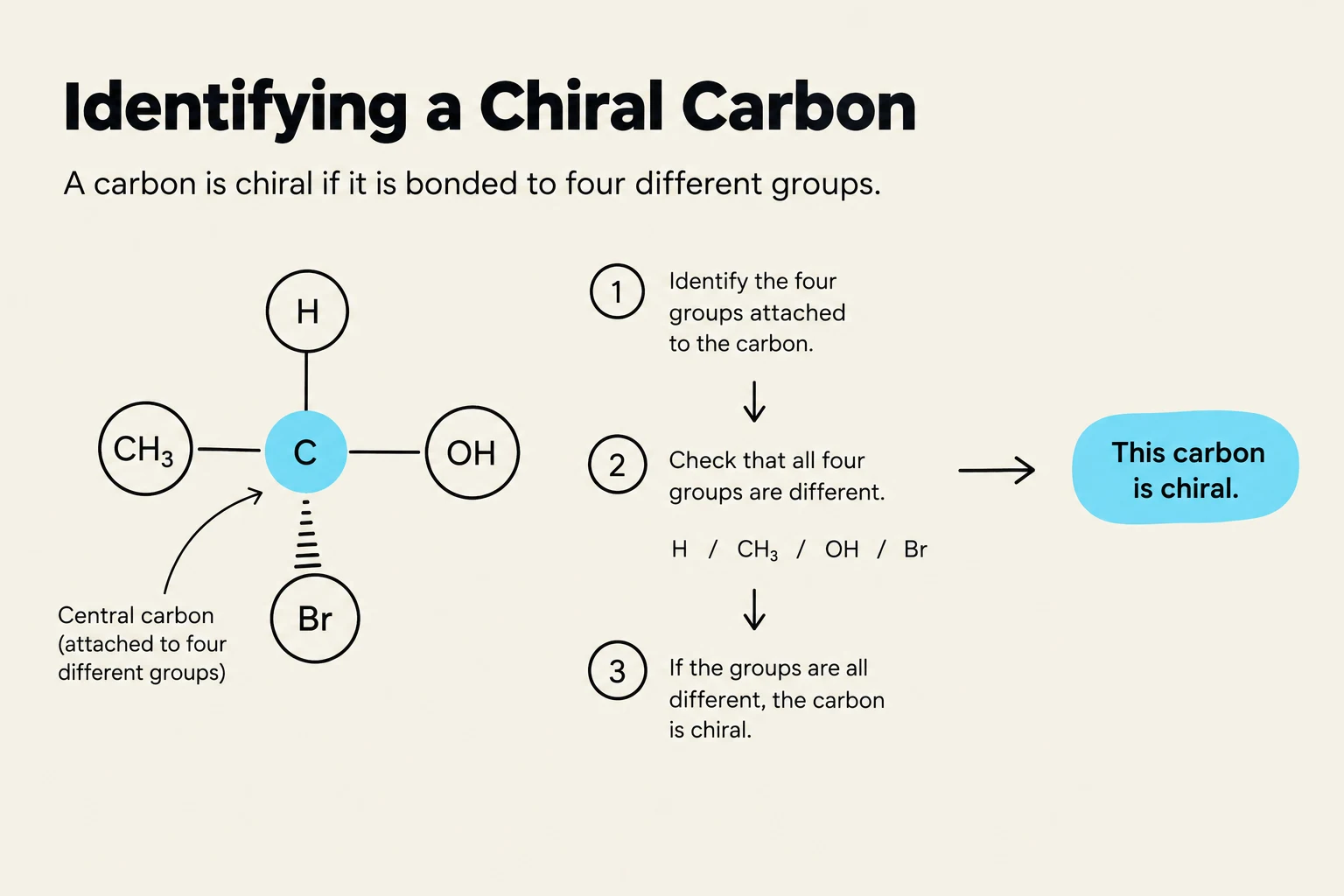
At the heart of stereochemistry is the concept of the stereocentre. While the term "stereocentre" is broad and can apply to atoms other than carbon, in introductory organic chemistry, we focus heavily on the chiral carbon.

Keep reading for free.
Create an account to finish this reading and make it part of your study routine.
Continue reading freeAlready have an account? Log in
Updated