A comprehensive guide to understanding the fundamental differences between ionic and covalent compounds, including their formation, naming conventions, molecular geometry, polarity, and the impact of intermolecular forces on physical properties.
Understanding the difference between ionic and covalent compounds is fundamental to mastering chemistry. These two types of bonding represent different ways that atoms achieve stability by interacting with their valence electrons. While ionic bonding involves the transfer of electrons to create electrostatic attractions, covalent bonding involves the sharing of electrons to fill atomic shells. This guide explores the mechanics, naming conventions, geometries, and physical properties of both systems.
Ionic Compounds: The Power of Electrostatic Attraction
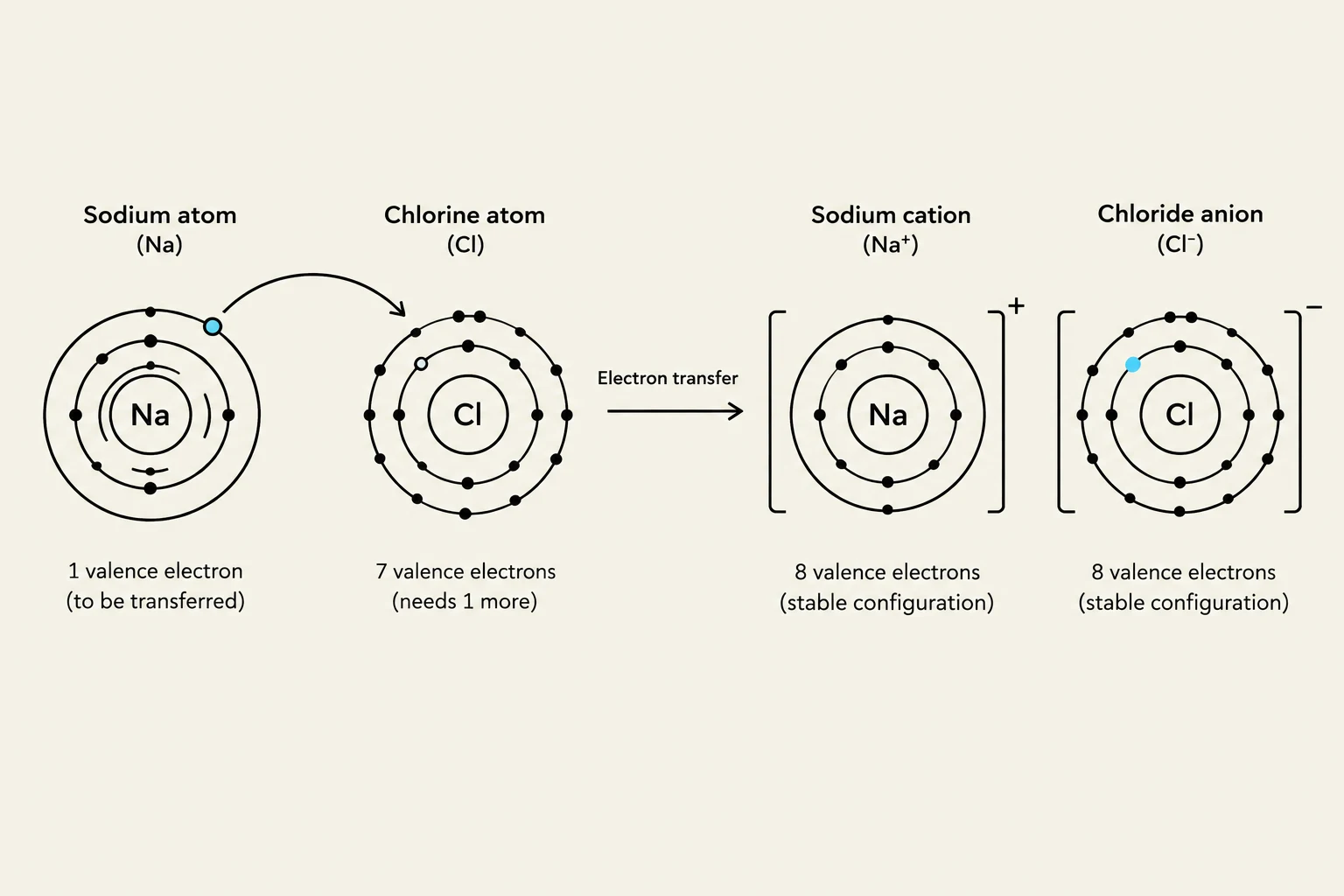
Ionic compounds form when there is a significant difference in electronegativity between atoms, typically occurring between a metal and a nonmetal. In this process, the metal atom loses one or more electrons to become a positively charged cation, while the nonmetal atom gains those electrons to become a negatively charged anion. The resulting bond is the strong electrostatic attraction between these oppositely charged ions.
Predicting Charges and Formulas
To write the correct formula for an ionic compound, you must first determine the charges of the constituent ions. For main group elements, you can predict the charge based on their position in the periodic table:
Group 1 (Alkali Metals):+1
Group 2 (Alkaline Earth Metals):+2
Group 13:+3
Group 15:−3
Group 16:−2
Group 17 (Halogens):−1
When constructing a formula, the total positive charge must exactly balance the total negative charge to ensure the compound is electrically neutral.
Worked Example: Predicting Formulas
To find the formula for Aluminum Oxide:
Identify the ions: Al3+ and O2−.
Use the "criss-cross" method: The magnitude of the Aluminum charge becomes the subscript for Oxygen, and vice versa.
Result: Al2O3.
Diagram illustrating the electron transfer from a sodium atom to a chlorine atom, forming a sodium cation and a chloride anion, resulting in stable electron configurations for both.
Naming and Complex Ions
Naming ionic compounds follows specific rules depending on the type of metal involved:
Main Group Cations: Simply name the metal (e.g., Na+ is Sodium).
Transition Metal Cations: Many transition metals can form multiple different charges. To avoid confusion, we use Roman numerals to specify the charge (e.g., Fe2+ is Iron(II), while Fe3+ is Iron(III)).
Polyatomic Ions: These are groups of atoms that stay together as a single unit with a net charge, such as Nitrate (NO3−) or Sulfate (SO42−).
Because of the intense electrostatic forces holding the ions together in a rigid crystal lattice, ionic compounds generally possess high melting and boiling points.
Covalent Compounds: Sharing is Caring
Covalent compounds form when two or more nonmetals share valence electrons to achieve a stable electron configuration, typically an octet.
Naming and Lewis Structures
For binary covalent compounds (compounds consisting of only two elements), we use Greek prefixes to indicate the number of atoms of each element present:
1: mono- (used only on the second element)
2: di-
3: tri-
4: tetra-
To visualize how these electrons are shared, we use Lewis Dot Structures. These diagrams represent valence electrons as dots and bonding pairs as lines, allowing us to see the distribution of electrons around each atom.
Molecular Geometry and Polarity
Once a covalent bond is formed, the physical shape and electrical properties of the molecule are determined by the arrangement of its electrons.
VSEPR Theory and Shape
VSEPR (Valence Shell Electron Pair Repulsion) Theory is used to predict the three-dimensional molecular shape. The core principle is that electron groups (both bonding pairs and lone pairs) around a central atom will repel each other and move as far apart as possible to minimize repulsion. This results in specific geometries like linear, trigonal planar, tetrahedral, or bent shapes.
Bond vs. Molecular Polarity
It is vital to distinguish between the polarity of a single bond and the polarity of the entire molecule:
Bond Polarity: This is determined by the difference in electronegativity between the two bonded atoms. If one atom pulls electrons more strongly than the other, the bond is polar.
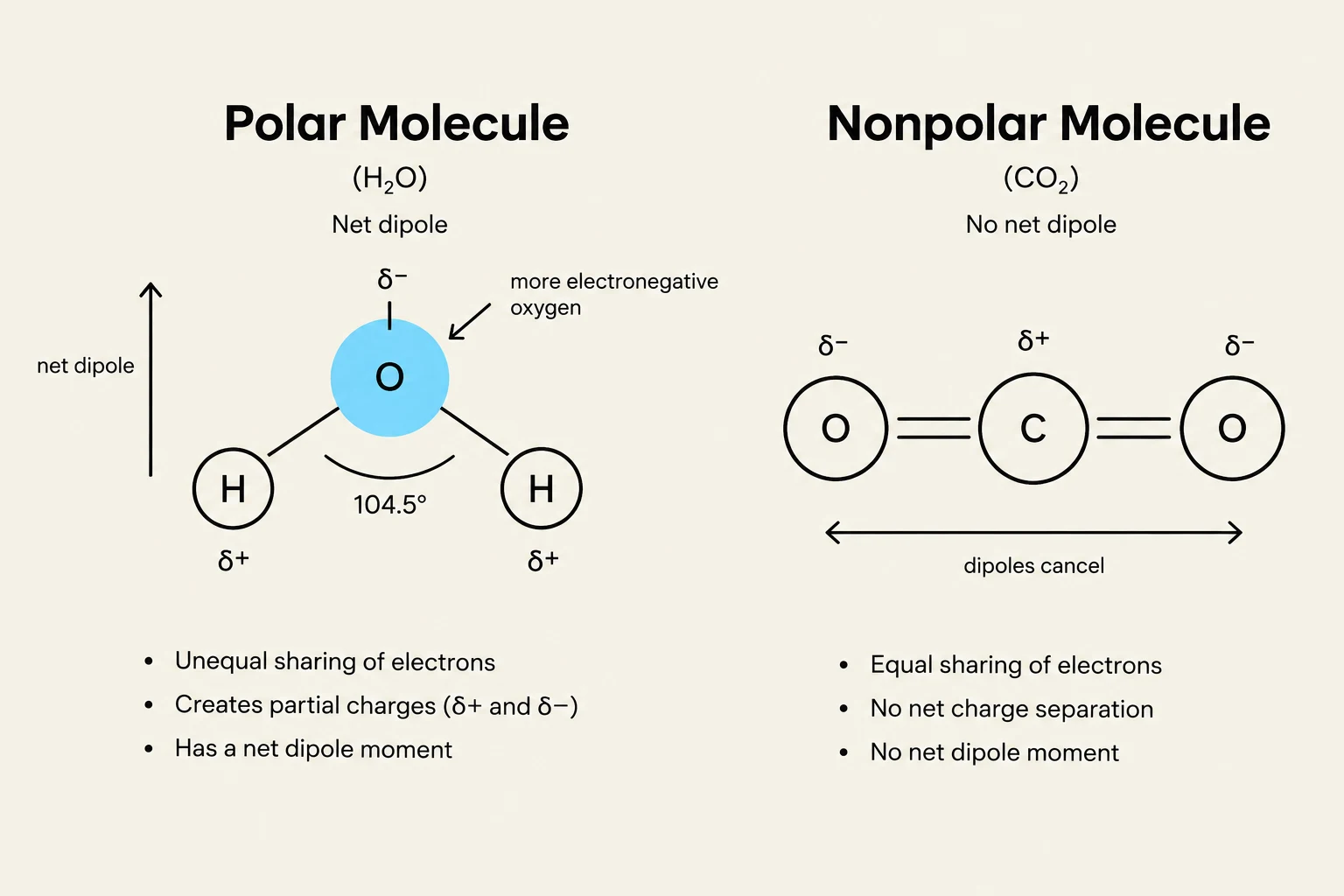
Molecular Polarity: This is the "net" polarity of the molecule. Even if a molecule contains polar bonds, it may be nonpolar if the VSEPR shape is highly symmetrical, causing the individual bond dipoles to cancel each other out.
This illustration compares polar and nonpolar molecules, using water (H2O) as an example of a polar molecule and carbon dioxide (CO2) as an example of a nonpolar molecule. It highlights differences in electron sharing, charge distribution, and net dipole moments.
Intermolecular Forces (IMFs) and Physical Properties
While covalent bonds hold atoms together within a molecule (intramolecular), intermolecular forces (IMFs) are the attractions between separate molecules. These forces are much weaker than chemical bonds, but they dictate the physical state and behavior of the substance.
The Hierarchy of IMFs
The strength of IMFs determines how much energy is required to separate molecules, which directly affects melting points, boiling points, and solubility:
London Dispersion Forces (LDF): The weakest force, present in all molecules. They arise from temporary, induced dipole-induced dipole interactions caused by the constant movement of electrons.
Dipole-Dipole Interactions: Occur between the permanent positive end of one polar molecule and the permanent negative end of another.
Hydrogen Bonding: A particularly strong type of dipole-dipole interaction that occurs when Hydrogen is bonded directly to highly electronegative atoms: Nitrogen (N), Oxygen (O), or Fluorine (F).
Physical Properties and Solids
The type and strength of these forces determine the physical properties of materials:
Boiling/Melting Points: Stronger IMFs (like H-bonding) require more thermal energy to overcome, resulting in higher boiling and melting points.
Solubility: "Like dissolves like"—polar substances tend to dissolve in polar solvents, while nonpolar substances dissolve in nonpolar solvents.
Finally, the way molecules or ions are arranged can lead to different types of solids. Ionic compounds form crystalline lattices, while covalent substances may form molecular solids held together by IMFs, or even network covalent solids (like diamond) where atoms are linked by continuous covalent bonds.
Exam Tip: When asked to predict which substance has a higher boiling point, always identify the strongest IMF present in each. If one has Hydrogen bonding and the other only has London dispersion forces, the Hydrogen-bonding molecule will almost certainly have the higher boiling point.
Keep reading for free.
Create an account to finish this reading and make it part of your study routine.