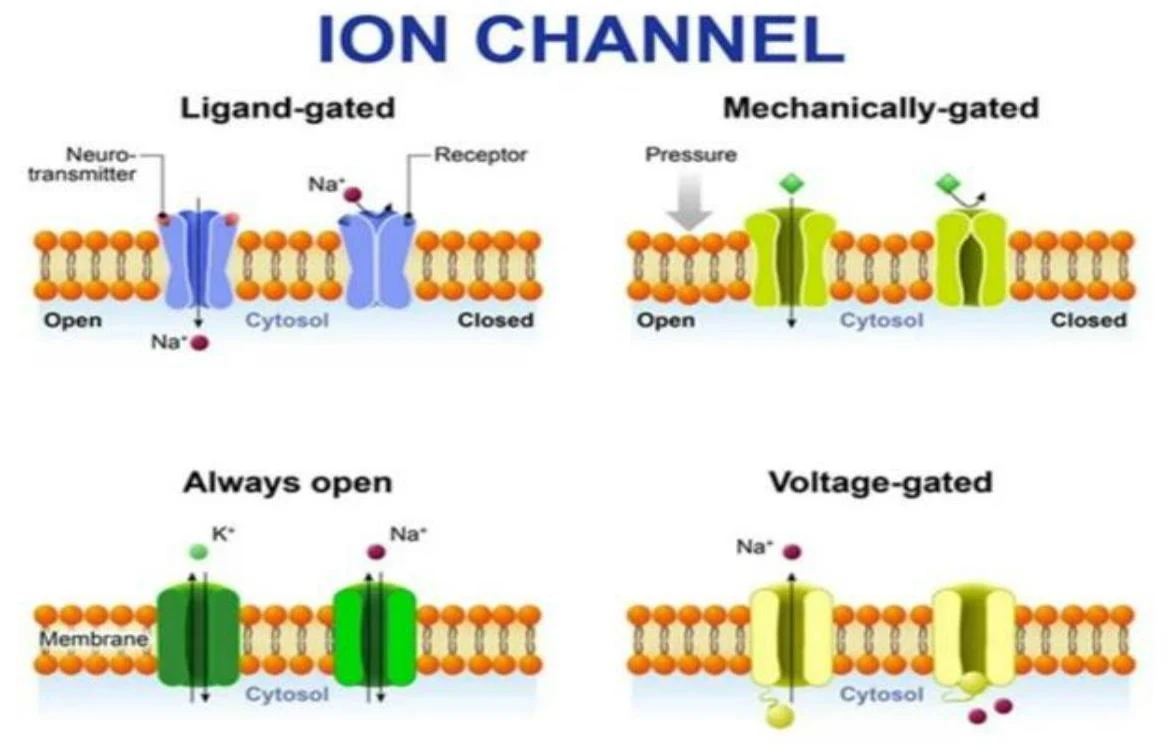
Explores the fundamental role of ion channels in cellular physiology, detailing their gating mechanisms (leak, voltage-gated, ligand-gated, mechanically-gated) and their critical involvement in processes like action potentials and resting membrane potential.
In the complex landscape of cellular physiology, the cell membrane acts as more than just a boundary; it is a sophisticated regulatory barrier. While the lipid bilayer prevents the free movement of most charged particles, specialized proteins known as ion channels serve as the "doors" that allow specific ions to cross. By opening, closing, or inactivating in response to various stimuli, these channels regulate the flow of ions, thereby controlling the electrical state of the cell. Understanding these gating mechanisms is fundamental to grasping how neurons fire, how muscles contract, and how sensory information is processed.
The Foundation: Resting Membrane Potential
Before understanding how signals are sent, we must understand the cell's "baseline" electrical state. The resting membrane potential (Vm) is the difference in electrical charge between the inside and the outside of the cell membrane.
At rest, the membrane is not equally permeable to all ions. It is significantly more permeable to potassium ($K^+$) than to sodium (Na+). This high permeability is due to the presence of leak channels, which are specialized proteins that lack a gate and remain open continuously. Because $K^+$ concentration is much higher inside the cell, these channels allow a continuous potassium efflux (movement out of the cell). This loss of positive charge leaves the interior of the cell negative relative to the exterior.
While the equilibrium potential for potassium (EK) is approximately −91 mV, the actual resting potential of a typical nerve cell is closer to −70 mV. This slight difference exists because small amounts of sodium (Na+) leak into the cell, pulling the potential slightly more positive. This baseline state is maintained by the sodium-potassium ATPase, an active transporter that uses ATP to pump three Na+ ions out and two $K^+$ ions in, restoring the gradients that diffusion constantly erodes.
Exam Tip: Nernst vs. Resting Potential
Do not confuse the Nernst potential with the resting membrane potential. The Nernst equation calculates the equilibrium potential for a single ion in isolation. The resting membrane potential is a "weighted average" of all ions present, determined by their relative permeabilities.
The Four Families of Gating Mechanisms
Ion channels are categorized by the specific stimulus required to open their "gates".
1. Leak Channels
As discussed, leak channels are "always open". They are the primary determinants of baseline permeability and are essential for establishing the resting membrane potential.
2. Voltage-Gated Channels
These channels respond to changes in the electrical charge across the membrane. They are the essential components for generating and propagating the action potential in excitable tissues like nerves and muscles.
Sodium (Na+) Channels: These open rapidly during depolarization, allowing Na+ to rush into the cell.
Potassium ($K^+$) Channels: These open more slowly, allowing $K^+$ to exit the cell to restore the negative potential.
Calcium (Ca2+) Channels: These are critical for triggering various intracellular processes, such as neurotransmitter release.
Clinical relevance is high: drugs like Lidocaine work by blocking sodium channels to prevent pain signaling, while certain cardiac arrhythmias (long-QT syndromes) are caused by defects in potassium channels.
3. Ligand-Gated Channels
These channels act as chemical sensors. They open only when a specific chemical messenger (a ligand), such as a neurotransmitter, binds to a receptor site on the protein. This mechanism is the primary way cells convert a chemical signal into an electrical one at a synapse.
Examples: Nicotinic Acetylcholine (ACh) receptors, GABA-A receptors, and glutamate receptors.
Pharmacology: Many drugs target these channels. For instance, Benzodiazepines enhance the effect of GABA-A, while curare blocks nicotinic receptors to prevent muscle contraction.
4. Mechanically Gated Channels
These channels respond to physical deformation of the cell membrane, such as stretch, pressure, vibration, or tension of the cytoskeleton. This process, known as mechanotransduction, converts physical stimuli into electrical signals.
Sensory Roles: They are the first step in hearing (via hair cells in the inner ear), touch (via Merkel cells), and blood pressure regulation (via baroreceptors).
Diagrams illustrating four types of ion channels: ligand-gated, mechanically-gated, always open, and voltage-gated, showing their open and closed states and the movement of ions across a cell membrane.
The Action Potential: The All-or-None Signal
When a stimulus is strong enough to reach a specific threshold (typically around −55 mV), the cell undergoes an action potential—a rapid, self-sustaining reversal of membrane potential.
The process follows a predictable sequence:
Depolarization: Voltage-gated Na+ channels open quickly. Na+ rushes into the cell down its electrochemical gradient, causing the membrane potential to shoot toward +30 mV.
Peak and Inactivation: At the peak, Na+ channels undergo "inactivation," where a molecular gate closes and stays closed for a short time.
Repolarization: Slower voltage-gated $K^+$ channels open. $K^+$ exits the cell, bringing the potential back down toward a negative value.
Hyperpolarization: Because $K^+$ channels are slow to close, the potential often undershoots the resting level, becoming more negative than −70 mV.
Critical Concept: The Refractory Period
The action potential is "all-or-none"—once threshold is reached, the spike occurs at a constant amplitude. The absolute refractory period occurs when Na+ inactivation gates are closed, making it impossible to fire another signal. The relative refractory period occurs during hyperpolarization; a second signal can be fired, but it requires a much stronger stimulus.
Mathematical Context: The Nernst Equation
To predict how an ion will move, we use the Nernst Equation to find its equilibrium potential (Eion)—the voltage at which there is no net movement of that ion.
For a monovalent ion at body temperature, the practical formula is:
Eion=61 mV×log10([Ion]inside[Ion]outside)
For example, for Potassium ($K^+$) with an outside concentration of 4.5 mM and an inside concentration of 140 mM:
EKEKEK=61×log10(1404.5)=61×(−1.49)≈−91 mV
This calculation shows why $K^+$ dominates the resting potential; the cell's resting state (−70 mV) sits much closer to EK (−91 mV) than to ENa (+60 mV).
Keep reading for free.
Create an account to finish this reading and make it part of your study routine.