Explore the fundamental concepts of waves, including their types (mechanical vs. electromagnetic, transverse vs. longitudinal), characteristics (wavelength, amplitude, frequency, period, velocity), and phenomena like the Doppler effect, reflection, refraction, diffraction, and resonance. Understand sound energy, human
At its most fundamental level, a wave is a vibration or disturbance in space that facilitates the transfer of energy without the transfer of matter. While the energy moves from one point to another, the actual particles of the medium do not travel with the wave; they merely oscillate around a fixed position.
Most waves originate from vibrating objects. These vibrations can be categorized into two primary types:
Oscillations: When an object repeats the same motion periodically.
Forced Vibrations: When the motion of an object is driven by an external force.
Mechanical vs. Electromagnetic Waves
Waves are broadly classified by the medium through which they travel.
Mechanical Waves
Mechanical waves require a physical medium—such as a solid, liquid, or gas—to transfer energy. The particles within this medium must vibrate to pass the energy along. Common examples include ocean waves, seismic waves (earthquakes), vibrations traveling down a rope or spring, and sound waves.
Because sound is a mechanical wave, it cannot travel through a vacuum; it requires a medium to propagate. The efficiency of this travel depends heavily on particle density. Because particles are more closely packed in solids, sound travels faster and more effectively through solids than through gases, which are the slowest medium for sound propagation.
A water drop creating ripples on the surface of water.
Electromagnetic Waves
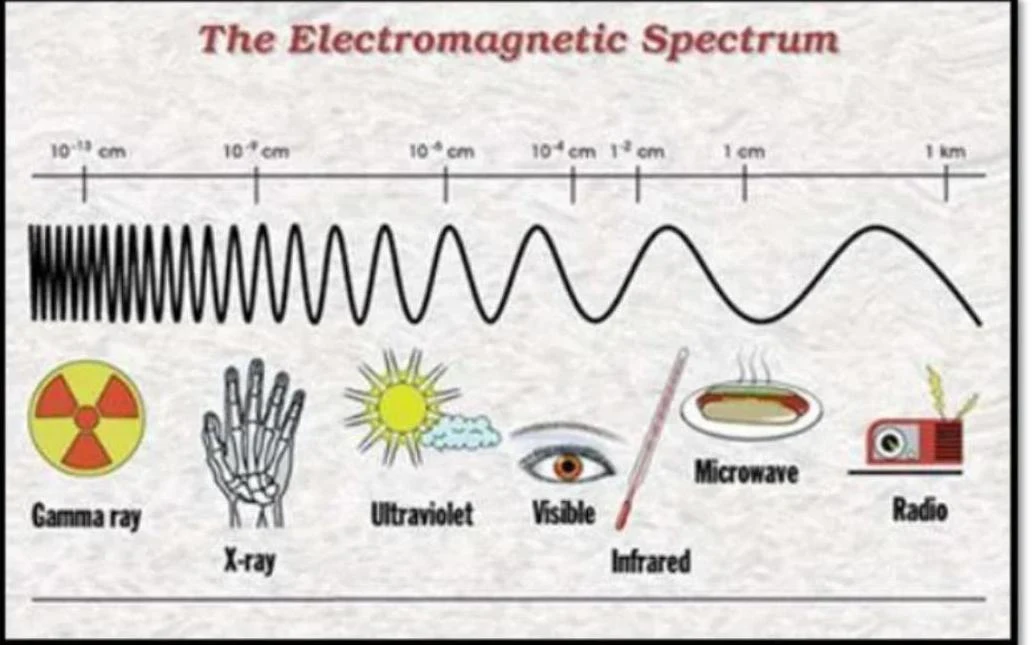
In contrast, electromagnetic waves do not require a medium and can travel through empty space. This spectrum includes radio waves, microwaves, infrared, visible light, ultraviolet, and X-rays.
The electromagnetic spectrum illustrates different types of electromagnetic radiation, including gamma rays, X-rays, ultraviolet, visible light, infrared, microwaves, and radio waves, ordered by their wavelengths.
Classifying Waves by Particle Motion
We can further classify waves by the relationship between the direction of the vibration and the direction of the wave's travel.
Transverse Waves
Transverse waves result from transverse vibrations, where the object moves in a direction perpendicular to its principal axis. In these waves, the particles of the medium move perpendicular to the direction of the wave's travel.
Key features of a transverse wave include:
Crests: The high points or peaks of the wave.
Troughs: The low points or valleys of the wave.
Examples include ripples in a pond or a "stadium wave" created by spectators.
Diagram illustrating the properties of a wave, including amplitude, wavelength, crest, trough, and direction of travel.
Longitudinal Waves
Longitudinal waves result from longitudinal vibrations, where the object moves in a direction parallel to its principal axis. In these waves, the particles move parallel to the direction of wave propagation.
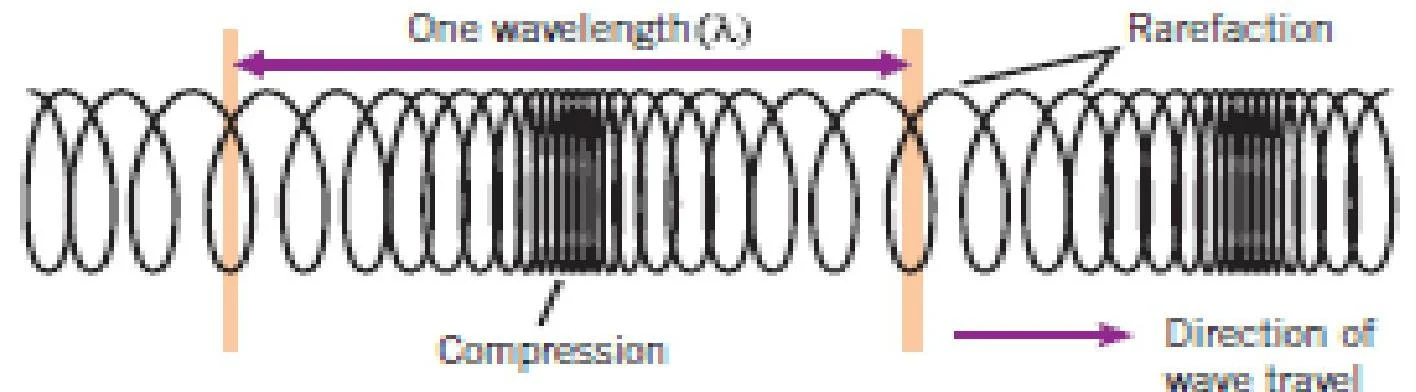
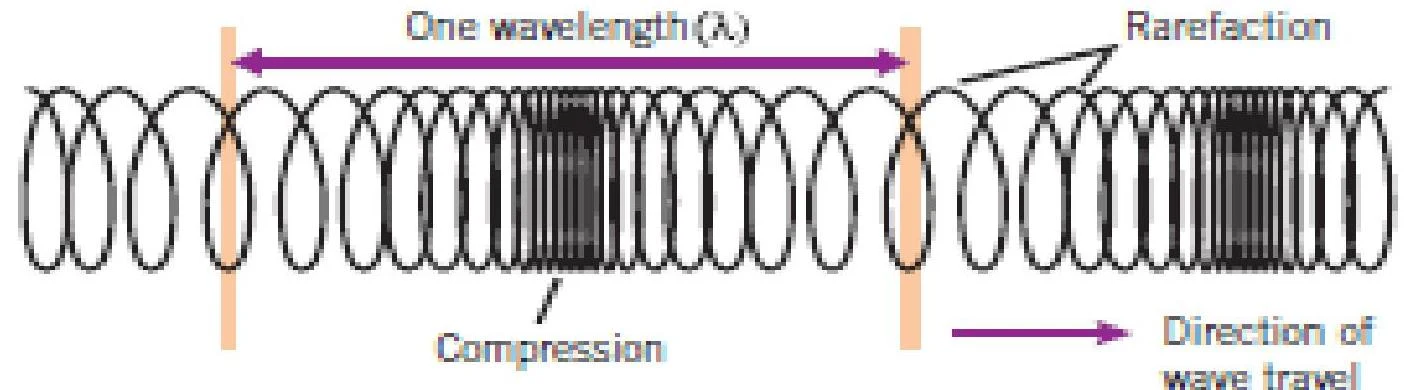
Sound waves are the primary example of longitudinal waves. They are characterized by two distinct regions:
Compression: A region of high pressure and high density where particles are pushed together.
Rarefaction: A region of low pressure and low density where particles are pulled apart.
Diagram illustrating compression and rarefaction in a wave, with one wavelength indicated.
This diagram illustrates a longitudinal wave, showing regions of compression and rarefaction, and indicating one wavelength and the direction of wave travel.
Torsional Waves
Torsional waves result from torsional vibrations, which occur when an object twists or moves around its principal axis. A historical example of the destructive power of torsional waves was the collapse of the Tacoma Narrows Bridge in 1940.
Essential Wave Characteristics
To describe waves mathematically, we use several key parameters:
Wavelength (λ): The distance from crest to crest (or trough to trough), measured in meters.
Amplitude (A): The distance from the midpoint of the wave to the crest or trough, measured in meters.
Period (T): The time it takes for a wave to travel a distance equal to one wavelength, measured in seconds. It is related to frequency by:
T=f1
Frequency (f): The number of waves that pass a fixed point per second, measured in Hertz (Hz).
f=T1
Velocity (v): The speed of the wave, measured in meters per second (m/s). This can be calculated using the Universal Wave Equation:
v=Tλv=fλ
Sound Energy and Human Perception
Sound energy is produced when a force causes a substance to vibrate. This energy is transferred via sound waves. All sounds are fundamentally produced by a vibrating source.
Characteristics of Sound
We perceive sound through three primary characteristics:
Volume: Related to the amplitude of the wave. Higher amplitude means a louder sound.
Pitch: Related to the frequency of the wave. Higher frequency means a higher pitch.
Timbre: Related to the waveform. Most sounds are complex and contain a "fundamental frequency" along with various "harmonics" or "overtones".
Hearing Ranges
The human ear can typically hear frequencies between 20 Hz and 20,000 Hz.
Infrasound: Frequencies below 20 Hz (e.g., from earthquakes or volcanoes).
Ultrasound: Frequencies above 20,000 Hz (e.g., used in medical imaging).
Exam Tip: When calculating the speed of sound in air, remember that it is proportional to the square root of the temperature. At 0∘C, the speed is approximately 332 m/s, and it increases by 0.6 m/s for every degree Celsius rise.
Advanced Wave Phenomena
The Doppler Effect
The Doppler effect is the change in observed frequency when a source moves relative to an observer. For example, an approaching car sounds higher in pitch because the waves are "crowded" together, while a receding car sounds lower in pitch as the waves spread apart.
For a source moving toward a stationary observer:
f′=c−vscf
For a source moving away from a stationary observer:
f′=c+vscf
Where $f'$ is the observed frequency, f is the actual frequency, c is the speed of sound, and vs is the velocity of the source.
Reflection, Refraction, and Diffraction
Reflection: Waves bounce off barriers. If they hit a rigid barrier, they are inverted. If they hit a free boundary, they are not inverted.
Refraction: When a wave enters a new medium, its speed and wavelength change, but its frequency and period remain constant.
Diffraction: The change in direction of waves as they pass through an opening or around an obstacle.
Resonance
Resonance occurs when the applied frequency matches the natural frequency of an object, leading to a significant increase in the amplitude of vibrations. A simple example is pushing a child on a swing at the correct intervals to make them go higher.
Keep reading for free.
Create an account to finish this reading and make it part of your study routine.