Introduction to Vector Analysis in Physics and Engineering
This guide explains the fundamental concepts of vector analysis, including the distinction between scalars and vectors, vector components and resolution, and the dot and cross products. It covers their applications in physics and engineering, such as kinematics, dynamics, and electromagnetism.
In the study of physics and engineering, describing the world requires more than just numbers. If you tell a pilot to fly at 500 km/h, they lack the most critical piece of information: which direction to head. This distinction between "how much" and "which way" forms the foundation of vector analysis. Understanding how to manipulate these quantities is essential for mastering kinematics, dynamics, and electromagnetism.
Scalars vs. Vectors
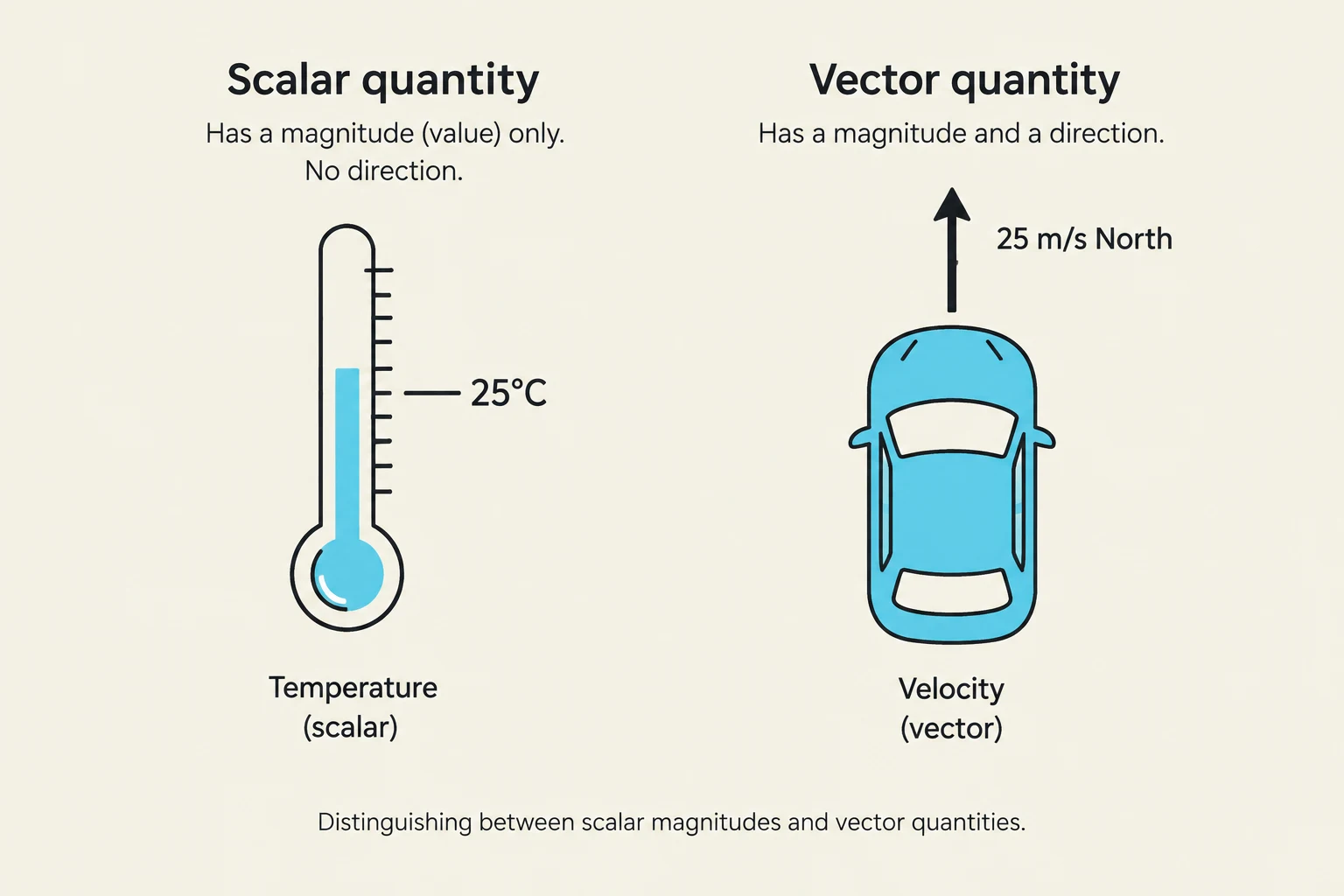
This illustration distinguishes between scalar quantities, which have only magnitude (like temperature), and vector quantities, which have both magnitude and direction (like velocity).
The first step in vector analysis is distinguishing between two fundamental types of physical quantities: scalars and vectors.
Scalars are quantities described entirely by a magnitude (a numerical value) and a unit. They represent "how much" of something exists. Common examples include mass, temperature, time, and speed. If a car is traveling at 25 m/s, that value alone is a scalar.
Vectors, however, require both a magnitude and a specific direction to be fully defined. Examples include displacement, velocity, acceleration, and force. If that same car is traveling at 25 m/sdue North, we are describing a vector quantity.
Exam Tip: When solving problems, always check if the direction is required. If a question asks for "velocity" rather than "speed," you must include a direction in your final answer to receive full credit.
Vector Components and Resolution
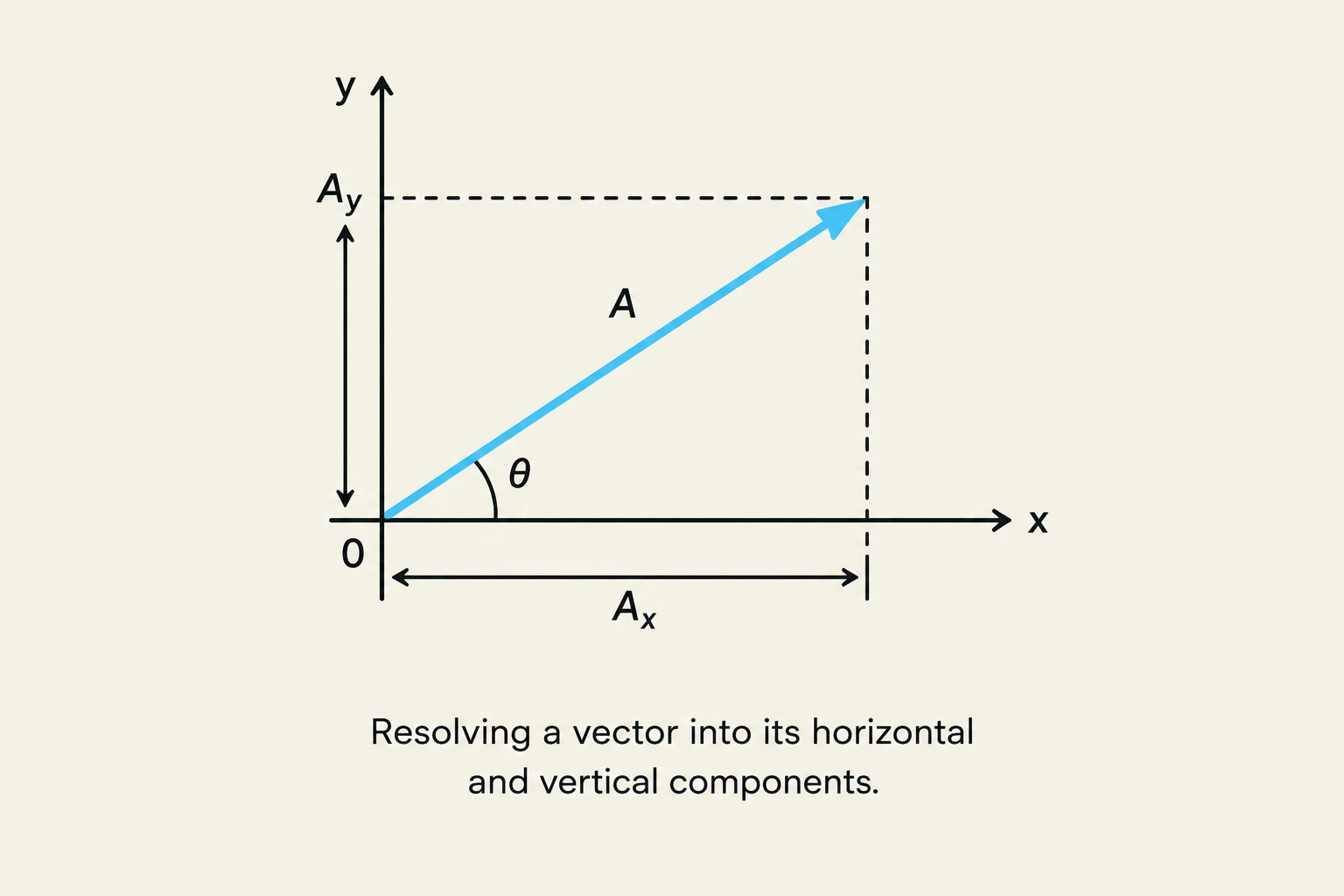
Resolving a vector into its horizontal and vertical components.
In a two-dimensional plane, a vector is often represented as an arrow pointing from an origin to a specific point. While it is easy to visualize a single diagonal arrow, mathematical operations are much simpler when we break that arrow down into its constituent parts, known as components.
Resolving a vector means finding its projection along the x and y axes. If we have a vector A with a magnitude A and an angle θ measured from the positive x-axis, we can use trigonometry to find its components:
AxAy=Acos(θ)=Asin(θ)
The vector can then be written in unit vector notation, which uses i^ to represent the x-direction and j^ to represent the y-direction:
A=Axi^+Ayj^
Worked Example: Resolving a Force
Suppose a person pulls a sled with a force of 50 N at an angle of 30∘ above the horizontal. To find the horizontal and vertical components of this force:
Identify the magnitude and angle:F=50 N, θ=30∘.
Calculate Fx:
FxFx=50cos(30∘)≈50×0.866=43.3 N
Calculate Fy:
FyFy=50sin(30∘)=50×0.5=25 N
The force vector is F=43.3i^+25j^ N.
Vector Multiplication: Dot and Cross Products
Vectors cannot be multiplied like ordinary numbers. Depending on the physical context, we use two distinct types of multiplication: the dot product and the cross product.
The Dot Product (Scalar Product)
The dot product takes two vectors and returns a scalar. It measures how much one vector "lines up" with another. For two vectors A and B with an angle θ between them, the dot product is defined as:
A⋅B=∣A∣∣B∣cos(θ)
In terms of components, it is calculated as:
A⋅B=AxBx+AyBy+AzBz
Physical Application: The dot product is used to calculate Work. Work is the dot product of the Force vector and the Displacement vector (W=F⋅d). If the force is perpendicular to the displacement, the dot product is zero, meaning no work is done.
The Cross Product (Vector Product)
Unlike the dot product, the cross product takes two vectors and returns a new vector. This new vector is unique because it is perpendicular to the plane formed by the original two vectors. The magnitude of the cross product is:
∣A×B∣=∣A∣∣B∣sin(θ)
The direction of the resulting vector is determined by the Right-Hand Rule: if you curl the fingers of your right hand from A toward B, your thumb points in the direction of A×B.
Physical Application: The cross product is used to calculate Torque (τ=r×F), which describes the rotational tendency of a force applied at a distance from a pivot point.
Summary Table: Dot vs. Cross Product
Feature
Dot Product
Cross Product
Result Type
Scalar (Number)
Vector (Magnitude + Direction)
Trig Function
cos(θ)
sin(θ)
Key Use
Work, Energy, Projections
Torque, Angular Momentum, Magnetism
Max Value
When vectors are parallel
When vectors are perpendicular
By mastering these fundamentals—distinguishing types, resolving components, and applying the correct product—you build the mathematical toolkit necessary to navigate the complexities of the physical world.
Keep reading for free.
Create an account to finish this reading and make it part of your study routine.