Introduction to Trigonometric Ratios using SOH CAH TOA
Learn the fundamental trigonometric ratios (Sine, Cosine, Tangent) and how to apply the SOH CAH TOA mnemonic to solve problems involving right-angled triangles.
Trigonometry is a fundamental branch of mathematics that explores the relationships between the sides and angles of triangles. For students first encountering this subject, the most important starting point is understanding how to navigate a right-angled triangle. By using specific ratios, we can calculate unknown angles or side lengths with incredible precision. To make these ratios easier to remember, mathematicians use a famous mnemonic: SOH CAH TOA.
Understanding the Right-Angled Triangle
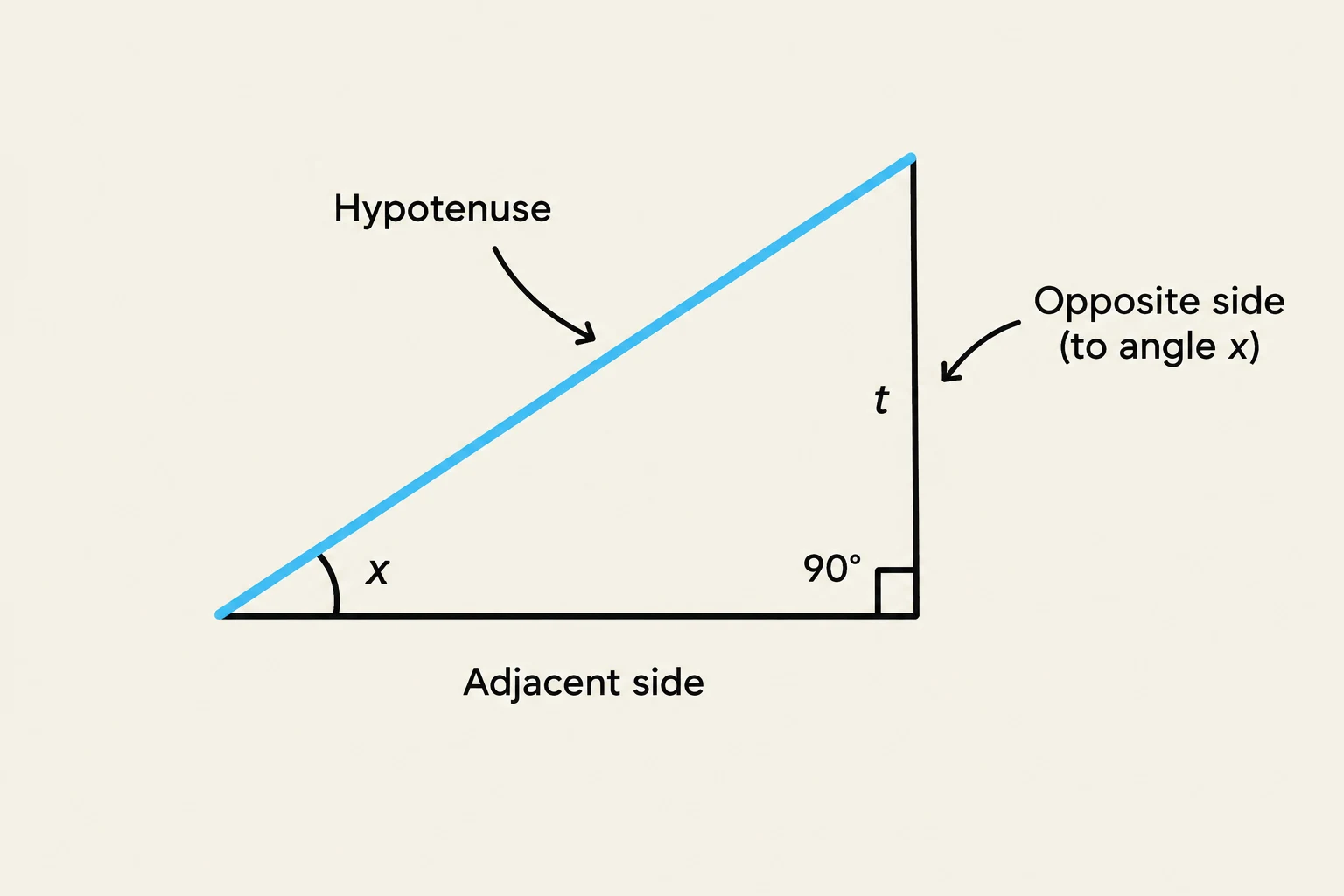
Before applying any formulas, you must be able to identify the three sides of a right-angled triangle in relation to a specific angle. In a right-angled triangle, one angle is always 90∘, often indicated by a small square in the corner.
The names of the sides depend entirely on which angle you are currently focusing on (often labeled as x):
Hypotenuse: This is the longest side of the triangle and is always located directly opposite the 90∘ angle.
Opposite: This is the side that is directly across from your chosen angle x. It does not touch the angle x at all.
Adjacent: This is the side that is next to your chosen angle x, helping to form the angle along with the hypotenuse.
A right-angled triangle is shown with its sides labeled as hypotenuse, adjacent side, and opposite side (to angle x). The angle x and the right angle (90 degrees) are indicated.
Pro Tip: Always identify the hypotenuse first! Since it is always opposite the right angle, it is the easiest side to find and serves as your anchor for the rest of the problem.
The Three Trigonometric Ratios
Trigonometric ratios are mathematical functions that describe the relationship between the sides of a right-angled triangle and its angles. There are three primary ratios you will use: Sine, Cosine, and Tangent.
1. Sine (SOH)
The Sine of an angle is the ratio of the length of the opposite side to the length of the hypotenuse.
sinx=hypotenuseopposite
2. Cosine (CAH)
The Cosine of an angle is the ratio of the length of the adjacent side to the length of the hypotenuse.
cosx=hypotenuseadjacent
3. Tangent (TOA)
The Tangent of an angle is the ratio of the length of the opposite side to the length of the adjacent side.
tanx=adjacentopposite
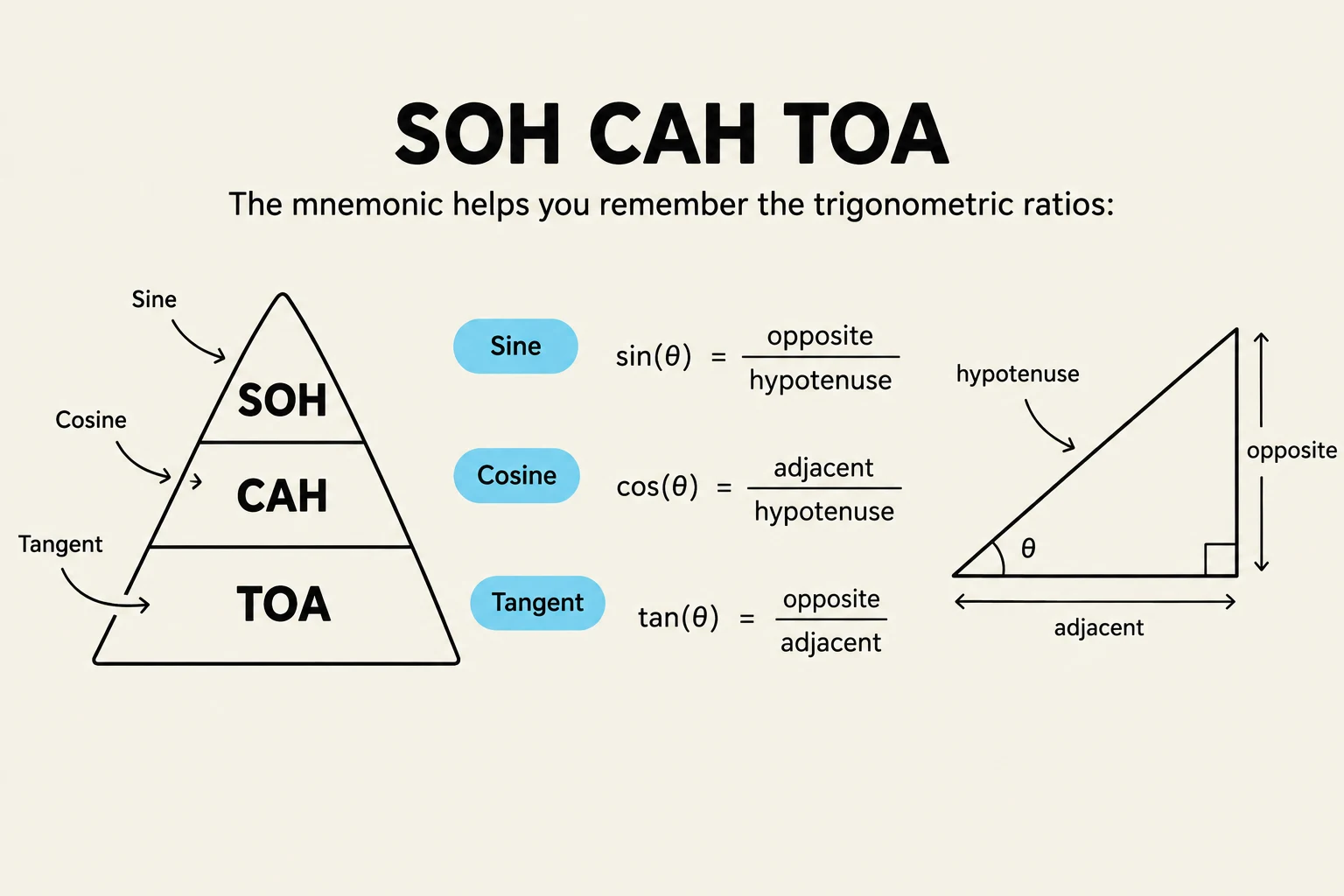
The SOH CAH TOA mnemonic is used to remember the trigonometric ratios: Sine, Cosine, and Tangent, in relation to the sides of a right-angled triangle.
Using the SOH CAH TOA Mnemonic
The mnemonic SOH CAH TOA is a memory tool designed to help you quickly recall which sides belong to which function. If you are stuck during an exam, simply write the word out:
SOH: Sine = Opposite / Hypotenuse
CAH: Cosine = Adjacent / Hypotenuse
TOA: Tangent = Opposite / Adjacent
When solving a problem, follow these three steps:
Identify the angle you are working with.
Label your sides (Opposite, Adjacent, and Hypotenuse) based on that angle.
Choose your ratio by looking at which sides you already know and which side you are trying to find.
Exam Tip: If you know two sides and need to find an angle, you will need to use the "inverse" function on your calculator (e.g., sin−1, cos−1, or tan−1).
Worked Example
Let's put this into practice. Imagine you have a right-angled triangle where:
The angle x is given.
The Opposite side is 5 cm.
The Adjacent side is 12 cm.
If you want to find the value of tanx, you look at your mnemonic. Since you have the Opposite and the Adjacent, you use TOA.
tanxtanxtanx=adjacentopposite=125≈0.4167
By following these structured steps, you can solve almost any basic trigonometry problem involving right-angled triangles.
Keep reading for free.
Create an account to finish this reading and make it part of your study routine.