An introduction to thermochemistry, covering the nature of energy, systems and surroundings, the first law of thermodynamics, calorimetry, and enthalpy changes in exothermic and endothermic processes.
Energy is the fundamental capacity to do work. In the study of chemistry, understanding how energy moves, transforms, and is stored is essential to predicting how substances will react. This field of study is known as thermochemistry, which focuses specifically on the heat changes that occur during chemical reactions.
The Nature of Energy
To understand thermochemistry, we must first distinguish between the various forms of energy that exist in a system:
Kinetic Energy: The energy of motion. The amount of kinetic energy an object possesses is directly proportional to its mass and the square of its velocity, expressed as KE=21mv2.
Thermal Energy: The energy associated with the random motion of atoms and molecules, which we perceive as temperature.
Potential Energy: Energy available due to an object's position or composition.
Chemical Energy: A specific form of potential energy stored within the bonds of chemical substances, associated with the positions of electrons and nuclei.
The Law of Conservation of Energy
A cornerstone of science is the Law of Conservation of Energy, which states that energy cannot be created or destroyed. When energy is transferred or converted, the total amount remains constant. Consequently, the total amount of energy in the universe is constant.
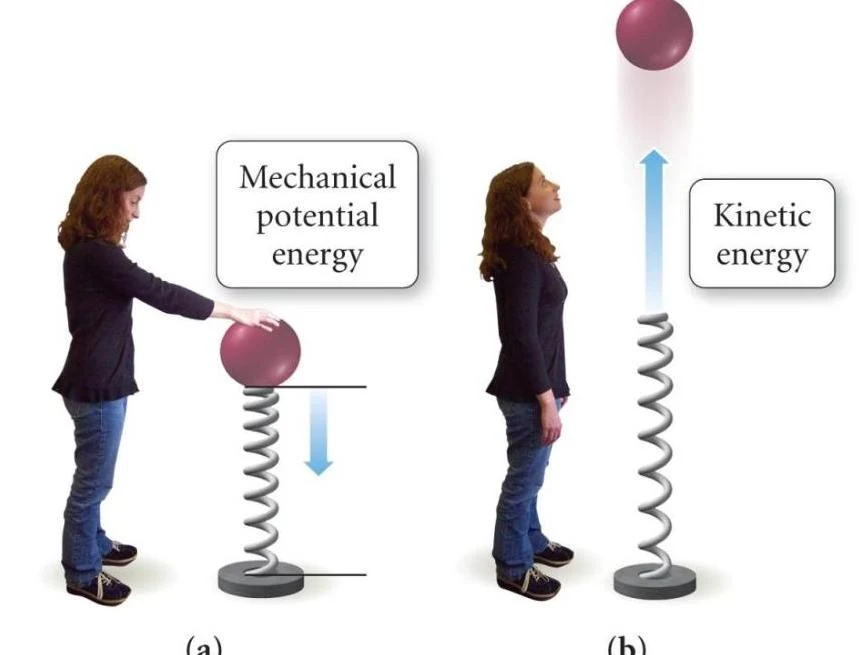
This illustration shows the conversion of mechanical potential energy to kinetic energy as a ball is released from a compressed spring.
Systems, Surroundings, and the First Law
In thermochemistry, we divide the universe into two parts: the system (the specific part of the universe we are studying) and the surroundings (everything else).
The First Law of Thermodynamics is essentially the application of the Law of Conservation of Energy to these systems. It dictates that any change in energy within a system must be balanced by an equal and opposite change in the surroundings:
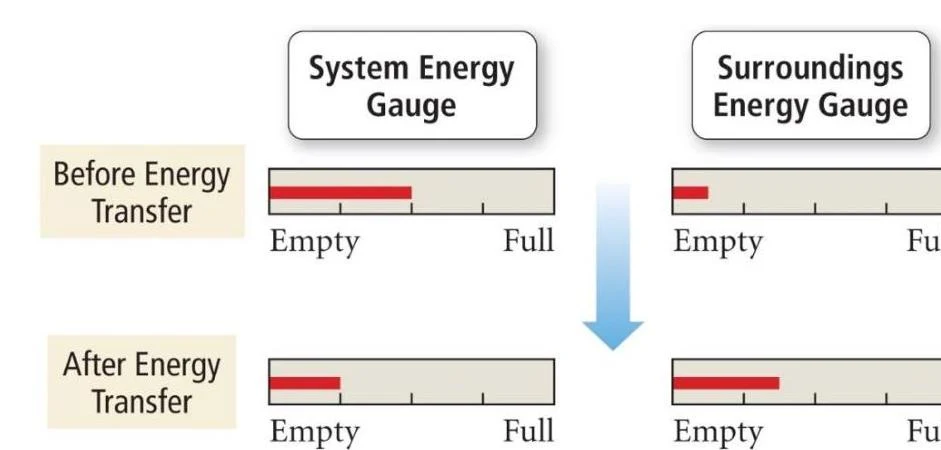
This diagram illustrates the concept of energy transfer between a system and its surroundings, showing how energy levels change before and after the transfer.
Internal Energy and Work
The internal energy (ΔE) of a system can change through the exchange of heat (q) or work (w):
ΔE=q+w
Energy exchange is defined by the following conventions:
Heat (q): A positive value (+) means the system gains heat; a negative value (-) means the system releases heat.
Work (w): A positive value (+) means the system gains energy from work; a negative value (-) means the system releases energy by doing work.
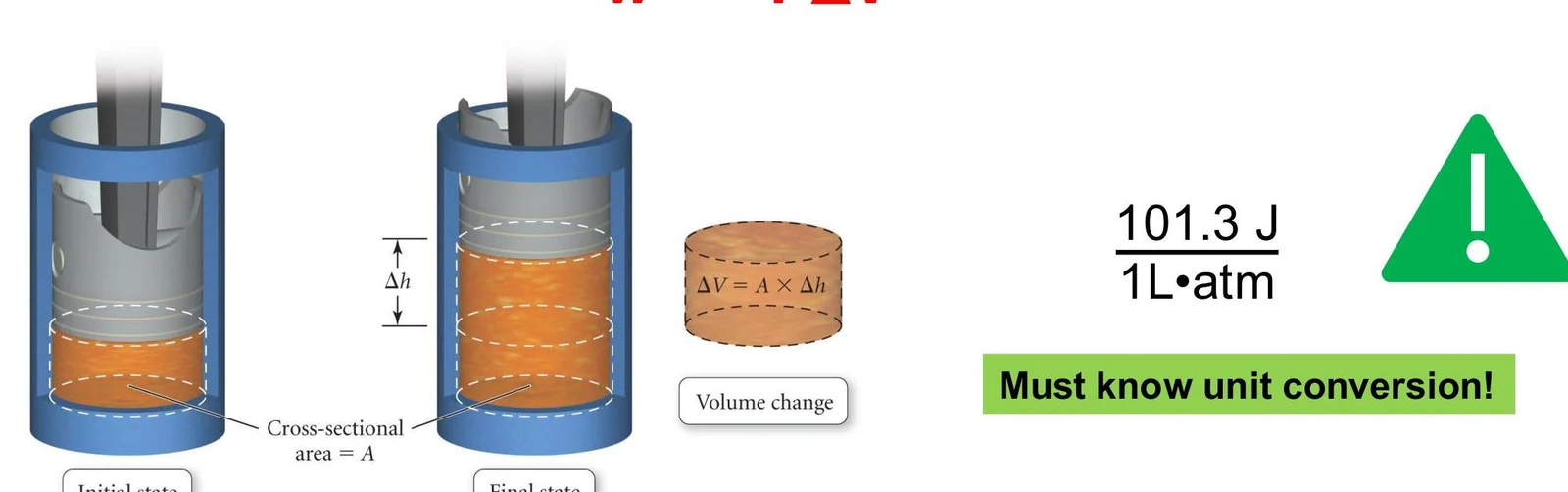
A common type of work in chemistry is PV work, which is work caused by a change in volume against an external pressure. For a system expanding against constant external pressure, the work is calculated as:
w=−PΔV
This illustration demonstrates the concept of volume change in a cylinder, where the change in volume (ΔV) is calculated as the product of the cross-sectional area (A) and the change in height (Δh). It also highlights a unit conversion factor between Joules and Liter-atmospheres, emphasizing the importance of unit conversion in calculations.
State Functions
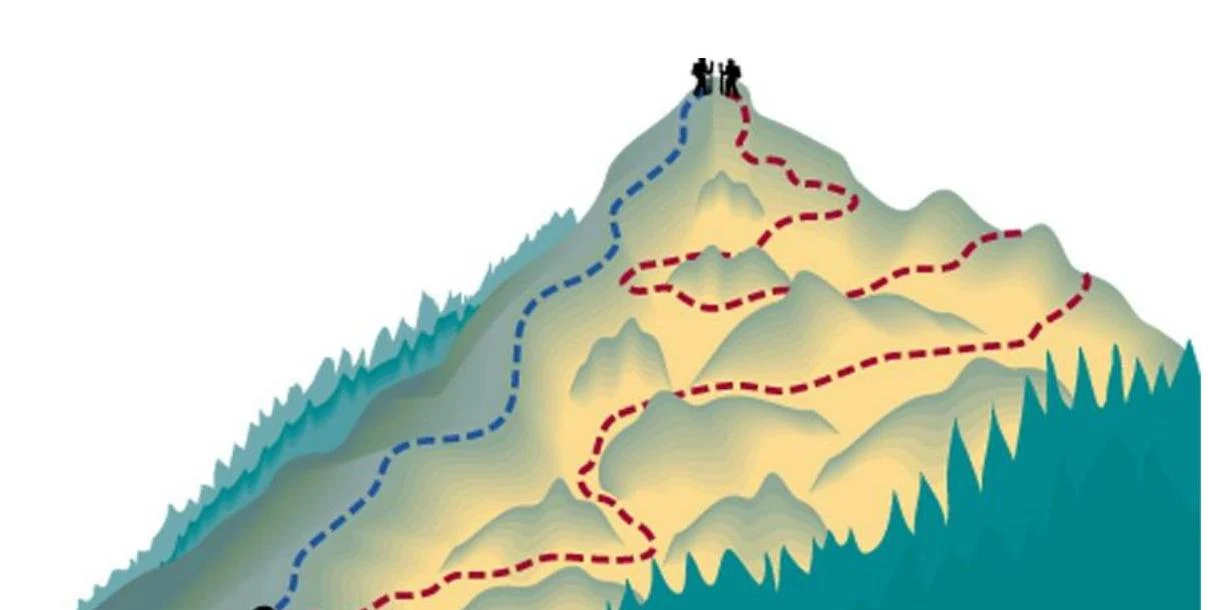
Not all properties of a system are treated equally. State functions are properties that depend only on the current state of the system (its initial and final conditions) and not on the path taken to get there. Examples include internal energy (E), pressure (P), volume (V), and temperature (T).
Illustration of two hiking trails leading to the summit of a mountain.
Measuring Heat: Calorimetry
To measure the thermal energy exchanged during a reaction, scientists use calorimetry.
When measuring heat, we distinguish between two concepts:
Heat Capacity (C): The amount of heat required to raise the temperature of a given quantity of a substance by 1∘C.
Specific Heat Capacity (Cs): The amount of heat required to raise the temperature of one gram of a substance by 1∘C.
The formula for heat (q) is:
q=mCsΔt
Where m is mass and Δt is the change in temperature (tfinal−tinitial).
Exam Tip: When two objects at different temperatures are placed in contact, heat flows from the hot object to the cold object until they reach thermal equilibrium. In these problems, remember that the heat lost by the hot object is equal to the heat gained by the cold object: qhot=−qcold.
Enthalpy (ΔH)
While internal energy (ΔE) is a useful concept, most chemical reactions occur at constant pressure (such as in an open beaker). For these processes, we use Enthalpy (H) to quantify heat flow. The change in enthalpy (ΔH) is the heat involved in a reaction at constant pressure:
ΔHreaction=qreaction at constant pressure
Exothermic vs. Endothermic Processes
Chemical reactions can either release or absorb energy, which we categorize into two types:
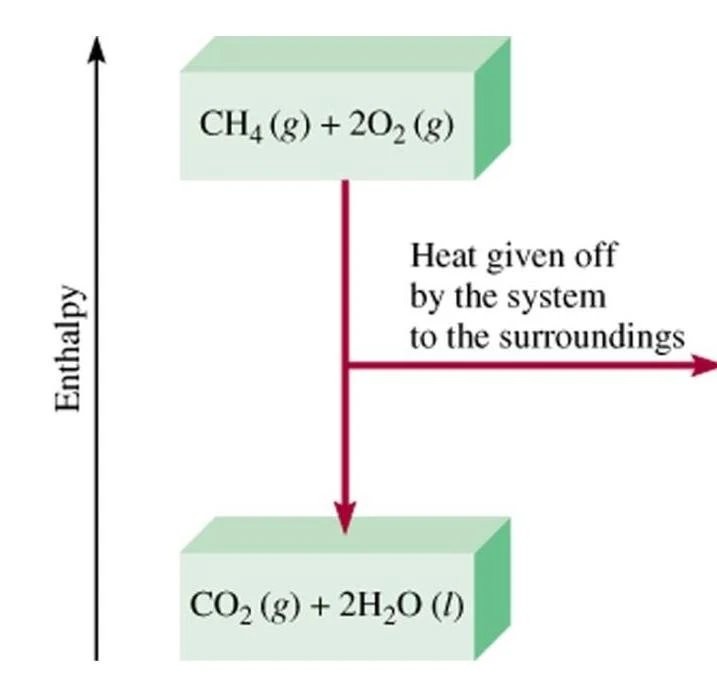
Exothermic Process: The system releases heat to the surroundings. The surroundings' temperature rises, and the enthalpy change is negative (ΔH<0).
Example: The combustion of methane.
This diagram illustrates the combustion of methane, showing the reactants CH4 and O2 at a higher enthalpy level than the products CO2 and H2O. The downward arrow indicates that heat is released to the surroundings during this exothermic reaction.
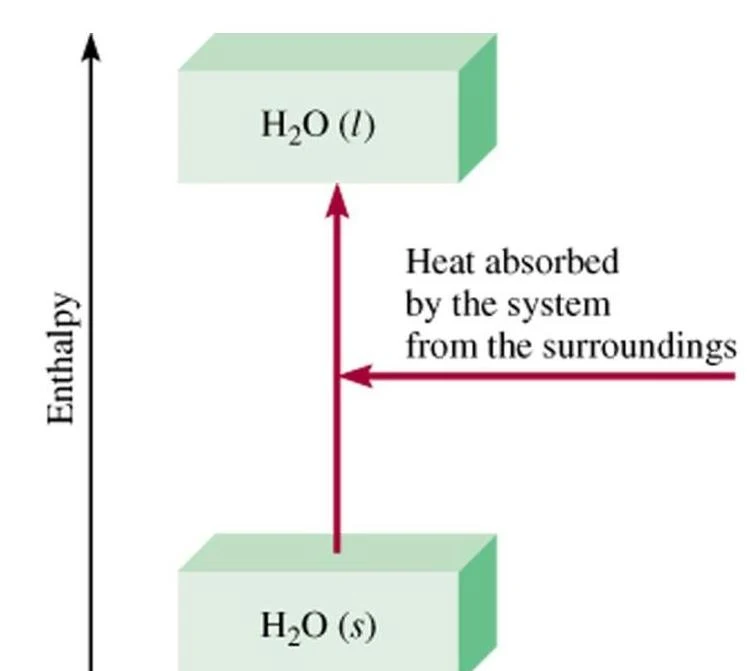
Endothermic Process: The system absorbs heat from the surroundings. The surroundings' temperature drops, and the enthalpy change is positive (ΔH>0).
Example: The melting of ice.
This diagram illustrates the enthalpy change during the phase transition of water from solid (ice) to liquid. The upward arrow indicates an increase in enthalpy, and the text explains that heat is absorbed from the surroundings for this process.
Relationship between ΔH and ΔE
The difference between enthalpy and internal energy is related to the work done by or on the system:
ΔH=ΔE+PΔV
For reactions involving gases, this difference can be significant. If a reaction produces a large volume of gas, ΔH and ΔE will differ more noticeably than in reactions occurring in aqueous solutions.
Calculating Enthalpy Changes
Hess's Law
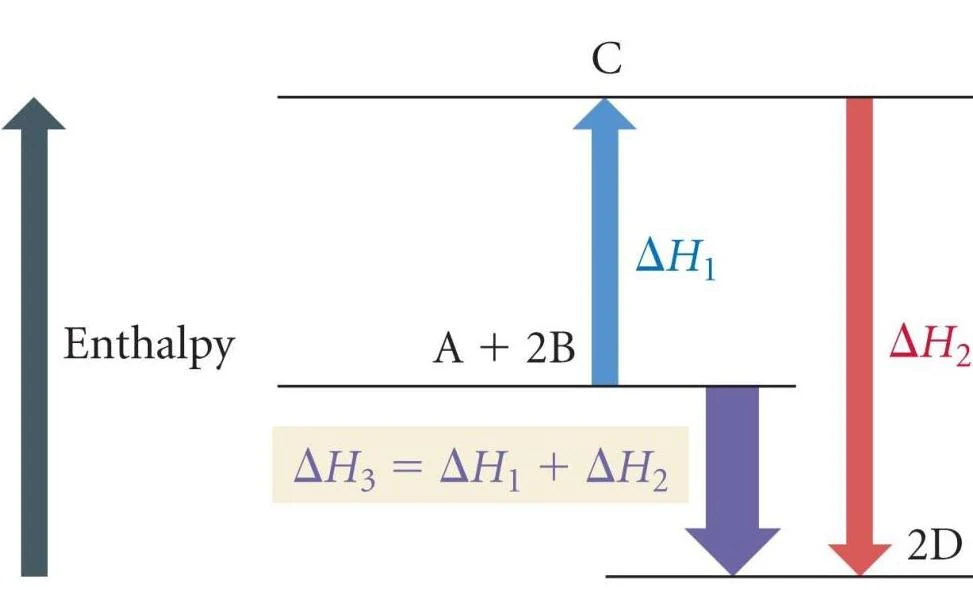
Hess's Law states that the change in enthalpy for a stepwise process is the sum of the enthalpy changes of the individual steps. This allows us to calculate the ΔH of a complex reaction by breaking it down into simpler, known reactions.
This diagram illustrates enthalpy changes in a chemical reaction. The vertical axis represents enthalpy, with different levels indicating the energy states of reactants and products. The arrows show the enthalpy changes (ΔH) associated with different reaction pathways. The equation ΔH3 = ΔH1 + ΔH2 represents Hess's Law, which states that the total enthalpy change for a reaction is independent of the pathway taken.
Standard Enthalpy of Formation (ΔHf∘)
A very useful way to calculate the enthalpy of a reaction is by using the Standard Enthalpy of Formation. This is the enthalpy change for the reaction forming 1 mole of a pure compound from its constituent elements in their standard states (at 1 atm and usually 25∘C).
Important Note: The ΔHf∘ for any pure element in its standard state (such as O2(g) or C(graphite)) is exactly 0 kJ/mol.
To find the standard enthalpy of a reaction (ΔHrxn∘), you subtract the sum of the enthalpies of the reactants from the sum of the enthalpies of the products:
ΔHrxn∘=∑nΔHf∘(products)−∑mΔHf∘(reactants)
Worked Example: Combustion of Methane
To calculate the enthalpy change for the combustion of methane:
CH4(g)+2O2(g)→CO2(g)+2H2O(g)
Using standard values from a table:
ΔHf∘[CO2(g)]=−393.5 kJ/mol
ΔHf∘[H2O(g)]=−241.8 kJ/mol
ΔHf∘[CH4(g)]=−74.6 kJ/mol
ΔHf∘[O2(g)]=0 kJ/mol
The calculation is:
\Delta H^{\circ} &= [(-393.5) + 2(-241.8)] - [(-74.6) + 2(0)] \\
\Delta H^{\circ} &= [-877.1] - [-74.6] \\
\Delta H^{\circ} &= -802.5 \text{ kJ}
\end{aligned}$$