Introduction to the Nervous System: Structure and Function
An overview of the nervous system's structural and functional organization, including the central and peripheral nervous systems, sensory input, integration, motor output, and the cells that comprise nervous tissue.
The nervous system is a complex, highly organized network responsible for coordinating almost every aspect of human life. From the simple act of pulling your hand away from a hot stove to the complex processes of memory and higher-order thought, the nervous system manages the flow of information through specialized cells and electrical signals. To understand how this works, we must look at the system through two lenses: its structural organization and its functional roles.
Structural Organization: CNS vs. PNS
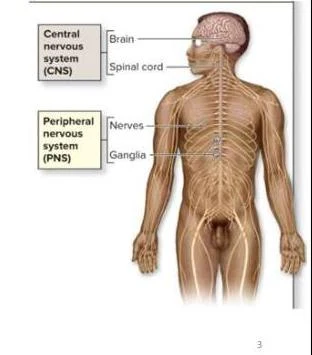
The nervous system is divided into two primary anatomical divisions: the Central Nervous System (CNS) and the Peripheral Nervous System (PNS).
The Central Nervous System (CNS)
The CNS serves as the body's command center and consists of the brain and the spinal cord. Because the CNS is the site of neural integration, it uses specific terminology to describe its internal structures:
Nucleus: A group of neuron cell bodies located within the CNS (often forming "gray matter").
Tract: A bundle of axons located within the CNS (often forming "white matter").
The Peripheral Nervous System (PNS)
The PNS consists of all nervous tissue located outside the CNS, primarily the cranial nerves and spinal nerves. In the PNS, the terminology shifts:
Ganglion: A group of neuron cell bodies.
Nerve: A bundle of axons.
Diagram of the human nervous system, illustrating the central nervous system (CNS) comprising the brain and spinal cord, and the peripheral nervous system (PNS) consisting of nerves and ganglia.
Functional Organization: The Flow of Information
Functionally, the nervous system is defined by the direction in which information travels. This involves three overlapping processes: sensory input, integration, and motor output.
1. Sensory Input (Afferent Division)
The afferent division of the PNS is responsible for collecting information from both internal and external environments and carrying it towards the CNS. This is subdivided into:
Somatic sensory system: Carries information related to the external environment (e.g., touch, temperature, pain).
Visceral sensory system: Carries information from internal organs.
2. Integration (The CNS)
Once sensory information reaches the CNS, the brain and spinal cord perform neural integration. This is the processing stage where the incoming data is analyzed, interpreted, and a decision is made regarding the appropriate response.
3. Motor Output (Efferent Division)
The efferent division of the PNS carries instructions away from the CNS toward effectors (such as muscles or glands) to produce a response. This division is split into two distinct systems:
Somatic Motor System: Controls voluntary movements by acting on skeletal muscles.
Autonomic Motor System (Visceral Motor): Manages involuntary functions, such as those involving organs and glands.
Exam Tip: Directional Terminology
Remember: Afferent = Arriving at the CNS. Efferent = Exiting the CNS.
Nervous System Cells: Neurons and Neuroglia
Nervous tissue is composed of two main types of cells: neurons, which transmit signals, and neuroglia, which support them.
The Neuron: The Communicator
Neurons are specialized for excitability, conductivity, and secretion. A typical neuron consists of three main anatomical features:
Dendrites: Branch-like extensions that receive information and direct it toward the cell body.
Soma (Cell Body): The metabolic center containing the nucleus; this is where "neural integration" occurs.
Axon: A long process that transmits information away from the cell body toward other cells. Axons often end in synaptic knobs, which house neurotransmitters.
Neurons are also classified by their structure (e.g., multipolar, bipolar, unipolar, or anaxonic) and their function (sensory, motor, or interneurons).
Neuroglia: The Support System
Neuroglia (or glial cells) are non-excitable cells that outnumber neurons roughly 2:1. They provide scaffolding, insulation, and protection.
Location
Cell Type
Primary Function
CNS
Astrocytes
Form the blood-brain barrier (BBB) and regulate fluid
CNS
Oligodendrocytes
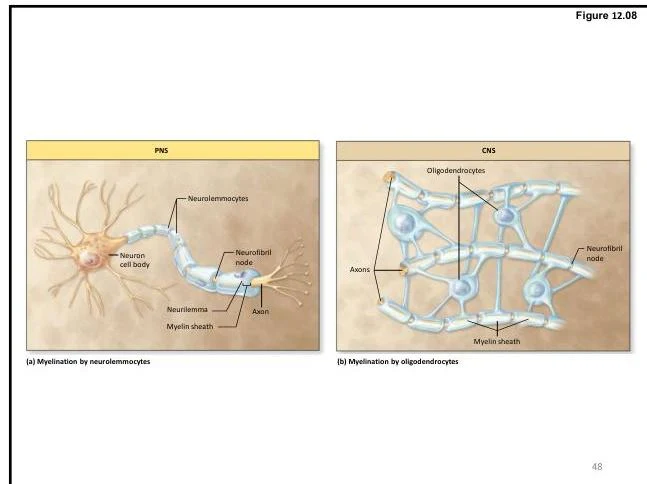
Form myelin sheaths around axons
CNS
Microglia
Immune defense
CNS
Ependymal Cells
Secrete cerebrospinal fluid
PNS
Schwann Cells
Form myelin sheaths (neurolemmocytes)
PNS
Satellite Cells
Insulate and regulate nutrients in ganglia
Diagrams illustrating myelination in the peripheral nervous system (PNS) by neurolemmocytes and in the central nervous system (CNS) by oligodendrocytes.
Neural Communication: Potentials and Synapses
Communication within the nervous system relies on changes in electrical charge across the cell membrane.
Graded Potentials vs. Action Potentials
Graded Potentials: Occur in the receptive region (dendrites/soma). They can be Excitatory (EPSP), which depolarizes the membrane by allowing Na+ entry, or Inhibitory (IPSP), which hyperpolarizes the membrane.
Action Potentials: Occur in the conductive region (axon). They are "all-or-none" signals that propagate down the axon once a threshold (typically -55 mV) is reached at the axon hillock.
The Synapse
When an action potential reaches the synaptic knob, it triggers the release of neurotransmitters into the synaptic cleft. These chemicals bind to receptors on the postsynaptic cell (a neuron or effector), creating a new potential.
Key Concept: Conduction Velocity
The speed of a signal is determined by two main factors: axon diameter (thicker is faster) and myelination (myelinated is much faster due to saltatory conduction).
Neuronal Circuits
Neurons do not work in isolation; they form complex circuits to process information:
Converging Circuit: Multiple inputs lead to one output (e.g., sensory inputs triggering salivation).
Diverging Circuit: One input spreads to many outputs (e.g., a single brain command controlling multiple muscles).
Reverberating Circuit: Uses feedback loops for cyclical activity, such as breathing.
Parallel-After-Discharge: Signals travel through multiple paths, arriving at different times; this is linked to higher-order thinking.
Keep reading for free.
Create an account to finish this reading and make it part of your study routine.