Introduction to the Immune System: Defense Mechanisms
An overview of the human immune system, detailing its three lines of defense: surface barriers, innate immunity, and adaptive immunity. It explains the roles of various cells like phagocytes and lymphocytes, as well as key processes such as inflammation and antibody production.
The human body is constantly under siege by a diverse array of biological threats, including bacteria, viruses, fungi, and parasites. Beyond these living pathogens, the immune system must also defend against non-living threats like bacterial toxins, animal venoms, and even the body's own mutated cancer cells. To manage these varied threats, the body utilizes a sophisticated, multi-layered defense strategy that integrates specialized cells, signaling proteins, and dedicated anatomical structures.
The Three Lines of Defense
The immune response is organized into three distinct levels of protection, moving from general physical barriers to highly specific cellular attacks.
The First Line (Surface Barriers): This is the initial physical and chemical blockade. The cutaneous membrane (skin) uses multiple layers and the protein keratin to resist mechanical stress, while its acidic sebum helps prevent the growth of most pathogens. Mucous membranes line the respiratory, gastrointestinal, and genitourinary tracts; while they are more susceptible to mechanical abrasion, they serve to trap pathogens and debris. Additionally, chemical barriers like stomach acid work to kill ingested pathogens.
The Second Line (Innate Immunity): If a pathogen breaches the surface, the innate immune response activates.
The Third Line (Adaptive Immunity): This is the most specialized level of defense, involving targeted recognition of specific invaders.
Innate Immunity: The Rapid Response
Innate immunity is "nonspecific," meaning it responds to all pathogens in a uniform manner regardless of whether the body has encountered them before. It is characterized by its speed, acting within seconds to hours of exposure.
Cellular Components: Phagocytes and Non-Phagocytes
The innate response relies heavily on specialized cells to identify and destroy invaders.
Phagocytes: These cells perform phagocytosis, the process of ingesting and destroying particles.
Macrophages: These can be fixed in tissues or roam freely. They ingest pathogens and display the resulting antigens on their plasma membranes to alert other cells.
Neutrophils: Primarily found in the blood, these cells respond to chemical signals to destroy bacteria using substances like H2O2, HClO, and lysozyme.
Eosinophils: These specialize in responding to parasitic pathogens.
Dendritic Cells: These act as antigen-presenting cells (APCs). They ingest substances and present them to B and T cells to trigger the adaptive response.
Non-Phagocytes:
Natural Killer (NK) Cells: These recognize and kill cancer cells or virally infected cells by releasing cytotoxic substances.
Basophils and Mast Cells: These contain granules that trigger inflammation and allergic reactions.
Antimicrobial Proteins and Inflammation
Innate immunity also utilizes antimicrobial proteins to assist in defense.
The Complement System: This consists of over 20 plasma proteins produced by the liver. It can be activated via the Classical Pathway (binding to antibodies attached to antigens) or the Alternative Pathway (spontaneous cleavage of C3 upon encountering foreign cells). Once activated, the complement cascade leads to:
Cell Lysis: The formation of a Membrane Attack Complex (MAC) that creates pores in the pathogen's membrane.
Enhanced Inflammation: Stimulating basophils and mast cells.
Opsonization: C3b coats pathogens, making them easier for phagocytes to "grab" and ingest.
Cytokines: These are signaling proteins produced by immune cells that enhance immune responses. They can induce "flu-like" symptoms, such as fever, to help fight infection.
Inflammation: This is a nonspecific response to cellular injury designed to isolate the damaged area, clean up dead cells, and bring repair proteins to the site. It is characterized by four cardinal signs: redness, heat, swelling, and pain.
Diagram illustrating the classical and alternative pathways of the complement system, showing how they lead to the formation of a membrane attack complex.
Adaptive Immunity: The Precision Strike
Adaptive (or acquired) immunity is highly specific and possesses the capacity for immunological memory. Unlike the innate system, it requires 3–5 days of exposure to an antigen to become fully active.
Lymphocytes and the Immune Response
The adaptive response is driven by two main types of lymphocytes:
B Lymphocytes (Antibody-mediated immunity): These produce antibodies to target pathogens.
T Lymphocytes (Cell-mediated immunity): These involve direct cellular attacks.
T Cell Development and MHC
T cells originate in the bone marrow but migrate to the thymus gland to mature. During maturation, the thymus ensures immunocompetence (the ability to recognize antigens) and self-tolerance (the ability to not attack the body's own cells) by destroying self-reactive T cells.
To recognize antigens, T cells use Major Histocompatibility Complex (MHC) molecules as docking sites.
Class I MHC: Found on nearly all nucleated cells; they present endogenous antigens to Cytotoxic T (TC) cells.
Class II MHC: Found only on antigen-presenting cells (like dendritic cells); they present exogenous antigens to Helper T (TH) cells.
Exam Tip: Remember the distinction between the two T cell roles: Helper T cells (CD4+) are the "generals" that coordinate the response via cytokines, while Cytotoxic T cells (CD8+) are the "soldiers" that directly kill infected or cancerous cells.
Mechanisms of Action
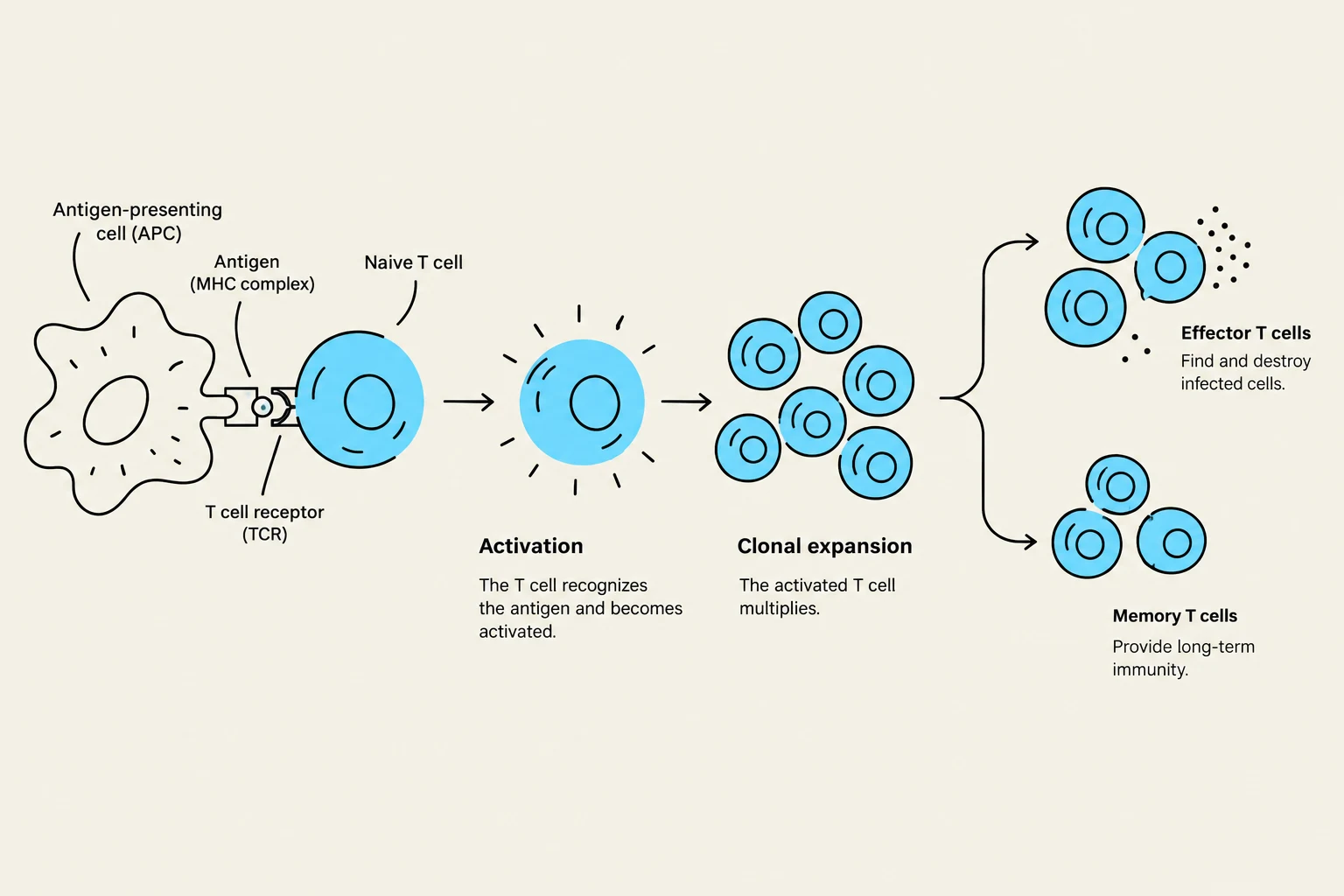
When a T cell encounters its specific antigen presented on an MHC molecule, it undergoes clonal selection and differentiation. The cell divides to produce effector cells (which act immediately) and memory cells (which provide long-term protection).
Helper T (TH) Cells: These do not kill directly. Instead, they secrete cytokines (like Interleukins) that activate B cells, enhance innate immunity, and stimulate macrophages.
Cytotoxic T (TC) Cells: These eliminate targets by binding to Class I MHC, releasing perforin to create holes in the target membrane, and injecting enzymes that fragment the target's DNA, inducing apoptosis (programmed cell death).
This diagram illustrates the process of T cell activation, clonal expansion, and differentiation into effector T cells and memory T cells, a key part of the adaptive immune response.
Integration: The Lymphatic and Immune Systems
The lymphatic system provides the physical infrastructure for the immune system to function. They are integrated in three primary ways:
Housing: Lymphoid organs like the spleen, lymph nodes, and MALT (Mucosa-Associated Lymphoid Tissue) provide the environment where B cells, T cells, and macrophages reside and develop.
Trapping: Lymphoid tissues use reticular fibers to form "nets" that trap pathogens, making them available for capture by leukocytes.
Activation: These organs facilitate the meeting of antigens and immune cells. For example, dendritic cells present antigens to T cells within these tissues to initiate the adaptive response.
Clinical Application: Transplantation
The specificity of the adaptive immune system is why organ transplantation is so challenging. When an organ is moved from one person to another, the recipient's T cells may recognize the new tissue as foreign.
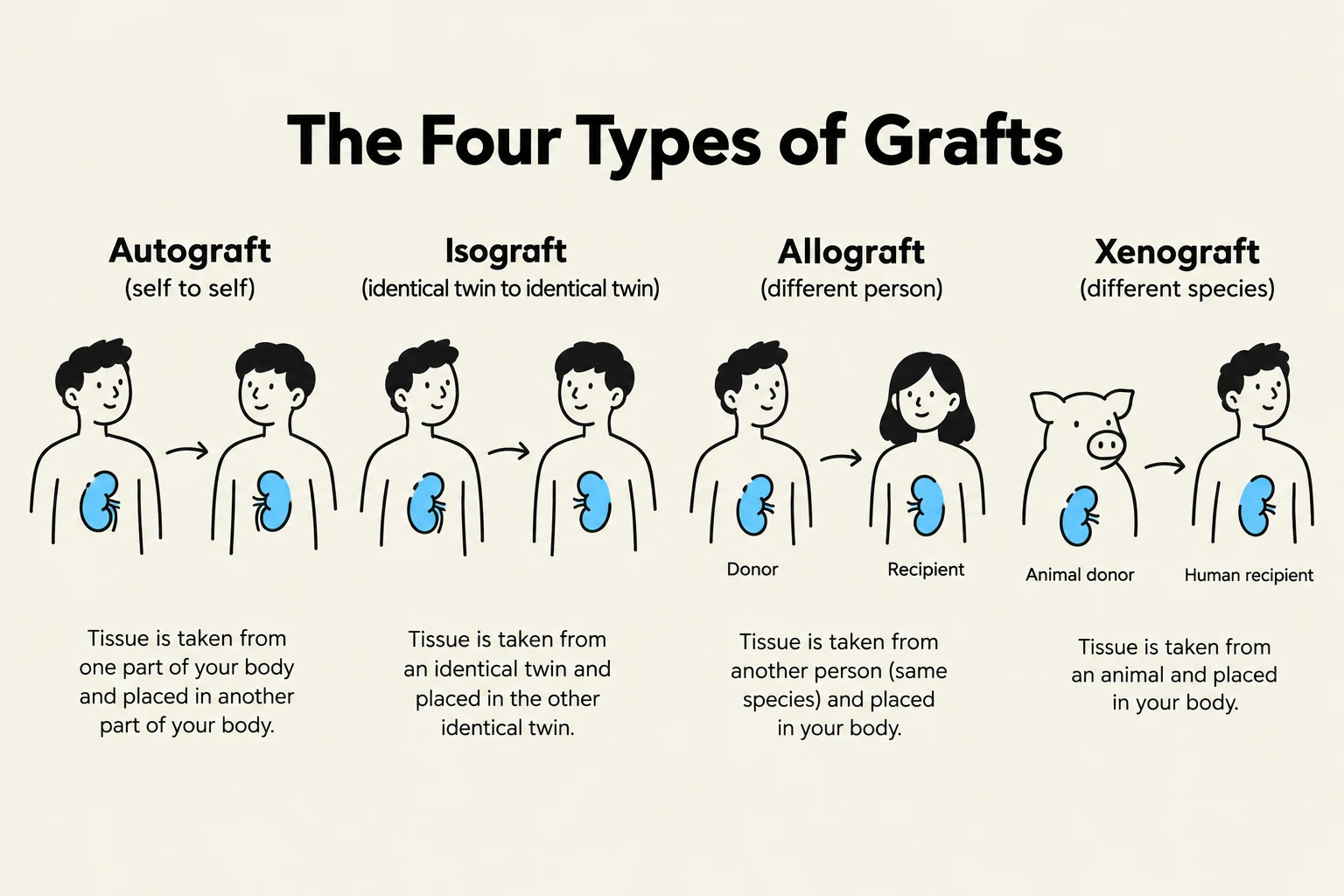
Autografts: Tissue from the same individual (e.g., skin grafts).
Isografts: Between genetically identical individuals.
Allografts: Between non-identical individuals of the same species (the most common type).
Xenografts: Between different species (e.g., pig heart valves).
Because allografts and xenografts contain foreign antigens, the recipient's T cells will often attack the tissue, leading to rejection and necrosis. To prevent this, doctors must use immunosuppressive therapy.
The four types of grafts: autograft (self to self), isograft (identical twin to identical twin), allograft (different person), and xenograft (different species).
Keep reading for free.
Create an account to finish this reading and make it part of your study routine.