When most people think of the livestock industry, they envision vast herds of cattle or swine being raised for meat production. However, the equine industry operates on a fundamentally different logic. Rather than focusing on the production of meat, milk, or fiber, the equine industry is primarily a service-based economy. It revolves around the breeding, training, recreation, and competition of animals that provide enhanced quality of life to their owners.
Equine Classifications
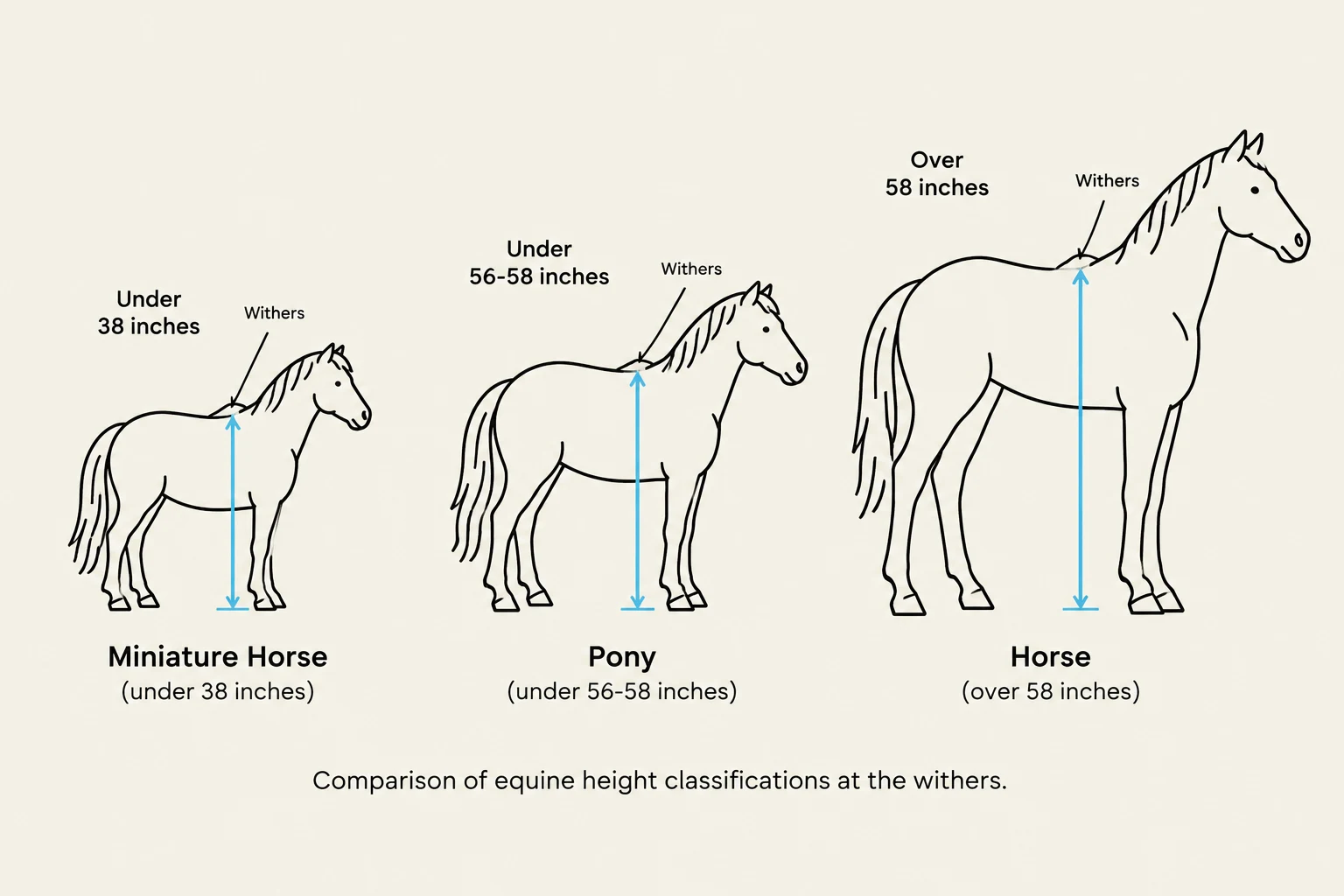
Comparison of equine height classifications at the withers.
To understand the industry, one must first define what constitutes an "equine." While the term is often used interchangeably with "horse," the industry encompasses a broader biological group.
Horses: The primary focus of the industry.
Mules and Donkeys: Important members of the equine family.
Ponies: Generally defined as equines that reach a height of under 56–58 inches at the withers at maturity.
Miniature Horses: A specific classification for equines that reach a height of under 38 inches at the withers at maturity.
Study Tip: Note the distinction between a pony and a miniature horse. The primary differentiator is the height at the withers (the highest point of the horse's back, located at the shoulder) upon reaching maturity.
Economic Impact and Demographics
Although the total number of horses in the United States is significantly lower than other livestock sectors, their economic footprint is massive. For comparison, the U.S. maintains approximately 73 million swine and 31.7 million beef cattle, compared to only 6.7 million horses. Despite these lower population numbers, the equine industry contributes $74 billion to the American Gross Domestic Product (GDP) and supports approximately 2.2 million jobs when indirect and induced impacts are considered.
The Horse Enthusiast
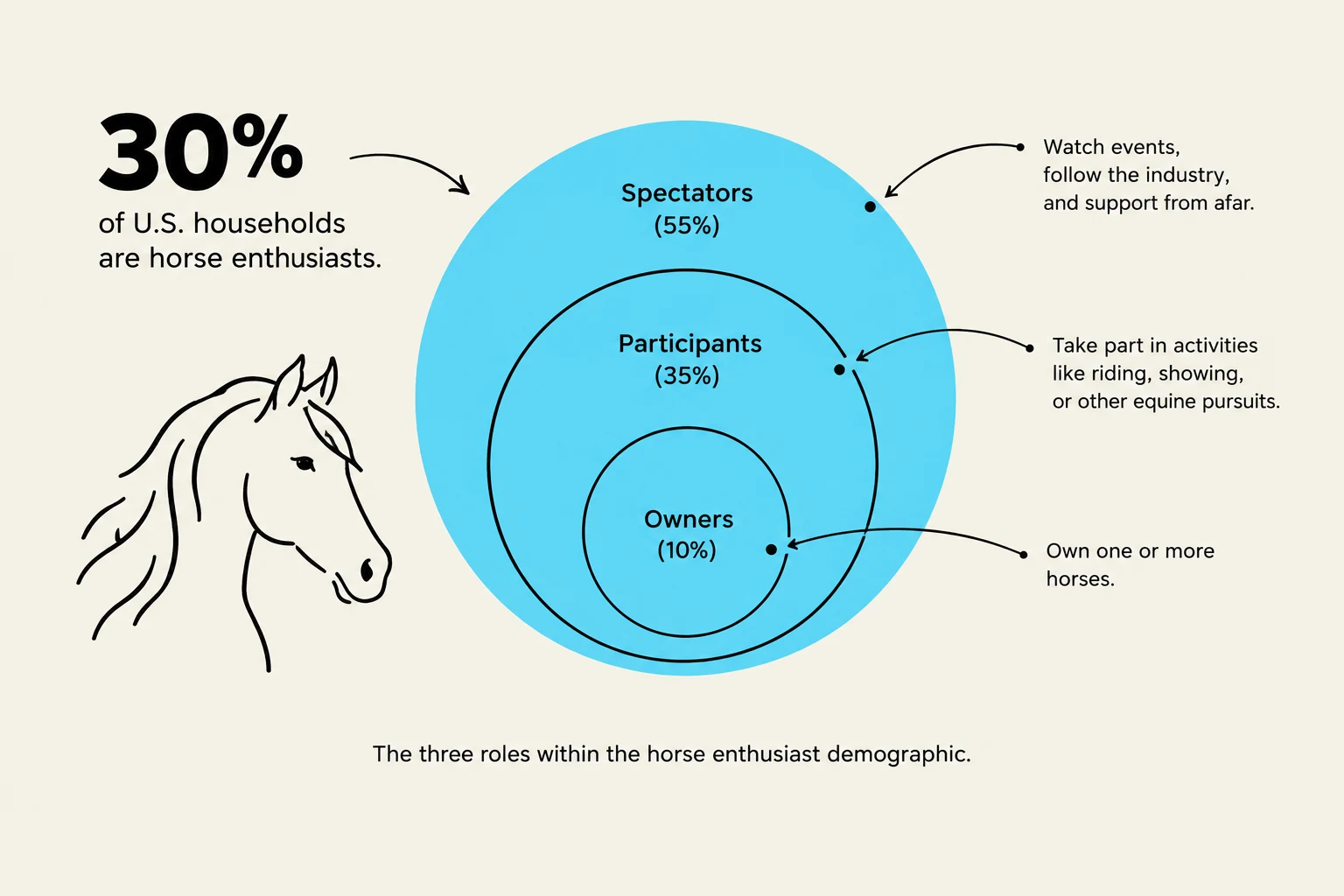
This diagram illustrates the three roles within the horse enthusiast demographic in the U.S., showing that 30% of households are horse enthusiasts. Spectators make up 55%, participants 35%, and owners 10%.
The industry is driven by a highly engaged demographic. Approximately 30% of U.S. households (roughly 39 million) contain horse enthusiasts. This group is not monolithic and is categorized into three distinct roles:
Owners: Those who possess the animals (representing 1.23% of enthusiasts).
Participants: Those actively involved in equine activities (19.40%).
Spectators: Those who watch events like racing or horse shows (9.85%).
The economic activity is also influenced by household income. Data shows a diverse range of income levels among horse-owning households, spanning from under $24,000 to over $125,000.
Geographic Distribution
Horse ownership is not evenly distributed across the United States. Some of the top states by horse numbers include:
Texas: 748,800
California: 477,400
Florida: 334,900
Ohio: 249,200
Oklahoma: 249,100
Kentucky: 224,600
Industry Structure: Direct and Indirect Enterprises
The equine industry is organized into two main types of business structures: direct enterprises that interact with the animals and owners, and indirect enterprises that provide the necessary support systems.
Direct Equine Enterprises
Direct enterprises are businesses that provide services or products directly related to the management and use of the horse. These can be further divided by their orientation:
Service-Oriented Enterprises:
These businesses often provide a service where the operator may not even own the horses they work with.
Boarding Stables: Providing housing and care for horses.
Pay-to-Ride Facilities: Offering recreational riding for a fee.
Lesson Providers: Teaching riding skills.
Trainers: Specializing in horse or rider development.
Racing and Show Operations: Managing competitive events.
Product-Oriented Enterprises:
Breeding Farms: These focus on producing a "product" (the animal itself). It is important to note that breeding farms represent a distinct economic category and often face the lowest opportunity for success due to high risks.
Indirect Equine Enterprises
Indirect enterprises support the direct industry by providing the specialized goods and services required to keep the equine economy moving. Examples include:
Veterinary Care and Pharmaceuticals: Medical services and drugs.
Tack Shops: Selling saddles, bridles, and other equipment.
Feed Companies: Providing hay, grain, and supplements.
Equipment Dealerships: Selling trailers, trucks, and specialized tools.
Media and Venues: Magazines, websites, and large-scale event venues.
Michigan Industry Profile
Michigan serves as an excellent case study for how the equine industry functions at a state level. The state maintains a robust equine presence with approximately 188,000 equines residing on 35,000 different operations.
Economic Impact in Michigan
The economic impact in Michigan is substantial, totaling approximately $1.069 billion annually. This impact is supported by significant equine-related assets, including:
Equine-specific assets: $280 million
Land: $2.6 billion
Facilities and Fencing: $743 million
Management and Activity
The Michigan equine population is characterized by small-scale operations. Approximately 65% of equines are managed on small farms with nine head or fewer. In terms of housing, the state sees a mix of stalled (15,000), pasture (60,000), and partial stall (80,000) arrangements.
Furthermore, the industry in Michigan is heavily driven by non-competitive activities. About 60% of Michigan equines are involved in activities such as trail riding. This has a "ripple effect" on the local economy; for example, owners hauling horses to state parks or forests purchase gas, meals, and lodging, further stimulating economic activity outside of the direct equine sector.
Keep reading for free.
Create an account to finish this reading and make it part of your study routine.