


At its core, economics is not just about money, stocks, or banking; it is the study of how society manages its limited resources to satisfy unlimited wants. Every day, individuals, businesses, and nations face a fundamental tension: we want more than we can possibly have. This tension creates a framework for decision-making that defines how civilizations function, how industries grow, and how resources are distributed across the globe.
The Foundation: Scarcity
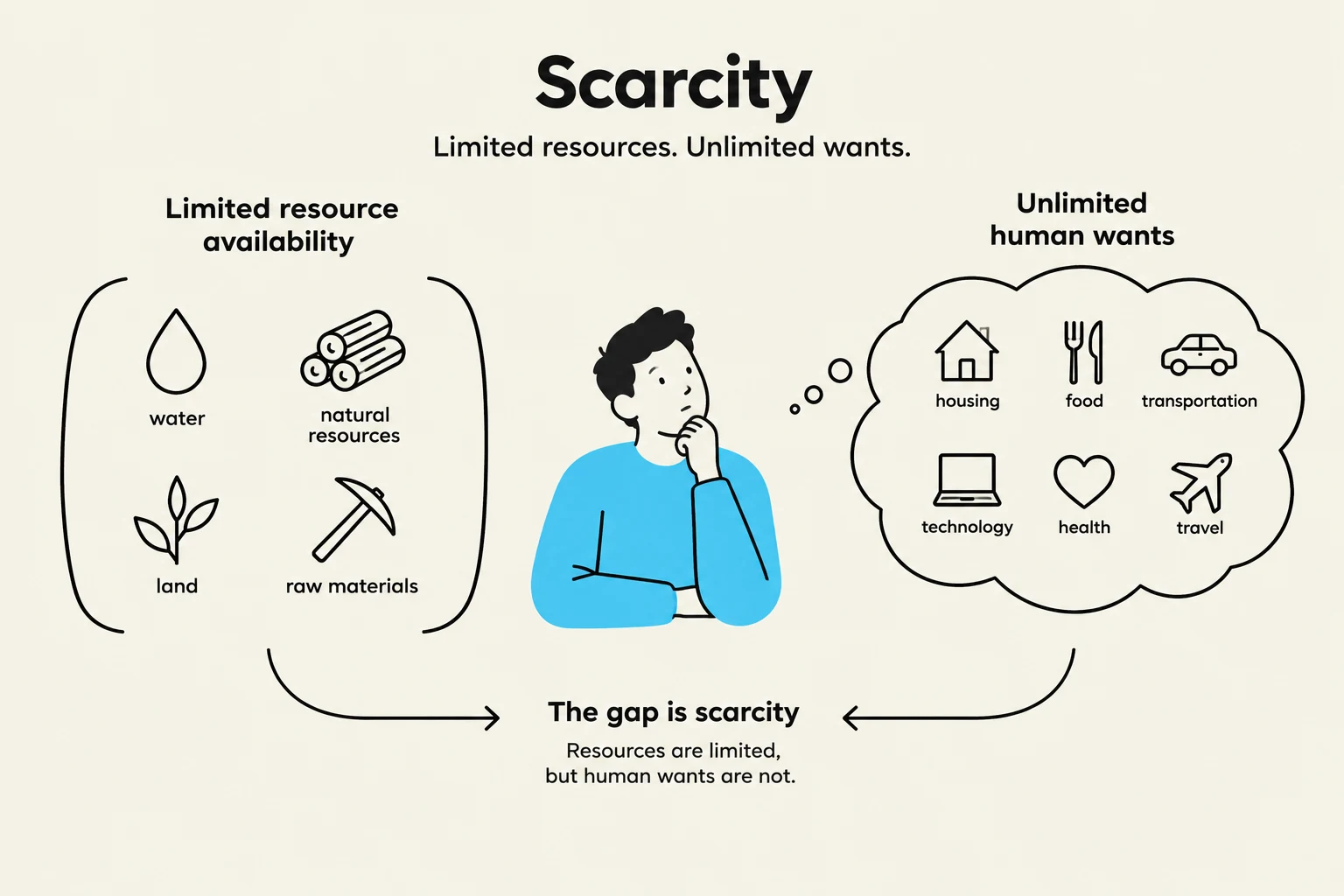
The starting point for all economic inquiry is the concept of scarcity. Scarcity refers to the fundamental problem that our resources—such as time, labor, land, and raw materials—are limited, while human desires and needs are virtually infinite. Because we cannot produce everything that everyone wants, we are forced to make choices.
Scarcity implies that every choice has a cost. If a nation decides to use its steel to build more hospitals, it cannot use that same steel to build more tanks. This relationship is often expressed through the concept of trade-offs: to get more of one thing, we must accept less of another.
Exam Tip: When you see the term "scarcity," do not confuse it with "poverty." Scarcity affects everyone, including the wealthiest individuals and nations, because even they have a finite amount of time and resources.
The Fundamental Question: What to Produce?
Because of scarcity, every society must answer the "What" question: What mix and quantity of goods and services should be produced?. This is not a simple mathematical calculation; it is a value judgment that reflects a society's priorities.

Keep reading for free.
Create an account to finish this reading and make it part of your study routine.
Continue reading freeAlready have an account? Log in
Updated