The Resource Theory: The Bank Account Analogy
One of the most important characteristics of attention is that it has a limited capacity. To understand this, think of your attention as a bank account. Every mental task you perform requires "spending" a portion of these limited resources.
There are two primary ways researchers view these resources:
- The Single Resource View: Proposed by Kahneman (1973), this suggests we have one flexible pool of cognitive energy. If a task is difficult, it drains the pool, leaving less for anything else.
- The Multiple Resource View: Proposed by Wickens, this suggests we have several separate "pools" or "banks" of attention—for example, a visual pool and an auditory pool. This explains why you can walk and talk simultaneously; the tasks draw from different sources.
Exam Tip: If a question asks why a person can listen to music while running but struggles to do mental math while running, consider the Multiple Resource View. The running is a motor/visual task, while the math is a verbal/cognitive task. If they used the same "pool," performance would drop significantly.
Task Complexity and the Path to Automaticity
The amount of attentional "currency" you spend depends heavily on task complexity. Simple, familiar tasks require very few resources, whereas complex or unfamiliar tasks demand a massive allocation.
This relationship is best illustrated by the difference between a novice and an expert in sports:
- The Novice: A beginner swimmer must consciously focus on every single mechanic—how to breathe, how to move their arms, how to kick. Because these movements are not yet "automatic," they consume almost all available attentional capacity, leaving no room for secondary tasks like pacing or spatial awareness.
- The Expert: Through extensive practice, these movements become automatic. An experienced swimmer can perform the stroke and breathing with minimal conscious effort, freeing up their "bank account" to focus on higher-level requirements, such as competition strategy or knowing exactly when to turn at the end of the pool.
Selective Attention and the Bottleneck
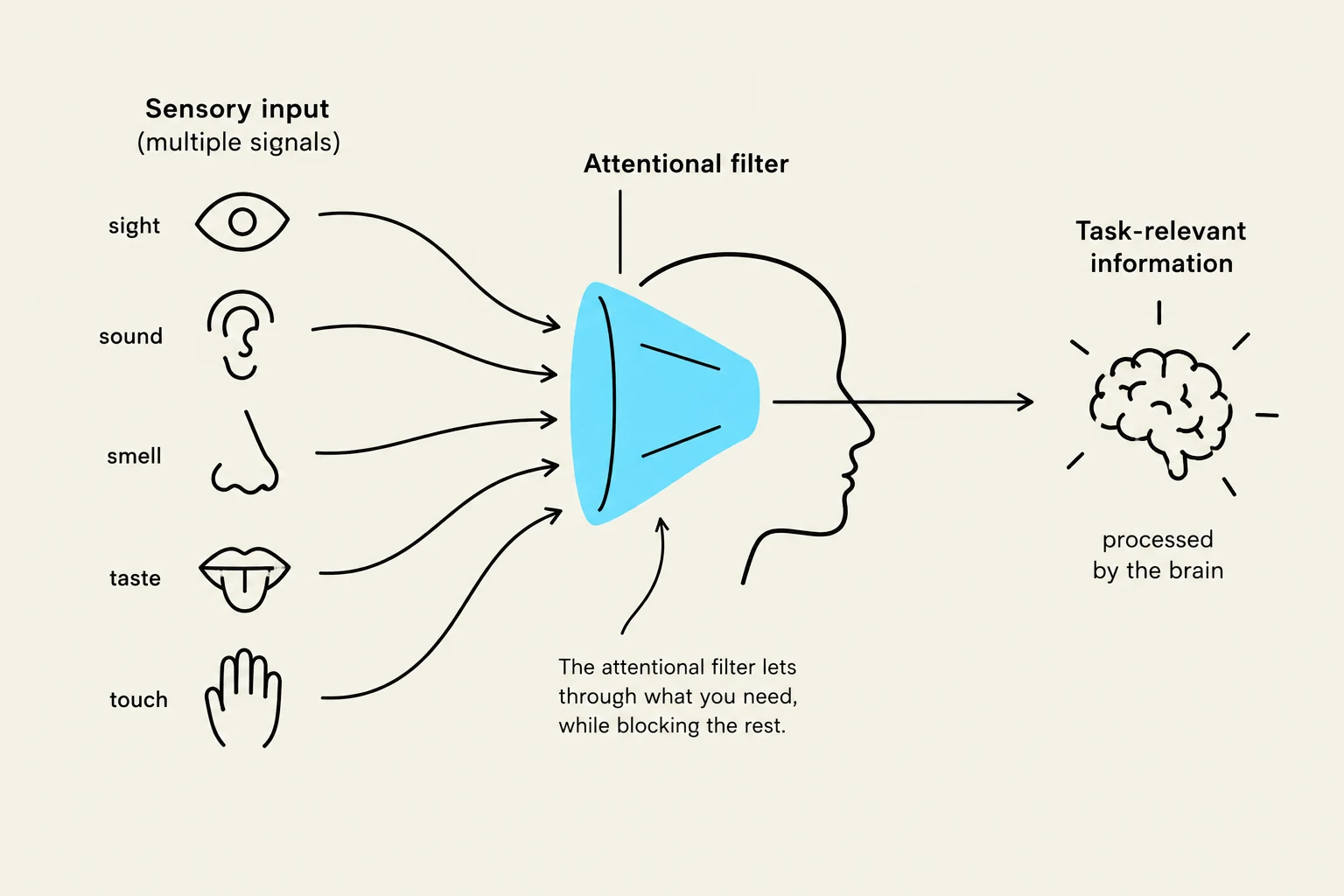
Attention is not just about how much we have, but how we choose to use it. Selective attention is our ability to prioritize task-relevant information while suppressing distractors. This can happen in two ways:
- Top-Down (Controlled): A deliberate, goal-directed focus, such as a football player scanning the field for a teammate.
- Bottom-Up (Automatic): An involuntary pull toward a sudden, salient event, such as a referee's whistle blowing.
However, even with selection, we encounter a "bottleneck" during the response selection stage of information processing. This is known as the Psychological Refractory Period (PRP). When two different responses are required in rapid succession, they compete for the same "channel," causing a delay in the second response.
A classic example of this interference is the Stroop Effect. If you are asked to name the ink color of a word, but the word itself spells out a different color (e.g., the word "RED" written in blue ink), your brain experiences a delay. This happens because reading is an automatic, involuntary process that competes with the task-relevant goal of naming the color.
Sustained Attention and Inattentional Blindness
Finally, attention must often be maintained over long periods, a concept known as sustained attention or vigilance. Tasks like lifeguarding require a person to maintain a high level of accuracy over time to detect a single, critical event. Unfortunately, vigilance often declines over time due to fatigue, low motivation, or environmental factors like heat and noise.
When our attentional resources are completely occupied by a primary task, we may experience inattentional blindness. This is the failure to notice a fully visible but unexpected event because our "gatekeeper" was too busy filtering for something else. A famous demonstration of this involves a video where viewers are asked to count basketball passes; because they are so focused on the counting, many completely fail to see a person in a gorilla suit walk through the middle of the scene.
Summary Table: Key Concepts
| Concept | Definition | Key Characteristic |
|---|
| Selective Attention | Filtering specific inputs | Can be Top-Down (deliberate) or Bottom-Up (involuntary) |
| Divided Attention | Performing multiple tasks | Successful when tasks are simple or use different senses |
| Sustained Attention | Maintaining focus over time | Subject to "vigilance decrement" (decline over time) |
| Automaticity | Highly practiced, low-effort skill | Frees up attentional capacity for other tasks |