An overview of the British Romantic period, exploring its unique demarcation by political events, the revival of the romance form, the impact of the Industrial Revolution, evolving national identities, and transformations in prose and the novel.
The British Romantic period is a complex and diverse era that stands apart from other epochs in literary history. While many historical periods are defined by the reigns of monarchs (such as the Elizabethan or Victorian ages) or the passing of centuries, the Romantic era is uniquely demarcated by significant political events. It is a period of profound transition, capturing a world moving from an agricultural past toward an industrial future, and from a landscape of traditional hierarchies toward one of revolutionary ideals and global interconnectedness.
Periodization: A Timeline of Revolution
Unlike other eras, the start and end dates of Romanticism are often tied to political upheavals rather than royal successions. Scholars debate the exact beginning, with some pointing to the American Declaration of Independence (1776), others to the British defeat in the American War of Independence (1783), and many to the French Revolution (1789). The latter event, in particular, ushered in decades of political unrest in Britain and set the stage for global conflict.
The period typically concludes around 1832, a date significant for the first major reform of the British Parliament. This shift from revolutionary fervor to institutional reform marks the transition into the Victorian era.
Exam Tip: When discussing periodization, avoid treating the Romantic era as a static block of time. Instead, frame it as a response to specific "watershed" political events like the French and American Revolutions.
The Romance and the Power of Imagination
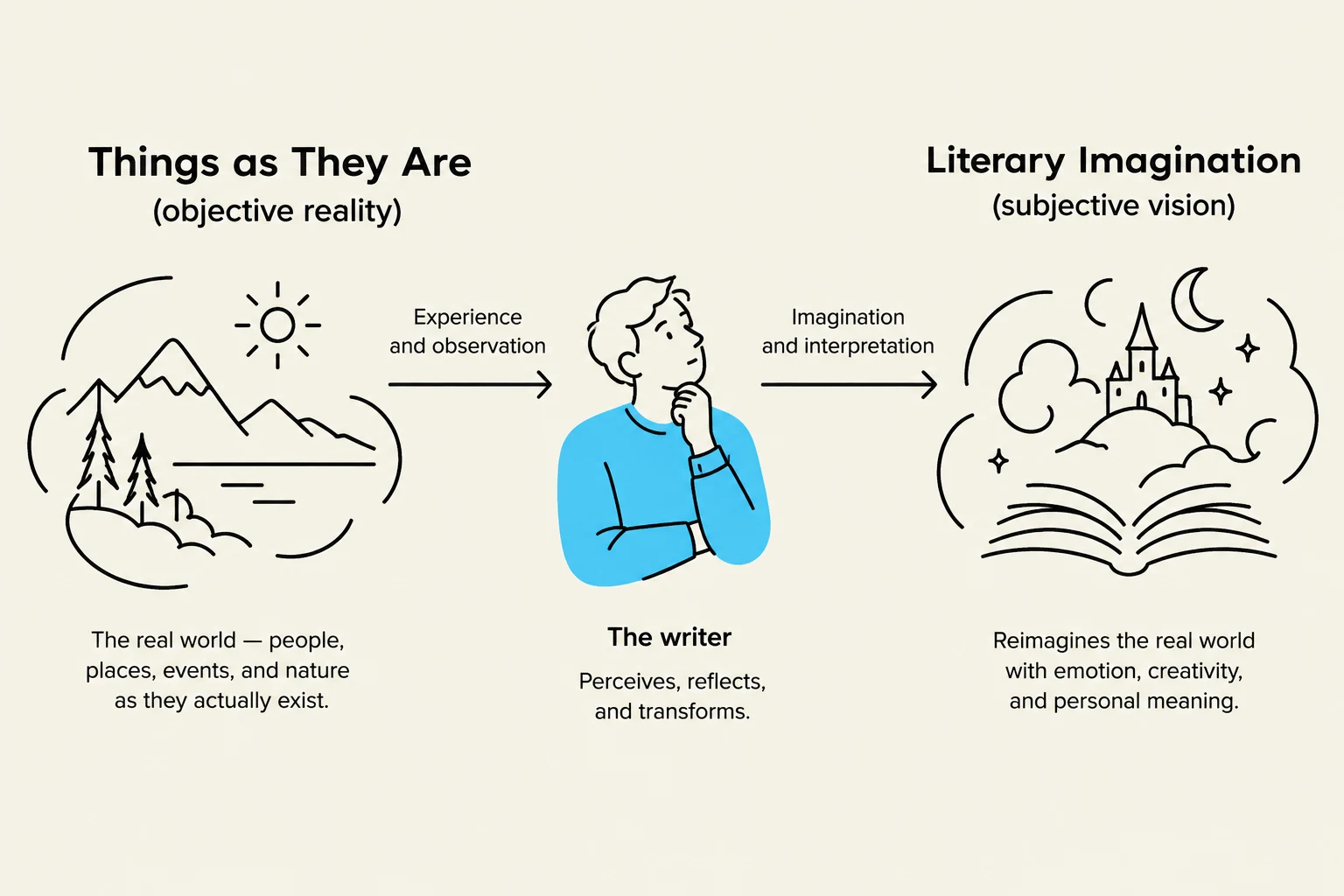
The era is uniquely named after a literary form: the romance. During the late eighteenth century, scholars rediscovered medieval tales of adventure, chivalry, and love that had previously been dismissed as irrational. Romantic writers repurposed these elements—such as idealization, visionary imagination, and boundary crossing—to explore the tension between "Things as They Are" and the alternative worlds summoned by the mind.
This era saw a shift in how the "literary imagination" was understood. Rather than just being a tool for escapism, the imagination was seen as a way to guide historical change. As William Blake famously declared in 1790, "What is now proved was once, only imagin'd".
This diagram illustrates the process of literary imagination, showing how a writer perceives objective reality through experience and observation, and then transforms it into a subjective vision through imagination and interpretation, adding emotion, creativity, and personal meaning.
Mobility, Industry, and Dislocation
The Romantic period was characterized by a dizzying sense of motion. This was driven by several interconnected forces:
The Industrial Revolution: The invention of steam power and industrial machinery transformed Britain from an agricultural society into a modern industrial nation. This created immense wealth for some but led to the "Two Nations" of capital and labor—the rich and the poor.
Urbanization and Enclosure: The movement of people from the countryside to sprawling mill towns like Manchester was accelerated by the "enclosure" of common lands, which stripped many of their means of subsistence.
Global Movement: The era saw massive human movement, including voluntary emigration to colonies and the horrific, involuntary displacement of millions of enslaved people from Africa to the Americas.
Writers often used the "wayfaring" character—the outcast, the exile, or the refugee—to reflect these unsettled conditions of modern life.
National Identity and the Expanding Canon
While "Englishness" was a central concept, the period was also a site of intense contestation regarding national identity. The rise of distinct Scottish, Irish, and Welsh literary identities challenged a monolithic English identity. For example, the works of Robert Burns (Scottish) and Maria Edgeworth (Irish) were highly influential and helped define their respective national characters.
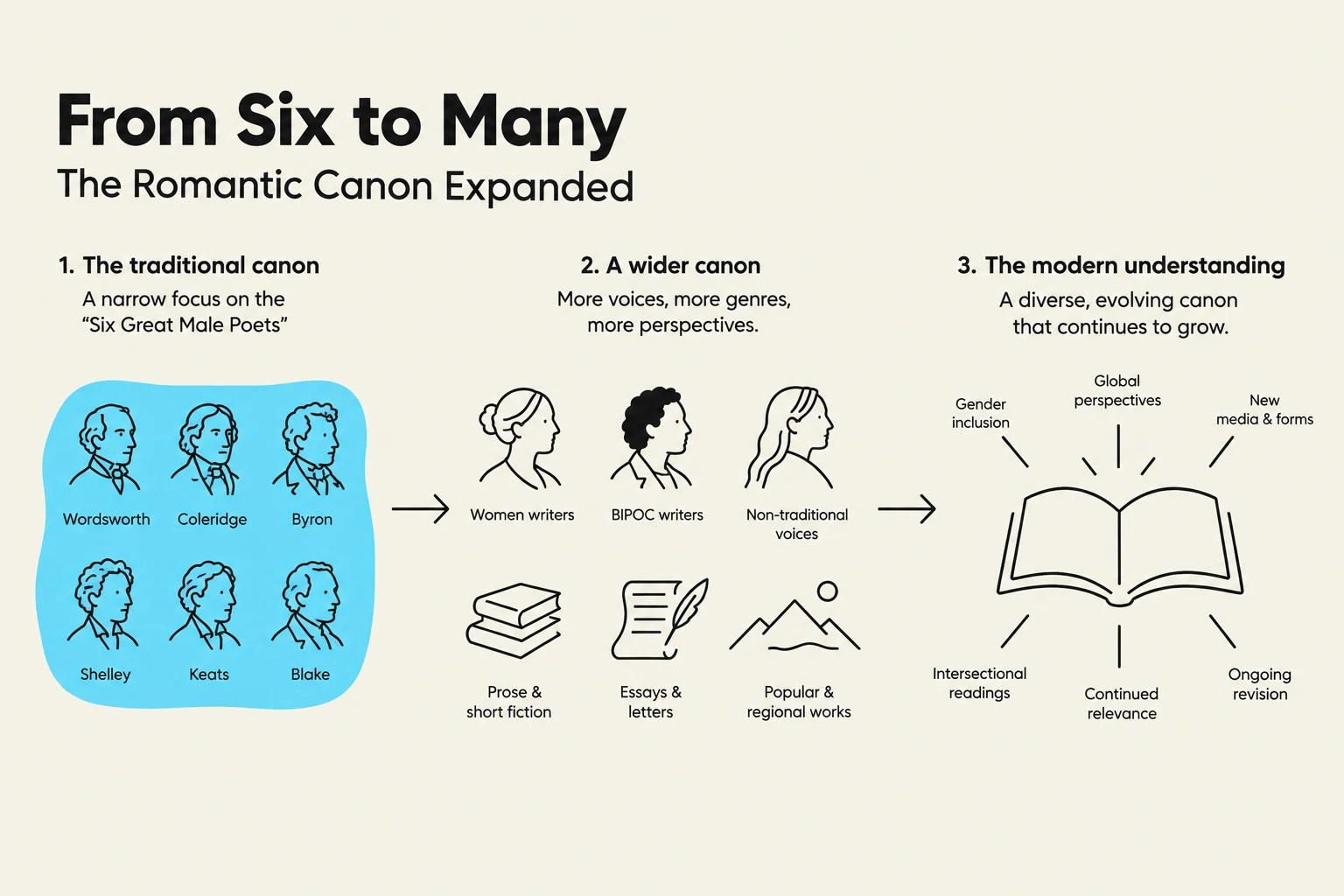
Modern scholarship has also significantly expanded the Romantic canon. While older studies focused almost exclusively on the "six great male poets" (Blake, Wordsworth, Coleridge, Byron, Shelley, and Keats), contemporary views include:
Women Writers: Figures such as Mary Shelley, Jane Austen, Ann Radcliffe, and Mary Wollstonecraft played crucial roles in shaping the era's intellectual and literary landscape.
Diverse Genres: The era was not just about lyric poetry; it included Gothic novels, political pamphlets, travelogues, and essays.
This diagram illustrates the expansion of the Romantic canon from a narrow focus on six male poets to a more diverse and inclusive understanding that incorporates a wider range of voices, genres, and perspectives.
Revolution and Reaction
The literature of the period was deeply reactive to the political climate. The early years were marked by the radical energy of the French Revolution, which inspired thinkers like Mary Wollstonecraft and Thomas Paine to advocate for liberty and equality.
However, as the French Revolution descended into the "Reign of Terror" and the rise of Napoleon, many English liberals retreated into a more conservative or reactionary stance. This tension between revolution (the desire for radical change) and reaction (the desire to preserve social order and traditional liberties) is a fundamental thread running through Romantic prose and poetry.
The Evolution of Prose and the Novel
While poetry is often the "face" of Romanticism, prose underwent a massive transformation. The familiar essay emerged, allowing writers like Hazlitt and Lamb to explore intimate, subjective responses to the world.
Simultaneously, the novel rose to prominence, challenging poetry's monopoly on literary prestige. This happened through two main avenues:
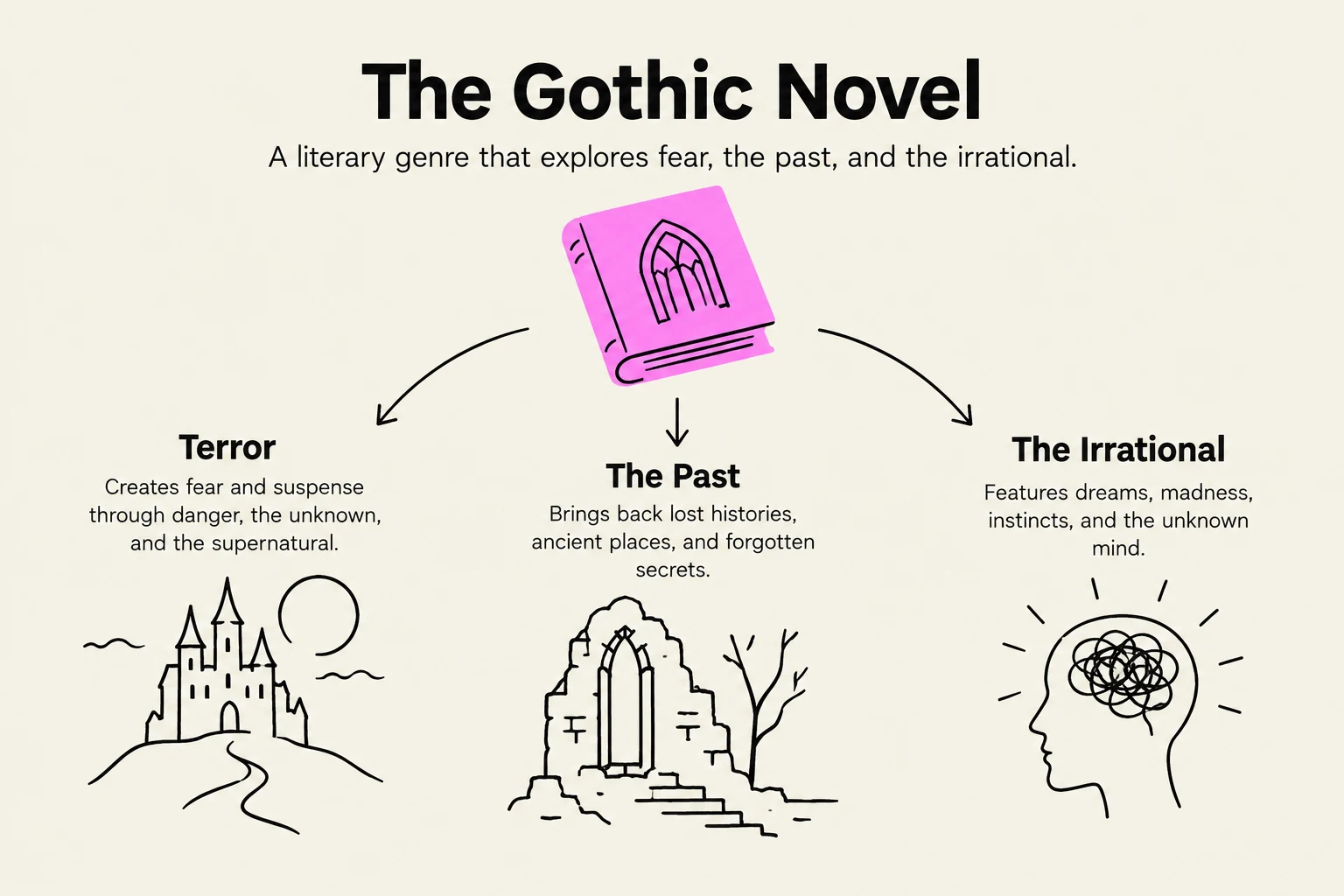
The Gothic Novel: Writers like Ann Radcliffe used "Gothic" settings (castles, ghosts, and terror) to explore the powers of the imagination and the nature of power.
The Historical and Social Novel: Authors like Sir Walter Scott and Jane Austen developed ways to link individual psychology with larger social and historical structures.
The Gothic Novel is a literary genre that explores themes of terror, the past, and the irrational, often featuring elements like danger, the supernatural, lost histories, ancient places, forgotten secrets, dreams, madness, and instincts.
Summary Concept: To understand a Romantic text, always ask: Is this writer responding to the rapid change of their time (industrialization/revolution), or are they using imagination to escape or critique that reality?
Keep reading for free.
Create an account to finish this reading and make it part of your study routine.