Introduction to Subatomic Particles and Atomic Structure
An overview of the fundamental subatomic particles: protons, neutrons, and electrons. Learn about their charges, locations within the atom (nucleus and electron cloud), and their roles in determining an element's identity and chemical behavior. Covers atomic number, ions, and electrical neutrality.
Everything you see around you—the screen you are reading this on, the air you breathe, and the cells in your body—is composed of matter. But if we were to zoom in past the microscopic level, past the cells and the molecules, we would encounter the fundamental building blocks of the universe: atoms. While we often think of atoms as solid spheres, they are actually complex systems composed of even smaller entities known as subatomic particles.
Understanding these particles is the first step in mastering chemistry and physics, as their arrangement and behavior dictate how elements interact and how matter behaves.
The Anatomy of the Atom
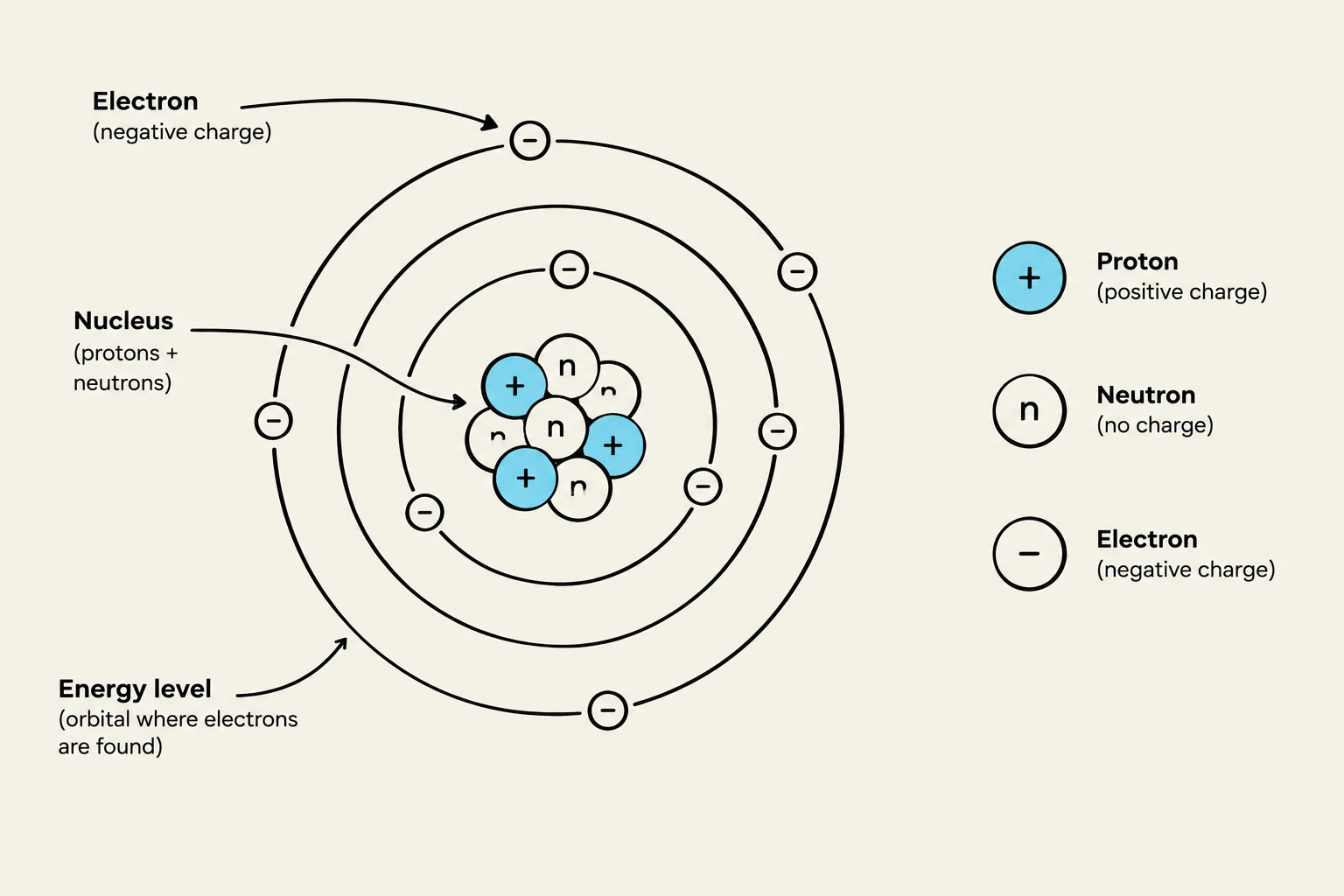
An atom is not a single, indivisible unit. Instead, it is composed of three primary subatomic particles: protons, neutrons, and electrons. These particles are organized into two distinct regions: a dense, central nucleus and a vast, surrounding cloud of electron activity.
The nucleus sits at the very center of the atom and contains nearly all of the atom's mass. Within this nucleus, protons and neutrons are tightly packed together. Surrounding this nucleus is the electron cloud, a region of space where electrons move at incredibly high speeds. Although the electrons are much smaller than the particles in the nucleus, their movement and arrangement are what allow atoms to bond and form chemical reactions.
Diagram illustrating the structure of an atom, showing the nucleus containing protons and neutrons, and electrons orbiting in energy levels.
The Nucleus: Protons and Neutrons
The nucleus is the "engine room" of the atom, providing its mass and its identity. It is composed of two types of particles: protons and neutrons.
Protons: The Identity Markers
Protons are subatomic particles that carry a positive electrical charge (+1). The most critical characteristic of a proton is that it defines the element itself. The number of protons in the nucleus is known as the atomic number. For example, any atom with exactly 6 protons is carbon; if you add a proton, it becomes nitrogen.
Neutrons: The Stabilizers
Neutrons are particles found alongside protons in the nucleus, but they carry no electrical charge; they are considered neutral. While they do not change the identity of the element, they contribute significantly to the atom's mass. Neutrons act as a sort of "nuclear glue," helping to stabilize the nucleus by buffering the repulsive forces between the positively charged protons.
Exam Tip: If a question asks you to identify an element, always look for the number of protons (the atomic number). The number of neutrons can change (creating isotopes), but the number of protons is the element's unique fingerprint.
Particle
Charge
Relative Mass
Location
Proton
+1
≈1 amu
Nucleus
Neutron
0
≈1 amu
Nucleus
Electron
−1
≈1/1840 amu
Electron Cloud
The Electron Cloud: Electrons
While the nucleus holds the mass, the electrons hold the "personality" of the atom. Electrons are much smaller than protons and neutrons, possessing a negative electrical charge (−1).
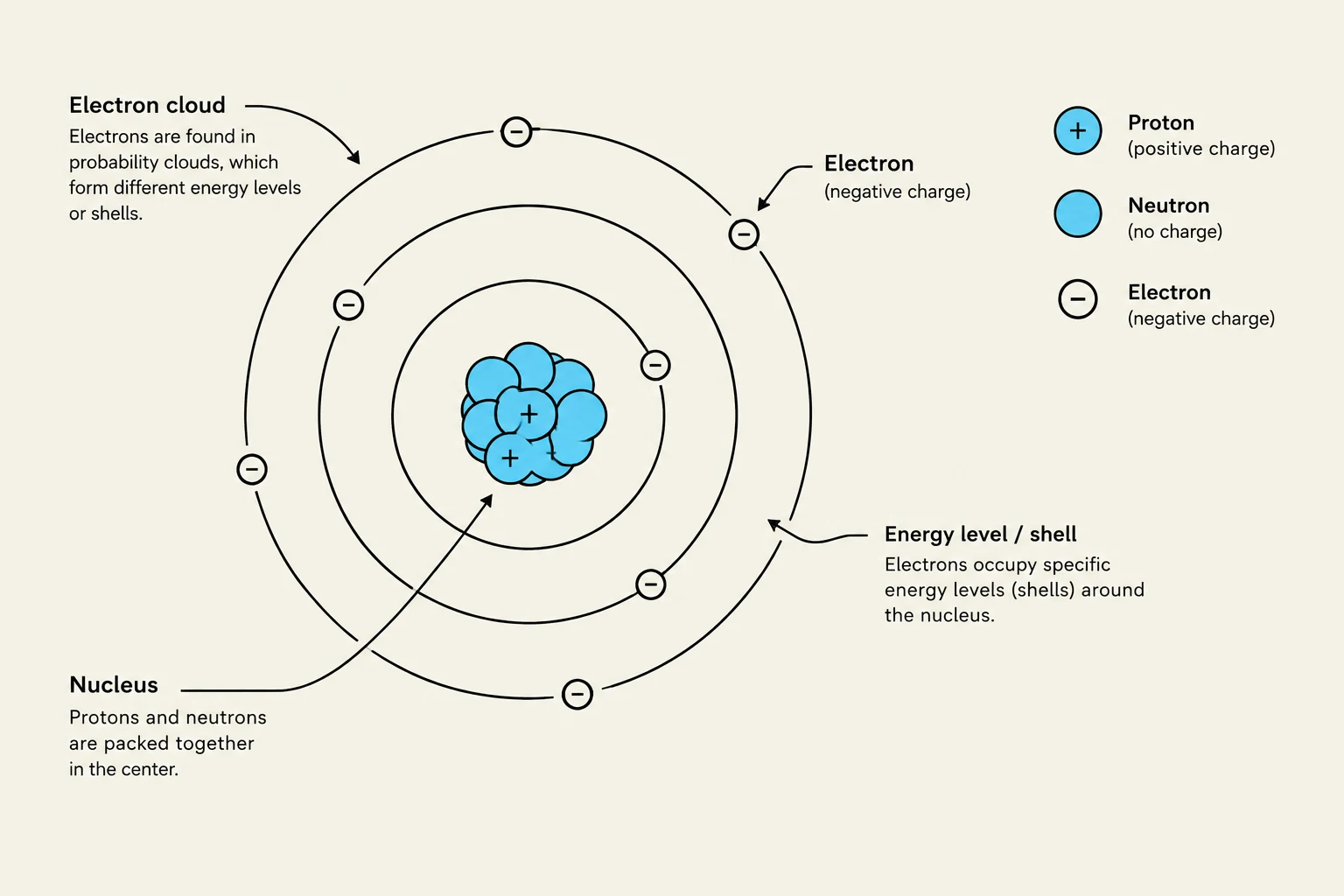
Unlike the protons and neutrons that are clustered in the center, electrons occupy the space surrounding the nucleus. In modern chemistry, we don't view electrons as tiny planets orbiting a sun in perfect circles. Instead, we describe them as existing in "orbitals" or "shells"—regions of probability where an electron is likely to be found.
The arrangement of these electrons is what determines how an atom will react with others. When atoms collide, it is the electron clouds that interact, allowing for the sharing or transferring of electrons to form chemical bonds.
This diagram illustrates the basic structure of an atom, showing a nucleus containing protons and neutrons, surrounded by electrons orbiting in energy levels or shells.
Electrical Neutrality and Ions
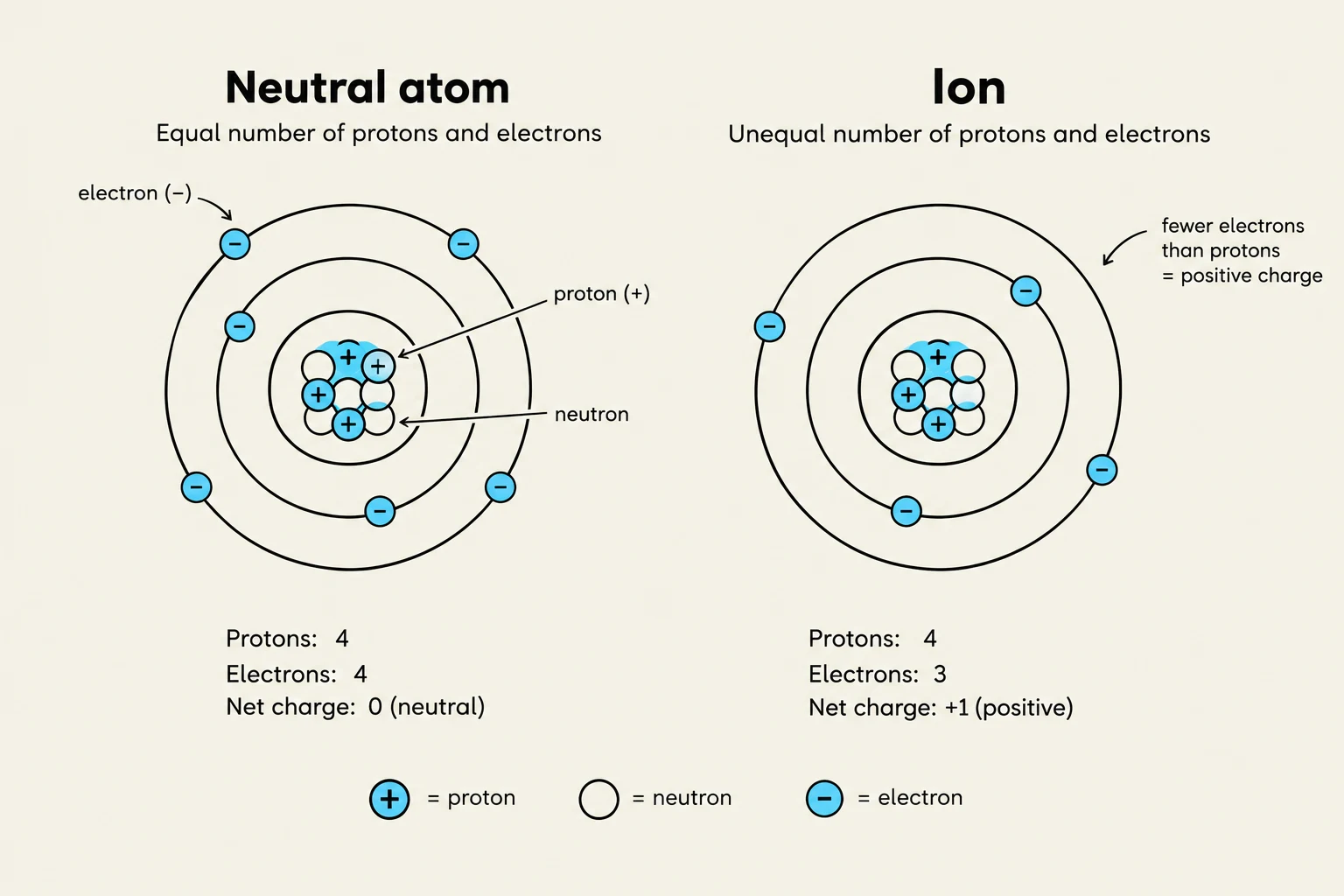
In a standard, stable atom, the number of protons is exactly equal to the number of electrons. Because the positive charges of the protons are perfectly balanced by the negative charges of the electrons, the atom has a net charge of zero.
We can express the net charge (Q) of an atom using a simple relationship:
Q=(number of protons)−(number of electrons)
If an atom gains or loses electrons during a chemical reaction, it becomes an ion.
If an atom loses an electron, it has more protons than electrons, resulting in a positive charge (a cation).
If an atom gains an electron, it has more electrons than protons, resulting in a negative charge (an anion).
Worked Example: Calculating Charge
Let's look at a Magnesium atom (Mg).
Magnesium has an atomic number of 12, meaning it has 12 protons.
In a neutral state, it also has 12 electrons.
If Magnesium undergoes a reaction and loses 2 electrons, we calculate the new charge:
ProtonsElectronsNet Charge=12=12−2=10=12−10=+2
The resulting particle is a Mg2+ ion.
Diagrams illustrating the difference between a neutral atom and an ion, showing the arrangement of protons, neutrons, and electrons.
Summary Table of Properties
To wrap up our study, let's consolidate what we have learned about these three fundamental particles:
Protons: Positive charge, located in the nucleus, determines the element's identity.
Neutrons: Neutral charge, located in the nucleus, contributes to mass and stability.
Electrons: Negative charge, located in the electron cloud, determines chemical reactivity.
By understanding these tiny components, we gain the ability to predict how much mass an atom has, what element it is, and how it will behave when it meets another atom in a chemical reaction.
Keep reading for free.
Create an account to finish this reading and make it part of your study routine.