Sociology is an academic and scientific discipline that focuses on our social world through three levels of analysis: macro, meso, and micro. It examines social structures, interactions, and patterns, distinguishing itself from psychology by emphasizing external societal influences over individual internal processes.
When we look at the world, we often see a collection of individuals making independent choices. However, to truly understand why society functions the way it does, we must look beyond the individual and toward the structures that surround them. This is the essence of sociology. As an academic discipline, sociology offers a unique perspective on reality by focusing specifically on the social world. While other fields, such as psychology, might focus on individual personality traits or internal mental processes, sociology examines humans as social animals shaped by their environment.
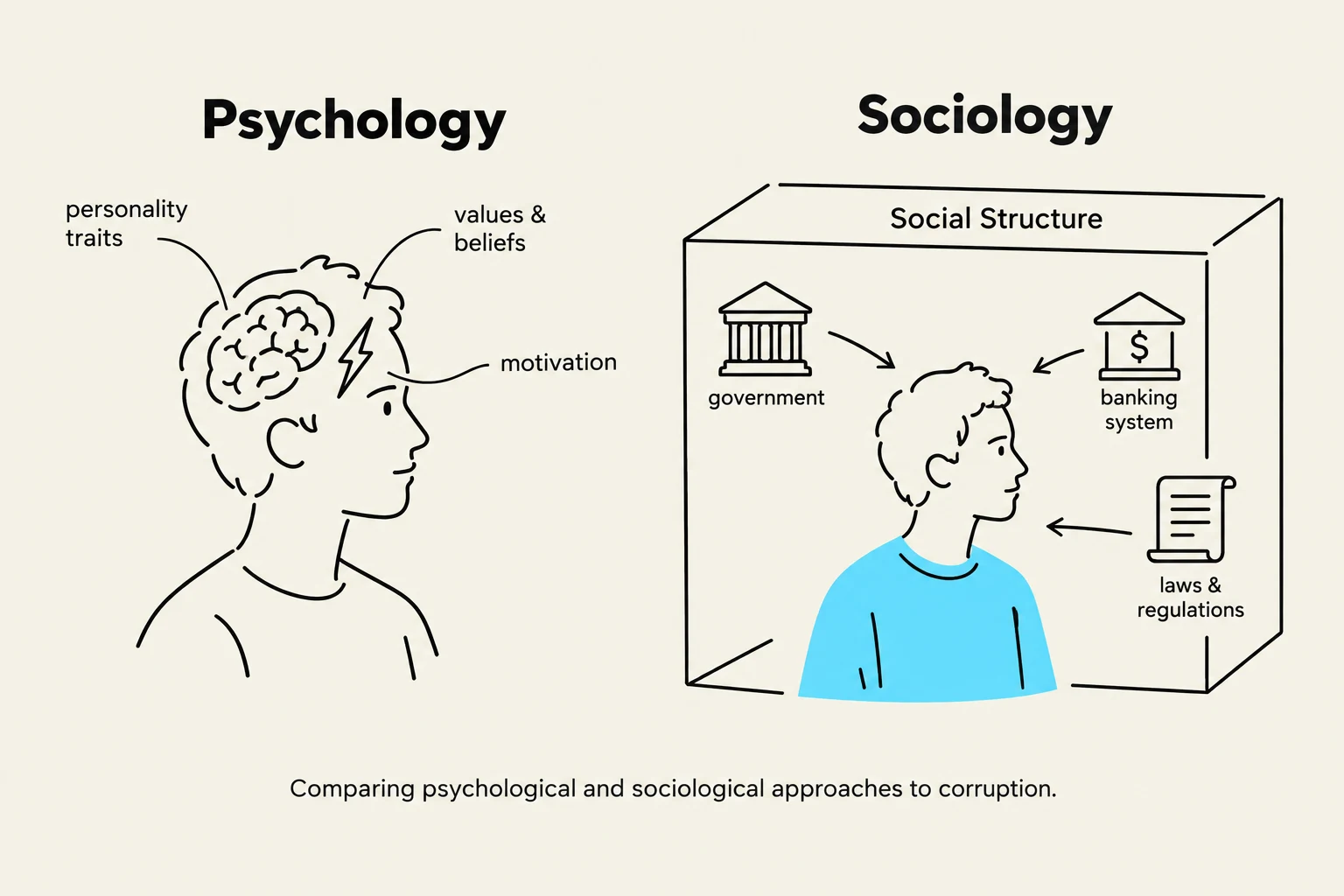
This illustration compares psychological and sociological perspectives on corruption, highlighting internal factors like personality and motivation in psychology, and external societal structures such as government, banking systems, and laws in sociology.
The Sociological Perspective: Beyond the Individual
To think like a sociologist, one must shift their focus from the "internal" to the "external." Sociology begins with the premise that humans are best understood within the context of their social lives. We are not isolated actors; rather, we are influenced by socialization (the process of learning how to live in a society), constant social interaction, and recurring social patterns.
To illustrate this difference, consider the phenomenon of "white-collar crime" (corruption). A psychologist might investigate the specific personality traits of a corrupt individual, such as narcissism or a lack of self-control. A sociologist, however, would look at the broader social context. For example, they might use the "public choice school" of thought to argue that corruption occurs because of a lack of competition in economic or political arenas. In short, sociology asks how the "rules of the game" influence the players.
Study Tip: When approaching a case study, ask yourself: "Am I looking at the person's character (Psychology), or am I looking at the social structures and patterns surrounding them (Sociology)?"
The Three Fundamental Questions
The entire discipline of sociology is unified by three core questions that help scholars organize their inquiries:
The Nature of Human Beings: What are we? Sociology views humans as social, socialized entities that are constantly changing through their interactions with others.
The Nature of Order: What holds society together? Sociologists investigate how social patterns, rules, and structures create stability. They also look at how institutions—such as family, religion, and the media—work to maintain this social order.
Inequality: What are the causes and consequences of inequality? This involves analyzing why certain groups have more power, wealth, or status than others and how these disparities affect society.
Three Levels of Analysis
This diagram illustrates the three levels of sociological analysis: Micro (face-to-face interaction), Meso (organizations and communities), and Macro (large-scale structures like the global economy and legal systems).
Because the social world is incredibly complex, sociologists divide their work into three distinct levels of analysis. This allows them to study everything from a single conversation to the rise and fall of entire civilizations:
Macrosociology
Macrosociologists view sociology as the "science of society". They focus on large-scale social structures, historical transformations, and global processes. If you are studying how capitalism changed the world or how entire legal systems evolve, you are working at the macro level.
Mesosociology
Mesosociology sits in the middle. It concentrates on social organizations, institutions, communities, networks, and specific groups. A mesosociologist might study the culture of a specific corporation, the dynamics of a local neighborhood, or how a religious organization functions.
Microsociology
Microsociologists focus on the "micro world" of face-to-face interaction. They are interested in the small-scale details of daily life: how people use gestures, how they interpret body language, and how meaning is constructed during a single conversation.
Sociology as a Scientific Discipline
This diagram illustrates the scientific process in sociology, outlining key steps such as observation, empirical data collection, pattern identification, generalization and explanation, and peer review.
It is a common misconception that sociology is merely "common sense" or based on personal opinion. In reality, sociology is a scientific discipline. The goal of science is to understand the universe in a careful, disciplined manner that controls for personal bias.
To be considered scientific, sociological claims must meet several criteria:
Empirical Evidence: Sociologists do not rely on personal experience or intuition. Instead, they rely on evidence that is observed and measurable. For example, saying "people are generally polite" is an opinion; providing data from 1,000 observed interactions to show a pattern of politeness is empirical evidence.
Generalization: Science seeks to find patterns that apply to more than just one specific case. Sociologists attempt to generalize about social phenomena, such as the roles people play in society, the behavior of minorities, or the causes of revolutions.
Explanation: Good science does more than just describe what is happening; it seeks to explainwhy it is happening by identifying causal relationships.
Finally, sociology functions as a "community of scholars". This means that knowledge is not built by one person in isolation, but through a continuous process of peer review, criticism, and debate, where researchers check each other's work to build a collective, reliable body of knowledge.
Keep reading for free.
Create an account to finish this reading and make it part of your study routine.