Explore the fundamental concepts of mathematical set theory, including the Universal Set, intersection, union, and complement operations. Learn how Venn diagrams visually represent these abstract ideas and aid in problem-solving.
In mathematics, we often need to group objects together based on shared characteristics. This process of grouping is known as Set Theory. Whether you are categorizing prime numbers, grouping students by their favorite subjects, or analyzing data in computer science, set theory provides the fundamental language used to describe these collections and the relationships between them.
To move from abstract ideas to mathematical certainty, we use specific notations and visual tools. This article explores the core components of set theory, from the concept of the Universal Set to the visual logic provided by Venn diagrams.
The Foundation: The Universal Set
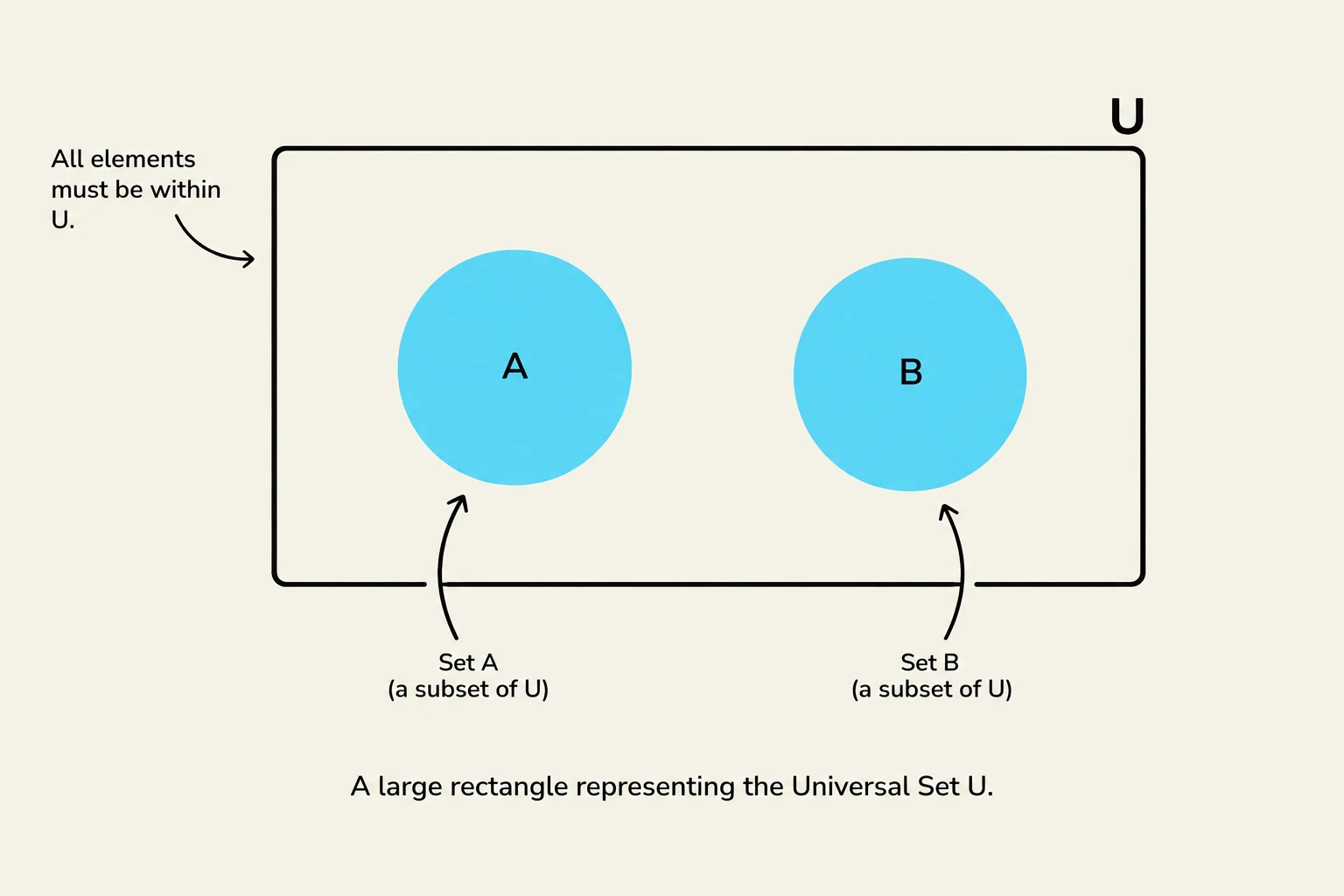
A Venn diagram illustrating two sets, A and B, as subsets within a universal set U.
Before we can discuss what is inside a group, we must define the boundaries of our discussion. In set theory, this boundary is known as the Universal Set, denoted by the symbol U.
The Universal Set encompasses every possible element that could be considered within a specific context. For example, if you are studying the properties of integers, your Universal Set might be the set of all integers. If you are studying human populations in a specific city, the Universal Set is everyone living in that city.
In a Venn diagram, the Universal Set is not represented by a circle, but rather by a large bounding rectangle. Every other set being discussed is contained within this rectangle, ensuring that we know exactly what the "world" of our problem looks like.
Exam Tip: When solving complex set theory problems, always identify your Universal Set first. If you forget the boundaries of U, you will likely struggle to find the correct "complement" of a set.
Core Set Operations and Notation
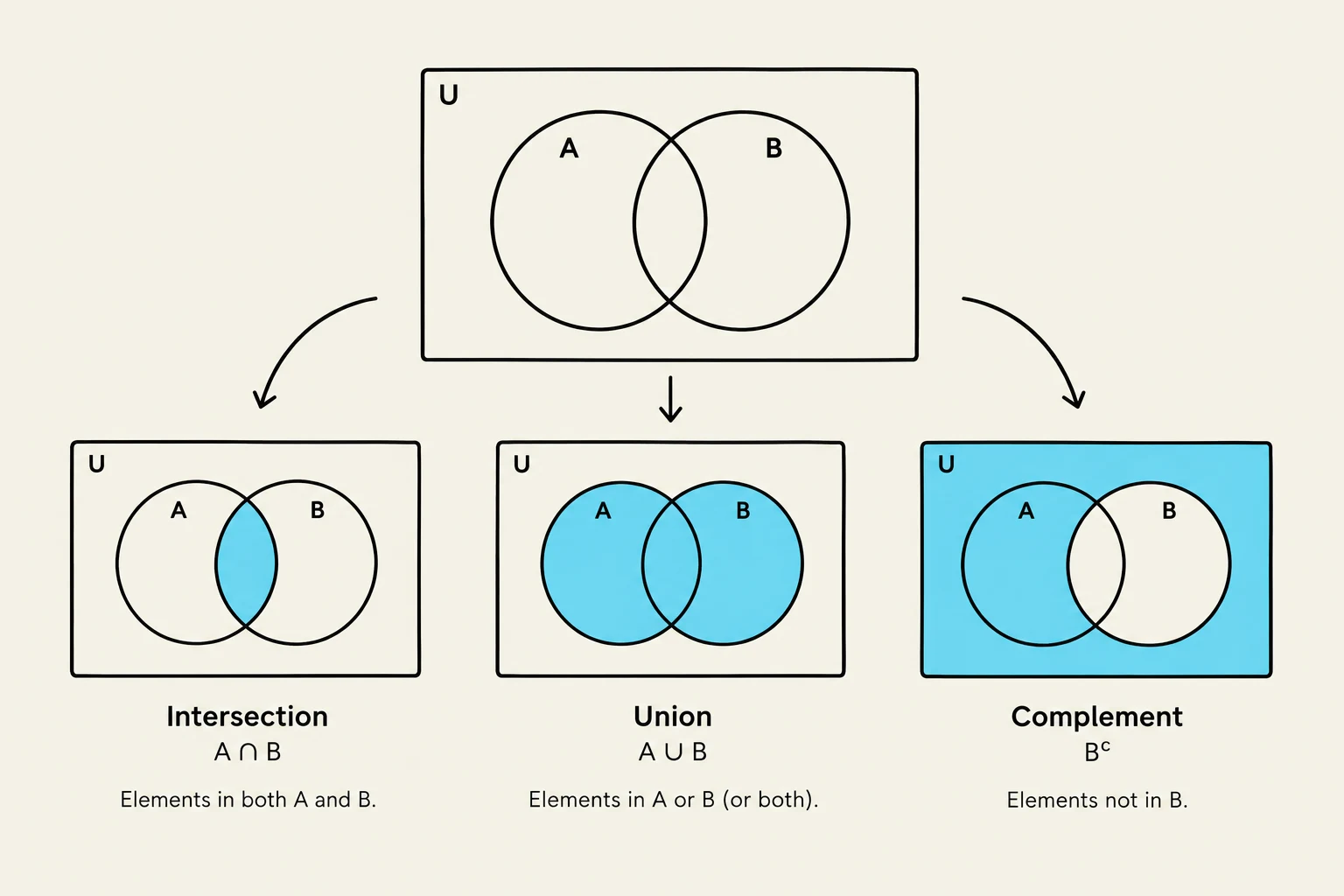
This diagram illustrates set theory concepts: Intersection (elements in both sets A and B), Union (elements in set A or set B or both), and Complement (elements not in set B).
Mathematical set theory relies on a precise shorthand called notation. These symbols allow mathematicians to express complex logical relationships concisely. The three most fundamental operations are intersection, union, and complement.
1. Intersection (∩)
The intersection of two sets, A and B, is the collection of elements that belong to both sets simultaneously.
Notation:A∩B
Logical Meaning: "A AND B"
In a Venn diagram, the intersection is the most intuitive part to find: it is the overlapping area where the circles for set A and set B meet.
2. Union (∪)
The union of two sets, A and B, is the collection of all elements that are in A, or in B, or in both. It essentially merges the two groups into one larger group.
Notation:A∪B
Logical Meaning: "A OR B"
3. Complement ($'$)
The complement of a set B (often written as $B'$) consists of all the elements in the Universal Set (U) that are not in set B.
Notation: $B'$
Logical Meaning: "NOT B"
Visualizing Logic with Venn Diagrams
While notation is excellent for calculation, Venn diagrams are essential for visualization. A Venn diagram translates abstract algebraic symbols into spatial regions. By using overlapping circles within a rectangular boundary (the Universal Set), we can see exactly which elements are shared, which are excluded, and which belong to specific combinations of sets.
Figure 1: A digital whiteboard displaying set theory notation and a Venn diagram illustrating the relationship between sets A and B within a Universal Set U.
Worked Example: Complex Operations
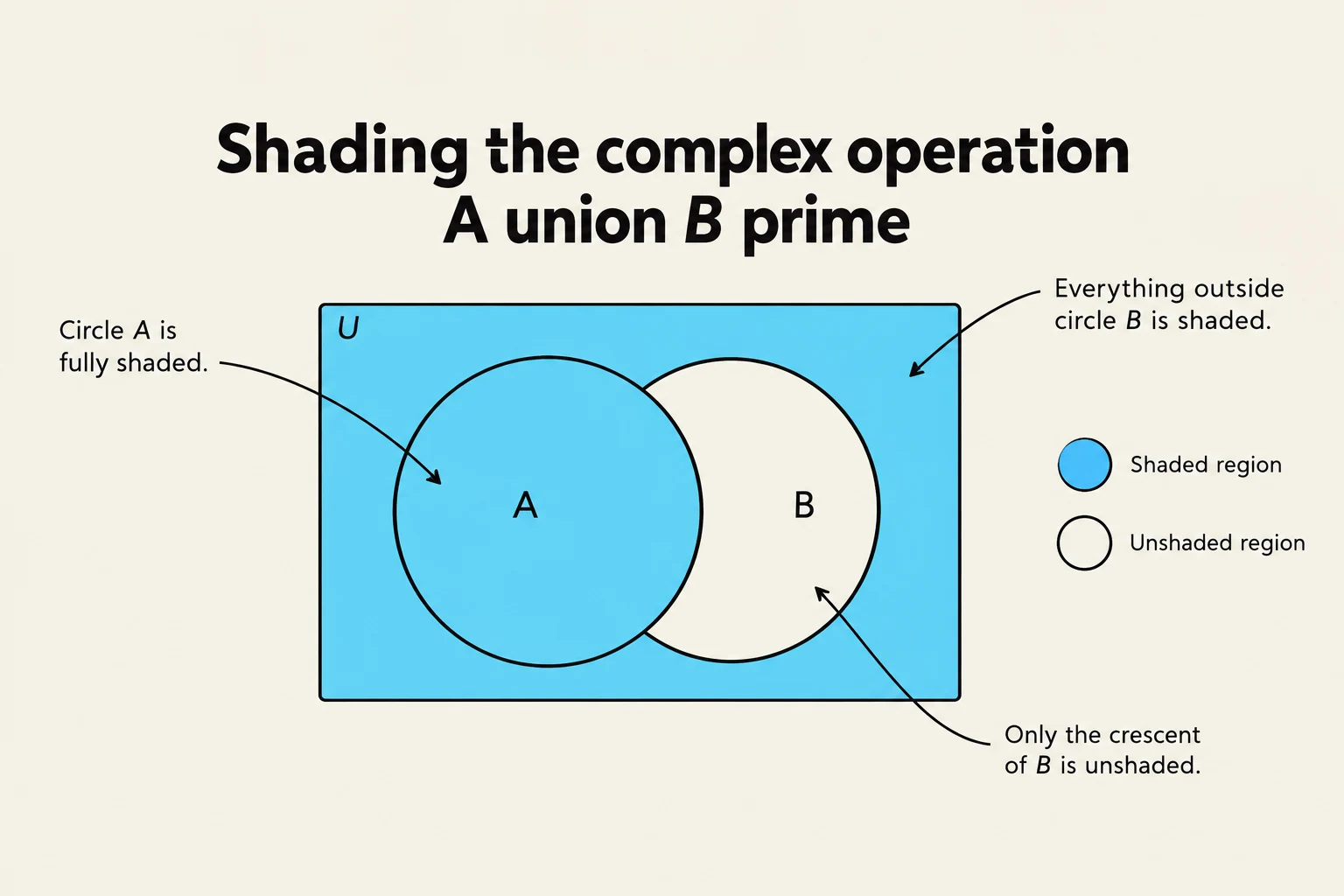
Venn diagram illustrating the shading of the complex operation A union B prime, where circle A is fully shaded and everything outside circle B is shaded.
In advanced problems, you will often see multiple operations combined. A common example is the expression:
A∪B′
To solve or visualize this, follow these steps:
Identify $B'$: Find everything in the Universal Set that is outside the circle for B.
Identify A: Look at everything inside the circle for A.
Perform the Union: Combine these two areas. The resulting region includes everything inside circle A plus everything in the rectangle that is not part of circle B.
Summary Table of Notations
Operation
Notation
Visual Representation in Venn Diagram
Intersection
A∩B
The overlapping middle section of the circles
Union
A∪B
The entire area covered by both circles
Complement
$B'$
Everything outside circle B (including the area in A not overlapping B)
Universal Set
U
The entire bounding rectangle
By mastering these symbols and their visual counterparts, you can navigate the complex logical landscapes of modern mathematics with ease.
Keep reading for free.
Create an account to finish this reading and make it part of your study routine.