How do we know that the red object in front of us is an apple, or that the sound coming from the kitchen is a boiling kettle? The answer lies in a complex biological and psychological journey that begins with physical energy in the environment and ends with a meaningful mental experience. To understand this journey, we must distinguish between two distinct but interrelated processes: sensation and perception.
The Foundations: Psychophysics, Sensation, and Perception
The scientific study of how physical stimuli from our environment are translated into psychological experiences is known as psychophysics. This field provides the framework for understanding how we bridge the gap between the physical world and our internal mental world.
To bridge this gap, the brain relies on two stages:
Sensation: This is the initial stage where our sensory organs (such as the eyes, ears, or skin) detect sensory stimuli from the environment and transmit that information to the brain.
Perception: This is the active process by which the brain organizes, interprets, and selects relevant information to create a meaningful psychological experience.
While sensation is about the detection of raw data, perception is about the interpretation of that data.
Measuring Sensation: Thresholds and Weber’s Law
Scientists use specific metrics to determine how sensitive our senses are to different stimuli. These measurements help us define the boundaries of our sensory capabilities.
Absolute Threshold
The absolute threshold is the lowest level of stimulation—the minimum amount of energy—required for a person to detect a stimulus's presence at all. For example, in hearing, this would be the quietest sound a human can detect.
Difference Threshold and JND
Often, we are less interested in whether a stimulus exists and more interested in whether it has changed. The difference threshold, also known as the Just Noticeable Difference (JND), is the smallest amount of change (either an increase or a decrease) in a stimulus that can be detected by an observer.
Weber’s Law
A common misconception is that the JND is a fixed amount (e.g., "I can always tell if a weight increases by 5 grams"). However, Weber’s Law states that the JND is not a fixed amount, but rather depends on a constant proportion or percentage of the original stimulus intensity.
Example: If you are holding a 100g weight, you might notice an increase of 5g. However, if you are holding a 1,000g weight, a 5g increase will be imperceptible; you would likely need a much larger increase (perhaps 50g) to reach the same "just noticeable difference" because the change must be a consistent percentage of the original weight.
The Biological Process: From Stimuli to Neural Impulses
How does a physical wave of light or sound become a thought? This transition involves specialized biological machinery.
Sensory Receptors and Transduction
Every sense organ contains sensory receptors, which are specialized cells designed to respond to specific types of sensory stimuli. For instance, your eyes have receptors for light, while your ears have receptors for sound vibrations.
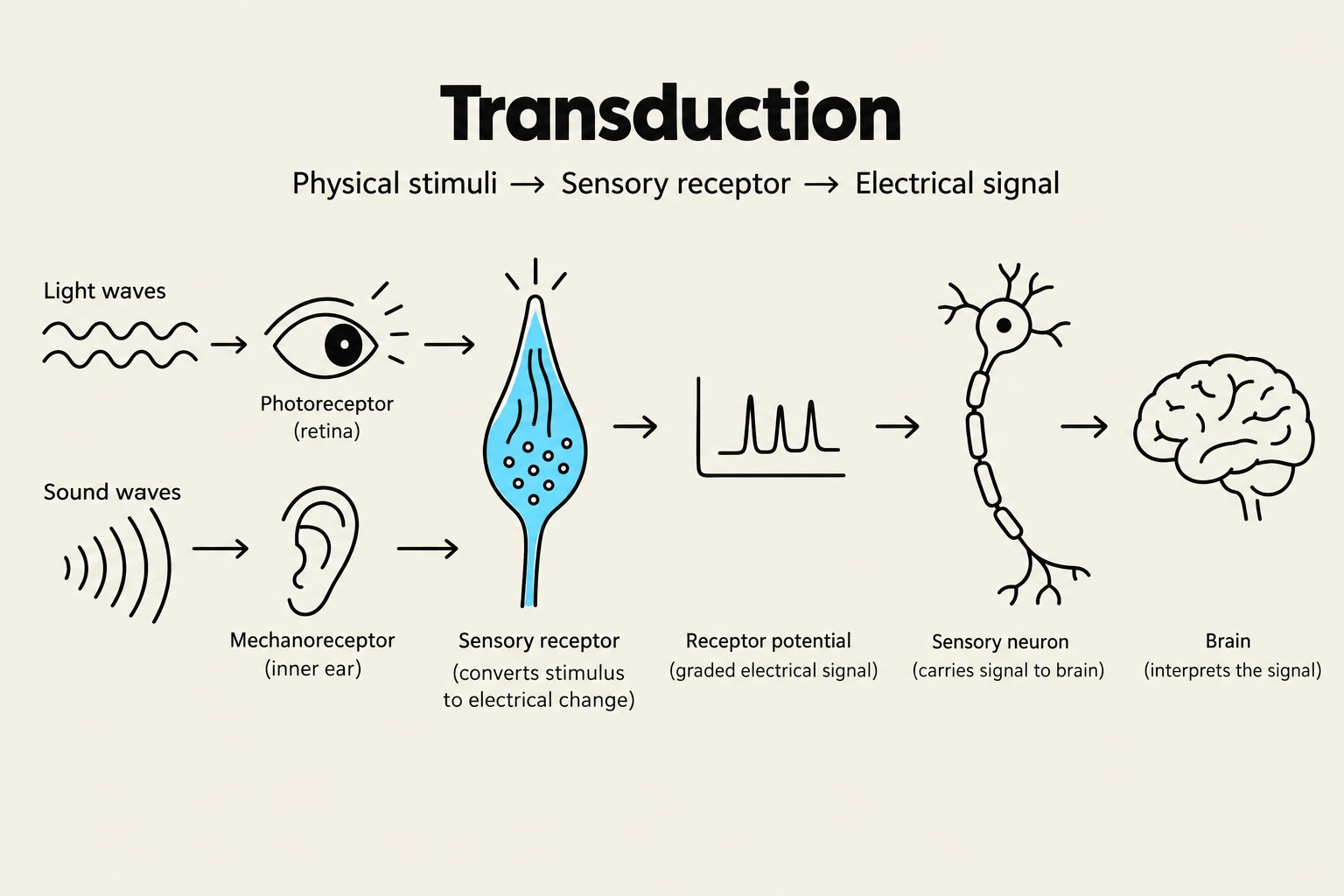
The most critical step in this process is transduction. This is the process where sensory receptors convert physical sensory stimulation into neural impulses (action potentials) that the brain can interpret. Without transduction, the brain would have no way to "read" the signals sent by the body.
This diagram illustrates the process of transduction, where physical stimuli like light and sound waves are converted into electrical signals that are processed by the brain.
Sensory Adaptation
While our senses are highly tuned, they are also efficient. Through sensory adaptation, we become less sensitive to a stimulus that remains unchanging over time. This allows the nervous system to ignore constant, non-threatening information (like the feeling of clothes against your skin) so that it can focus on new, potentially important changes in the environment.
When Perception Misleads: Illusions and Ambiguity
Because perception is an active process of interpretation, the brain sometimes makes "mistakes." It tries to make sense of the world based on patterns, even when those patterns are misleading. This discrepancy between physical reality and mental experience is often demonstrated through several phenomena:
Illusions: These are instances where our perception of a stimulus differs from its actual physical properties, such as seeing a line as longer than it actually is.
Impossible Figures: These are visual constructions that appear to be coherent objects but are geometrically impossible to exist in three-dimensional space (e.g., a shape that looks like it has an impossible number of legs or connections).
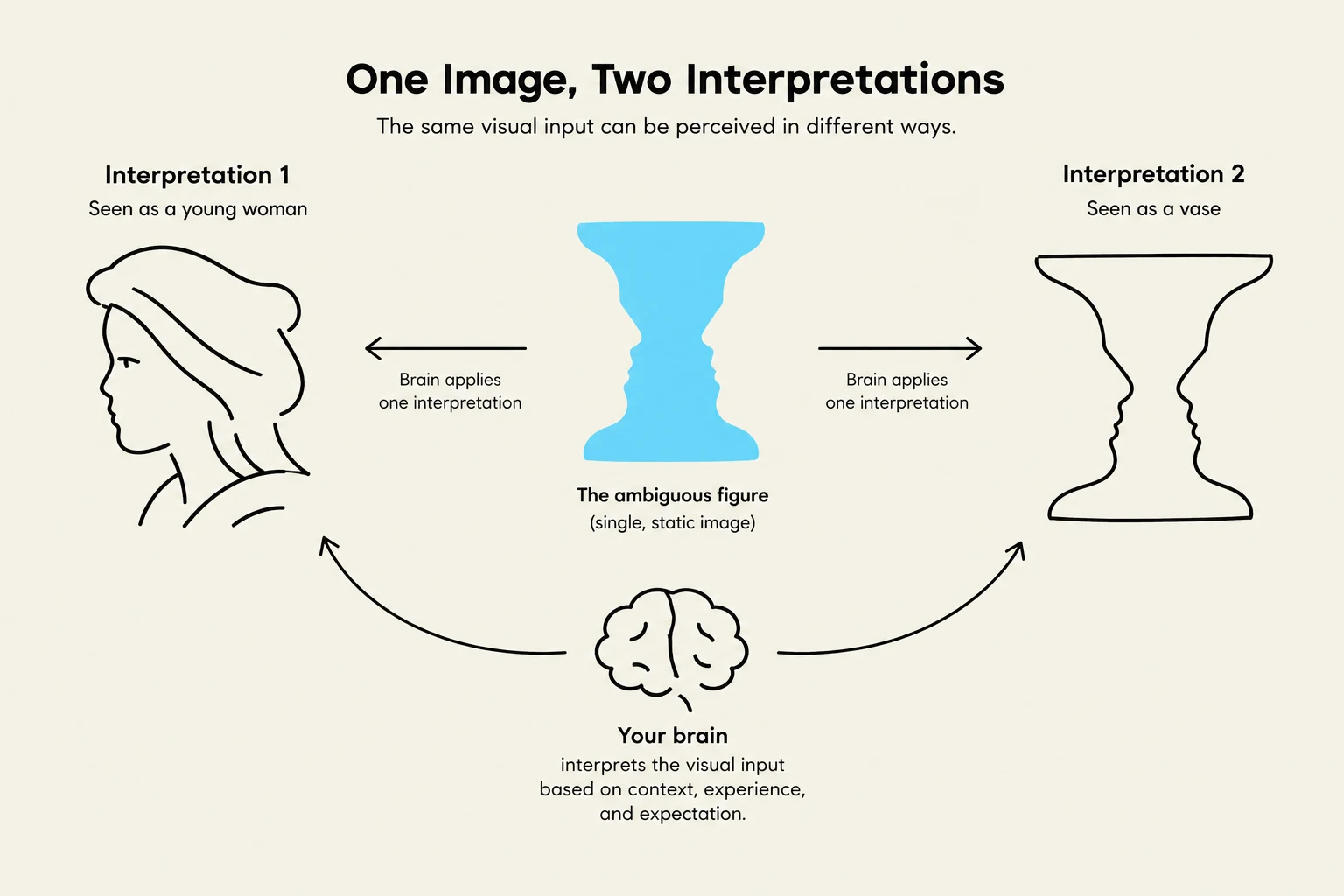
Ambiguous Figures: These are images that can be perceived in two or more distinct ways. The physical stimulus remains the same, but the brain's interpretation flips between different versions of the image.
This illustration demonstrates how the brain can interpret a single visual input in two different ways, either as a young woman or as a vase, based on context, experience, and expectation.
Exam Tip: If a question asks about the difference between an illusion and an ambiguous figure, remember: an illusion is a misinterpretation of a real stimulus, whereas an ambiguous figure is a single stimulus that can be interpreted in multiple, equally valid ways.
Summary Table: Sensation vs. Perception
Feature
Sensation
Perception
Primary Role
Detection of stimuli
Organization and interpretation
Process
Physical/Biological (Transduction)
Psychological/Cognitive
Input
Raw sensory energy (light, sound)
Processed neural signals
Outcome
Neural impulses sent to brain
Meaningful experience/knowledge
Keep reading for free.
Create an account to finish this reading and make it part of your study routine.