Introduction to Program Development and Evaluation
This course introduces the foundational concepts of program development and evaluation, focusing on the practical application of research skills to solve real-world problems in public administration and organizational management. It covers the transition from theory to applied research, the program lifecycle, and the u
Welcome to the foundational study of Program Development and Evaluation. This field represents a critical intersection between academic rigor and professional utility, specifically designed for those working within public administration and organizational management. Rather than focusing on abstract theories, this discipline is centered on the practical application of research to solve real-world problems and improve public services.
In this introduction, we will explore the core pillars of the course: the transition from general research to applied skills, the lifecycle of a program, and the empirical tools required to ensure that public interventions are both effective and efficient.
From Theory to Applied Research Skills
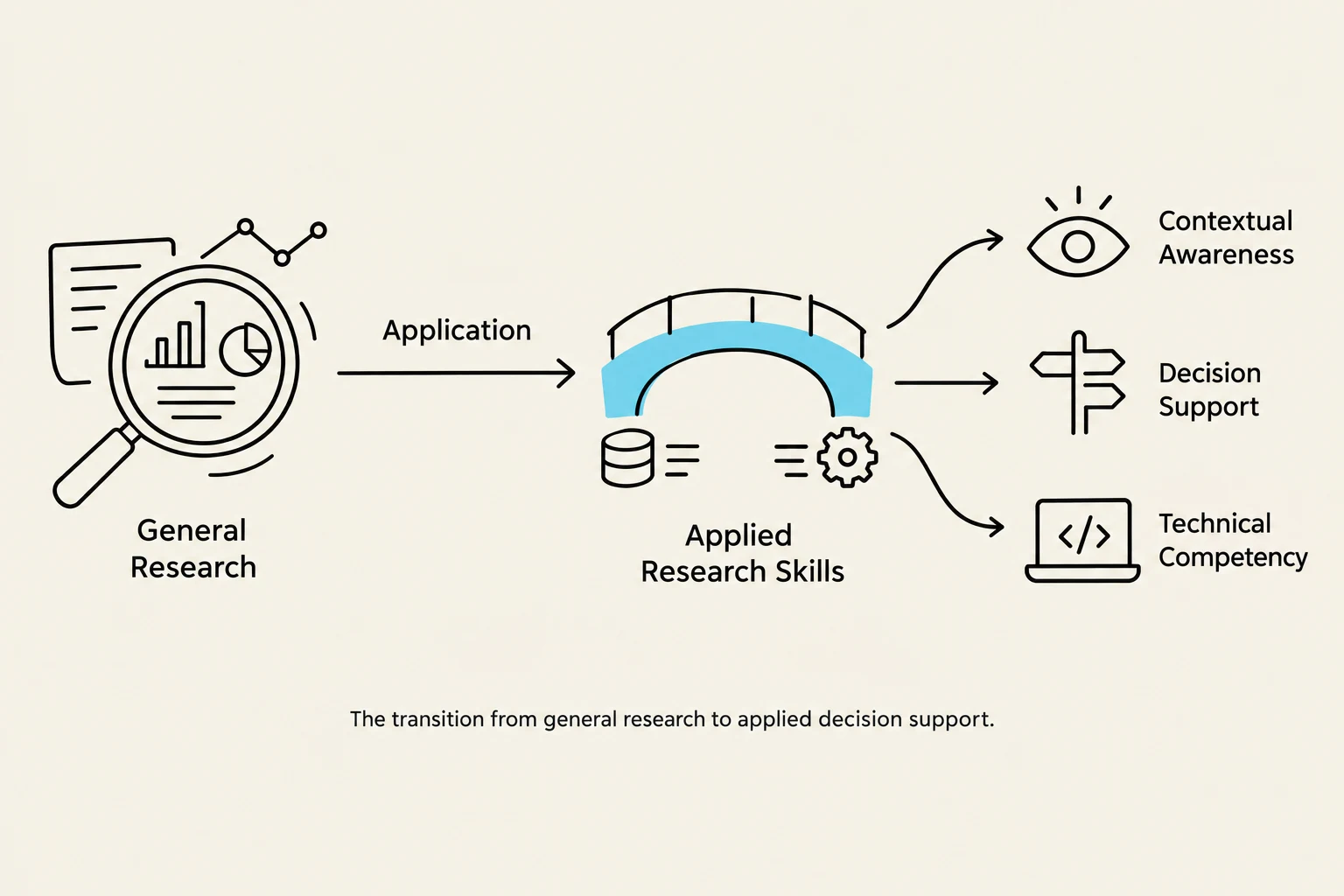
This diagram illustrates the process of transitioning from general research to applied research skills, leading to contextual awareness, decision support, and technical competency.
A common misconception in social sciences is that research is purely an academic exercise conducted in a vacuum. However, in the context of public administration, research must be applied. While general research methods classes provide the groundwork for understanding data, applied research skills focus on utilizing that data within the specific constraints and goals of an organization or a public program.
The goal is to move beyond simply asking "What does this data mean?" to asking "How can this data help my organization make a better decision?" This involves:
Contextual Awareness: Understanding the specific needs of the community or organization being served.
Decision Support: Using findings to justify budget allocations, policy changes, or service expansions.
Technical Competency: Developing the independent ability to handle data without relying on group-based efforts, ensuring that each professional can provide reliable insights to their superiors.
The Lifecycle: Program Development and Evaluation
This diagram illustrates the cyclical process of program development and evaluation, encompassing design, planning, effectiveness, efficiency, and impact, with a feedback loop connecting evaluation back to development.
To understand how research functions in the field, it is helpful to view it through the lens of a program's lifecycle. This lifecycle is divided into two primary, interconnected phases: development and evaluation.
1. Program Development
Program development is the proactive phase. It is the process of designing, structuring, and launching interventions or services. Instead of relying on intuition or tradition, modern program development uses research-driven insights to build a foundation. For example, before a city launches a new after-school program, developers use research to identify which neighborhoods have the highest need and what specific services (tutoring, nutrition, or sports) would most effectively address the local challenges.
2. Program Evaluation
Once a program is operational, the focus shifts to program evaluation. This is the systematic application of empirical tools to determine the "Three Es":
Effectiveness: Did the program achieve its intended goals?
Efficiency: Were the resources (time, money, personnel) used optimally to achieve those goals?
Impact: What were the long-term consequences—intended or unintended—of the program on the target population?
By linking development to evaluation, organizations create a feedback loop where the results of one program inform the design of the next.
Utilizing Empirical Tools
This diagram illustrates quantitative and qualitative tools used in program development and evaluation, including surveys, budgets, interviews, focus groups, and statistical analysis.
The "engine" that drives both development and evaluation is the set of empirical tools available to the researcher. Empirical tools are the specific methods and techniques used to collect, organize, and analyze data.
While you may have encountered these tools in a general research methods course, in this field, they are "geared specifically towards program development and evaluation". These tools might include:
Tool Category
Application in Program Context
Quantitative Tools
Using surveys, census data, or budgetary statistics to measure scale and reach.
Qualitative Tools
Conducting interviews or focus groups to understand the why behind participant behavior.
Statistical Analysis
Determining if a change in outcomes is statistically significant or merely due to chance.
💡 Study Tip: Mastering the Tools
Because these methodologies can be complex, do not rush through the learning process. Use the "pause and rewind" method: watch lectures, pause to take detailed notes, and if a specific empirical technique is unclear, rewind and listen to the explanation again. Mastery comes from iterative learning.
Success Strategies for Students
As you embark on this study, keep in mind that the learning approach is designed to build individual technical competency. Unlike many academic settings that rely heavily on group projects, this curriculum prioritizes individual mastery through practical, applied assignments. This ensures that when you enter a professional environment, you possess the independent skills necessary to conduct evaluations and present findings to stakeholders.
Focus on Application: Always ask yourself, "How would I use this specific tool in my current or future organization?"
Seek Clarification: In an asynchronous or online environment, communication is vital. If a concept remains elusive, reach out to your instructor early to bridge the gap.
By mastering these skills, you transition from a student of theory to a practitioner of evidence-based public administration.
Keep reading for free.
Create an account to finish this reading and make it part of your study routine.