This guide provides an overview of professional skin care treatments, including the biological basis of skin renewal, clinical routines like analysis and cleansing, advanced techniques such as exfoliation and ampoule application, and finishing steps like masks and protection.
For many clients, skin care is a deeply personal matter that extends far beyond simple aesthetics. Because many individuals link their self-worth to their physical appearance, skin concerns can trigger significant emotional responses. As a somatologist, your role is not merely technical; you are a professional advisor responsible for creating personalized treatment plans and providing sensitive, appropriate home care advice.
The Biological Foundation: Cell Renewal and Desquamation
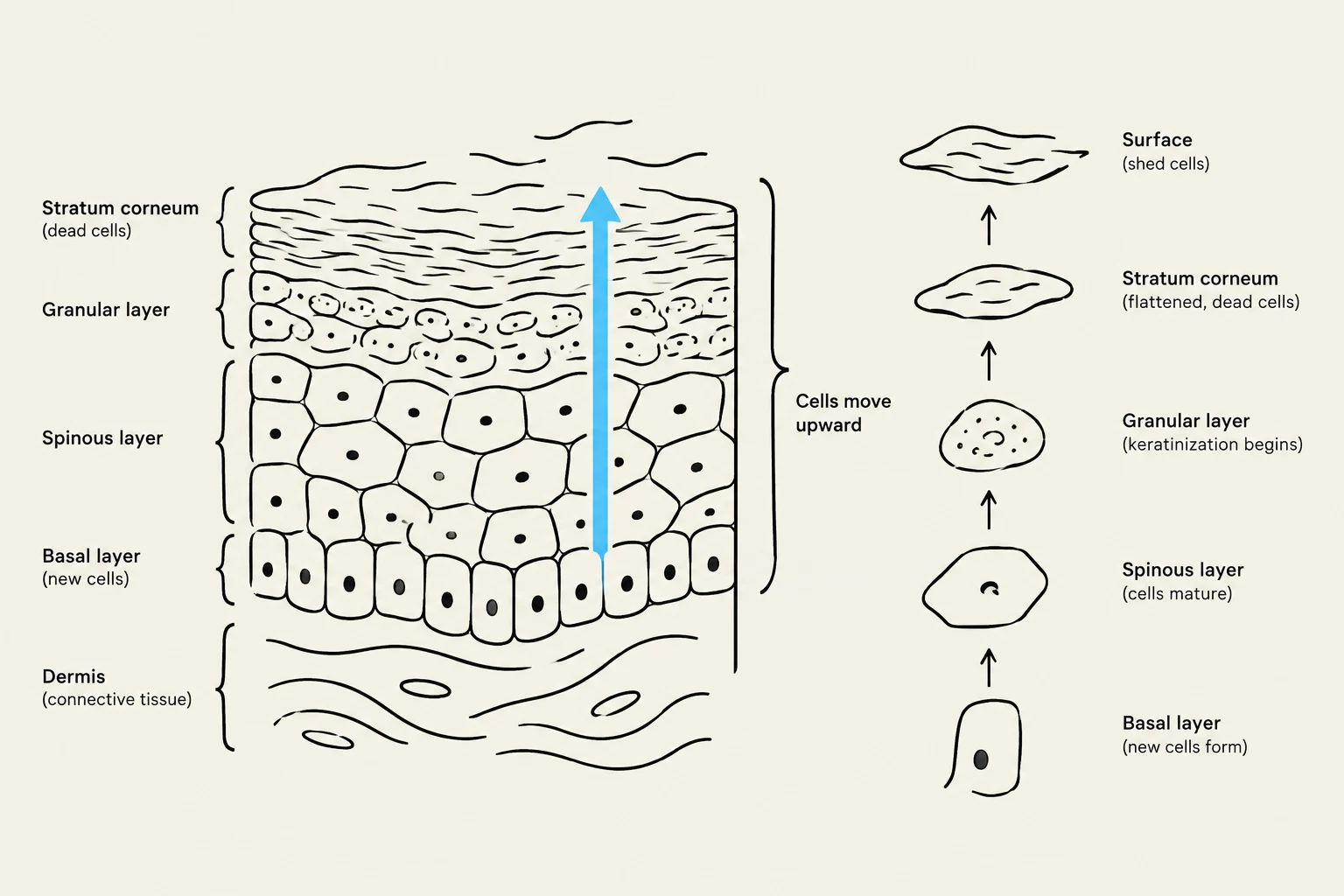
To provide effective treatments, a somatologist must understand the skin's natural rhythm. The skin undergoes a continuous renewal process where new cells are created and move toward the surface.
This cycle typically lasts approximately 4 to 6 weeks. During this period, cells move through the various layers of the skin, undergo a process of keratinization, and eventually reach the surface to be shed. This shedding process is known as desquamation.
Clinical Tip: When planning a course of treatments to achieve a specific goal, always consider this 4–6 week cycle. Scheduling appointments that align with the skin's natural renewal can maximize the efficacy of your interventions.
Diagram illustrating the layers of the epidermis and the process of keratinocyte differentiation and migration.
The Clinical Routine: From Analysis to Cleansing
A professional skin care treatment follows a structured sequence designed to address specific skin types and conditions.
Skin Analysis
The process begins with a thorough consultation. A somatologist asks questions regarding the client's lifestyle, including home care routines, exercise, diet, sleep habits, and emotional or physical stressors. For instance, high caffeine or cheese consumption might contribute to congestion, while smoking or intense exercise might lead to dehydration.
Following the consultation, the skin is inspected using a magnifying lamp or a skin analyzer. This allows the therapist to document findings on a consultation card and identify specific imperfections, such as excessive oiliness or fine lines, which will dictate the rest of the treatment.
The Cleansing Process
The first physical step is a thorough cleanse to remove make-up and impurities. During this stage, the therapist should feel the skin's texture to identify any potential barrier impairments. The choice of cleanser must be tailored to the skin type identified during analysis, while also respecting the client's current home care products.
Deep Cleansing and Exfoliation
Once the initial cleanse and analysis are complete, the professional moves into the "secondary cleanse," commonly referred to as exfoliation. This is often considered one of the most vital steps in a professional clinic routine.
The primary functions of exfoliation are:
To remove keratinized skin cells from the surface.
To loosen congestion and unclog pores (orifices).
To stimulate microcirculation.
To prepare the skin for better product absorption.
By removing these dead cells, the somatologist ensures that the next layer of cells can desquamate more effectively, which helps prevent the formation of expression lines. Depending on the skin's needs, exfoliation can be achieved through mechanical, chemical, enzymatic, or granular methods, or even via electrotherapy such as a brush machine or desincrustation.
Diagram illustrating the three steps of a skincare routine: primary cleansing, skin analysis, and secondary cleansing (exfoliation).
Advanced Treatments: Ampoules, Electricity, and Massage
After the skin is prepared, the somatologist introduces highly active ingredients and specialized techniques.
Ampoule Application
An ampoule is a highly concentrated serum with a very fine molecular structure. Because of this structure, ampoules can penetrate into the deepest layers of the skin, sometimes even reaching the basal layer. They are chosen based on specific needs—such as hydrating, nourishing, purifying, or regenerating—and are particularly useful during seasonal transitions. Application can be done manually using techniques like tapotement or pinchement Jacquet, or assisted by electrical means.
Electrical and Manual Stimulation
To further customize the treatment, a qualified therapist may incorporate electrical treatments using specialized machines. Following this, a massage is often performed using creams blended for the client's specific skin type. Beyond the relaxation benefits, massage serves a physiological purpose: it tones the facial muscles and accelerates microcirculation.
Finishing the Treatment: Masks and Specialized Care
Masks and Targeted Areas
A mask is used to reinforce the treatment's goals, such as increasing hydration or cleansing. While the mask works, the therapist must also address the neck and eye areas. These areas are often the first to show signs of aging because the skin is thinner and more susceptible to trans-epidermal water loss (TEWL). Specialized products with appropriate molecular sizes are required for these delicate zones.
Protection and Presentation
The final steps focus on stabilizing the skin and protecting it:
Toning: To assist in normalizing the skin's pH.
Moisturizing: Applying a suitable day cream.
Sun Care: Applying sun protection is essential before the client leaves the clinic.
Finally, a somatologist ensures the client feels presentable by applying basic makeup, such as lipstick or mascara, so they leave the clinic feeling confident.
Diagram illustrating Trans-epidermal Water Loss (TEWL), where moisture escapes through a compromised skin barrier due to gaps between corneocytes.
Exam Tip: Remember that the "secondary cleanse" is synonymous with "exfoliation" in a clinical context, and its main goal is to prepare the skin for deeper product penetration by removing keratinized cells.
Keep reading for free.
Create an account to finish this reading and make it part of your study routine.