


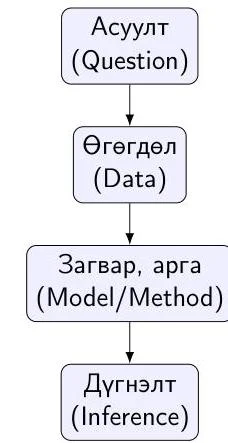
Statistics is a branch of mathematical science that provides the models and tools necessary for collecting, analyzing, and interpreting data. Rather than being a simple exercise in calculation, the statistical process is best understood as a continuous cycle: Question Data Inference. The ultimate goal is to understand the patterns within data, quantify uncertainty, and make informed decisions in fields ranging from marketing and finance to medicine and social sciences.
The Core Framework: Population and Sample
To understand any statistical study, we must first distinguish between the group we want to know about and the group we actually observe.
- Population (Source Population): This is the entire set of all possible objects, individuals, or measurements under study. For example, if you are studying the average lifespan of citizens in Mongolia, the population is the entire population of Mongolia.
- Sample: Because it is often impossible to measure every single member of a population, researchers select a subset known as a sample.
- Parameter vs. Statistic: A parameter is a numerical value that describes a specific characteristic of the entire population (and is often unknown). A statistic is a numerical value calculated from a sample used to estimate that population parameter.
The relationship between these concepts is the foundation of statistical inference—the process of using sample data to make educated guesses about the population.
Note on Sampling Error: Because a sample is only a part of the whole, it will rarely be a perfect reflection of the population. The discrepancy between the sample statistic and the true population parameter is known as sampling error.


Keep reading for free.
Create an account to finish this reading and make it part of your study routine.
Continue reading freeAlready have an account? Log in
Updated