An overview of heredity, biological variation, and the fundamental concepts of genetics, including genes, alleles, genotype, phenotype, and patterns of inheritance.
Genetics is the scientific study of heredity—the process by which genetic information is passed from one generation to the next—and biological variation, which explains why individuals within a species differ. By understanding how DNA differences contribute to varying traits, genetics provides a vital framework for explaining evolution, inherited diseases, and the complex interactions between genes and the environment.
The Building Blocks: Genes and Alleles
To understand how traits are passed down, we must first look at where the information is stored. In eukaryotic cells, most genetic information is housed in the nucleus, where DNA is packaged into structures called chromosomes. A gene is a specific region of DNA that contains the instructions used to produce a functional product, such as a protein or a functional RNA.
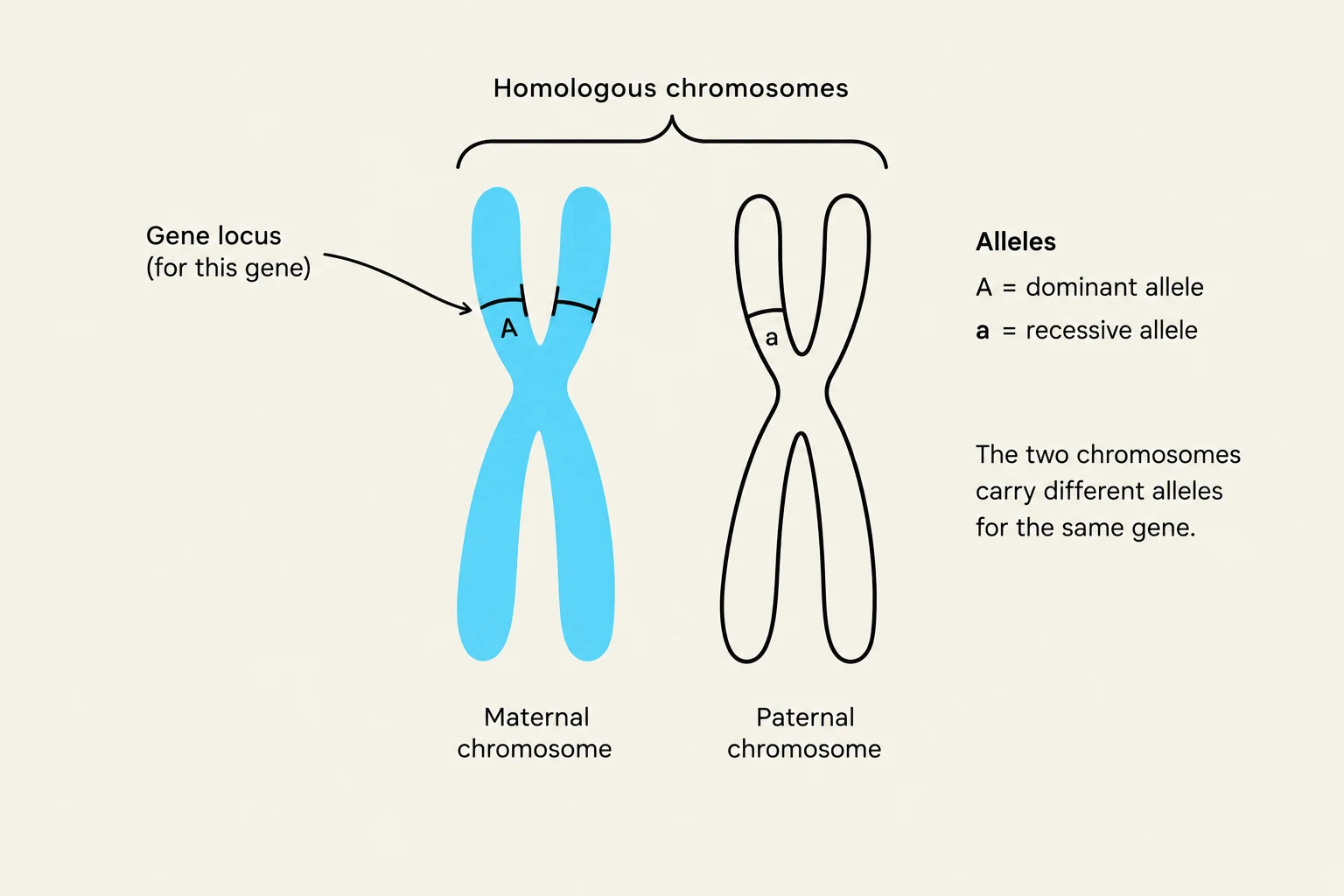
Genes exist at specific locations on a chromosome known as loci. Because humans inherit one set of chromosomes from each parent, we possess homologous chromosomes—pairs that carry the same types of genes at corresponding loci. However, the specific DNA sequence at a particular locus may differ between these homologs. These different versions of the same gene are called alleles.
Diagram illustrating homologous chromosomes, gene locus, and alleles, with A representing a dominant allele and a representing a recessive allele.
An individual can be described by their allele combinations:
Homozygous: Carrying two copies of the same allele (e.g., AA or aa).
Heterozygous: Carrying two different alleles (e.g., Aa).
Genotype vs. Phenotype
A fundamental distinction in genetics is the difference between an organism's internal genetic code and its external expression.
Genotype refers to the specific genetic information or set of alleles an individual carries for a particular gene. Phenotype is the observable or measurable characteristic of an organism.
It is important to note that the relationship between the two is not always a simple one-to-one match. While the genotype influences the phenotype through gene expression—the process of turning DNA instructions into functional proteins—different genotypes can sometimes result in the same phenotype. Furthermore, phenotypes are not just physical appearances; they include physiological traits (like blood type) and health-related traits (like disease susceptibility).
Exam Tip: Remember that "dominant" does not mean "better," "stronger," or "more common." It simply describes a specific inheritance pattern where one allele can mask the expression of another.
Patterns of Inheritance: Monogenic and Polygenic Traits
Traits are categorized based on how many genes contribute to their expression.
Monogenic Traits
Monogenic traits are characteristics controlled by a single gene that has a major effect on the phenotype. Classic examples include:
ABO blood type
Cystic fibrosis
Sickle-cell disease
Polygenic Traits
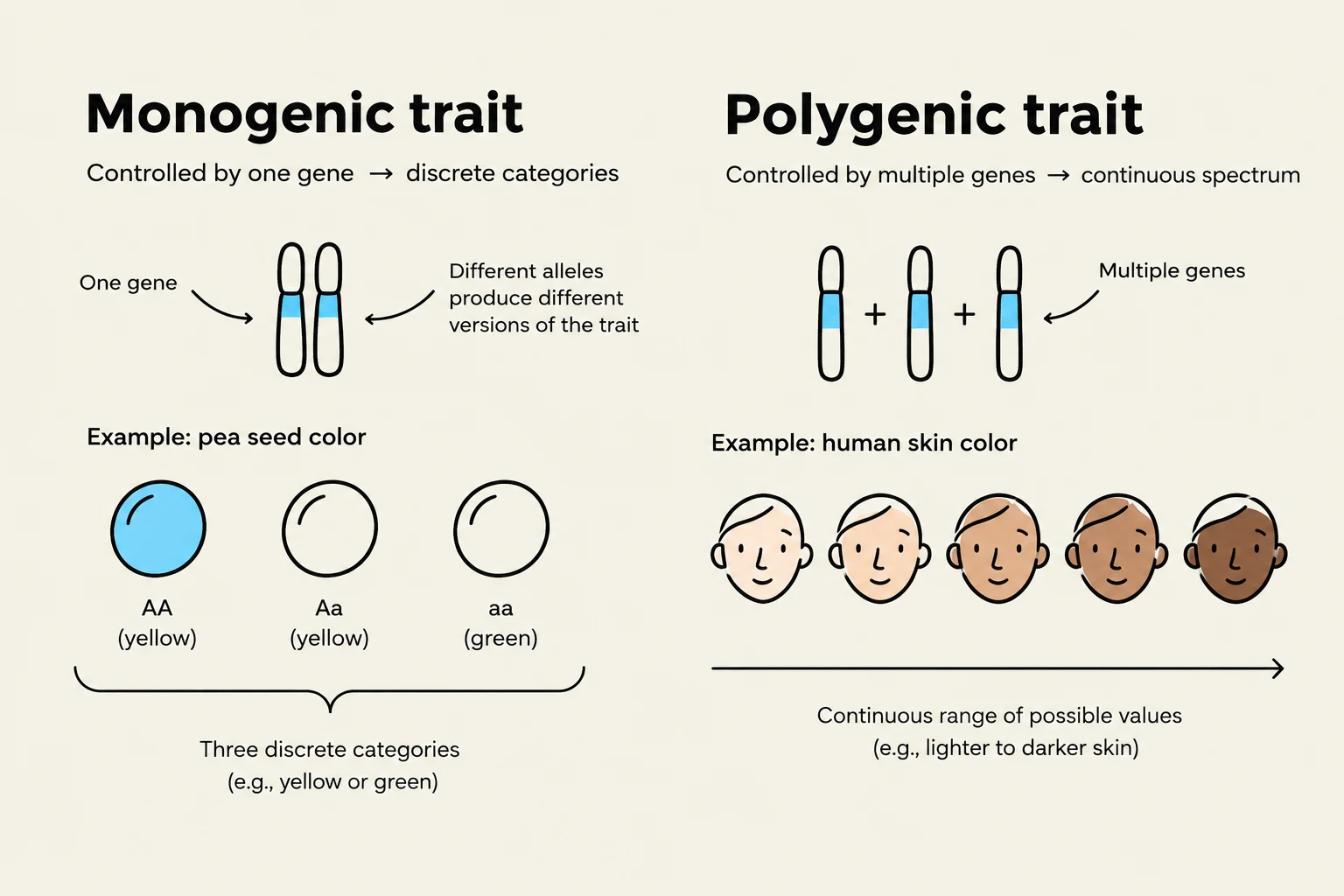
Most human characteristics are far more complex. Polygenic traits are influenced by the additive effect of many different genes. Instead of a single gene determining a result, multiple genes work together to create a spectrum of variation. Examples include height, skin pigmentation, and many complex disease risks.
This illustration contrasts monogenic and polygenic traits. Monogenic traits are controlled by a single gene and result in discrete categories, exemplified by pea seed color (yellow or green). Polygenic traits, on the other hand, are influenced by multiple genes, leading to a continuous spectrum of variation, as seen in human skin color ranging from lighter to darker tones.
Complex Inheritance Patterns
While Mendelian genetics focuses on simple dominant and recessive patterns, many traits follow more nuanced rules.
Codominance
In codominance, both alleles in a heterozygote are expressed equally, and neither masks the other. A prime example is the ABO blood type system. In this system, the A and B alleles are codominant. If an individual inherits an A allele from one parent and a B allele from the other, their phenotype will be type AB blood, expressing both A and B antigens on their red blood cells.
Genotype
Blood Type
RBC Antigen(s)
AA or AO
A
A
BB or BO
B
B
AB
AB
A and B
OO
O
Neither A nor B
Sex-Linked Inheritance
Some genes are located on the sex chromosomes (X and Y). X-linked inheritance is particularly important because males (XY) only have one copy of the X chromosome, while females (XX) have two. This means a single recessive allele on an X chromosome can cause a trait to be expressed in a male, whereas a female would need two copies to show the same trait. An example is hemophilia.
Predicting Inheritance: The Punnett Square
To predict the probability of offspring inheriting specific genotypes and phenotypes, biologists use a Punnett square. This tool organizes the possible allele combinations from the parents.
Worked Example: A Single-Gene Cross
If we cross a heterozygous parent (Aa) with a homozygous recessive parent (aa):
Determine gametes: Parent 1 produces A or a; Parent 2 produces only a.
Important Note on Probability: A Punnett square shows the probability of an outcome, not a guaranteed count. If a square predicts a 25% chance of a genotype, it means each individual fertilization event has a 25% chance; it does not mean that in a family of four, exactly one child will have that genotype.
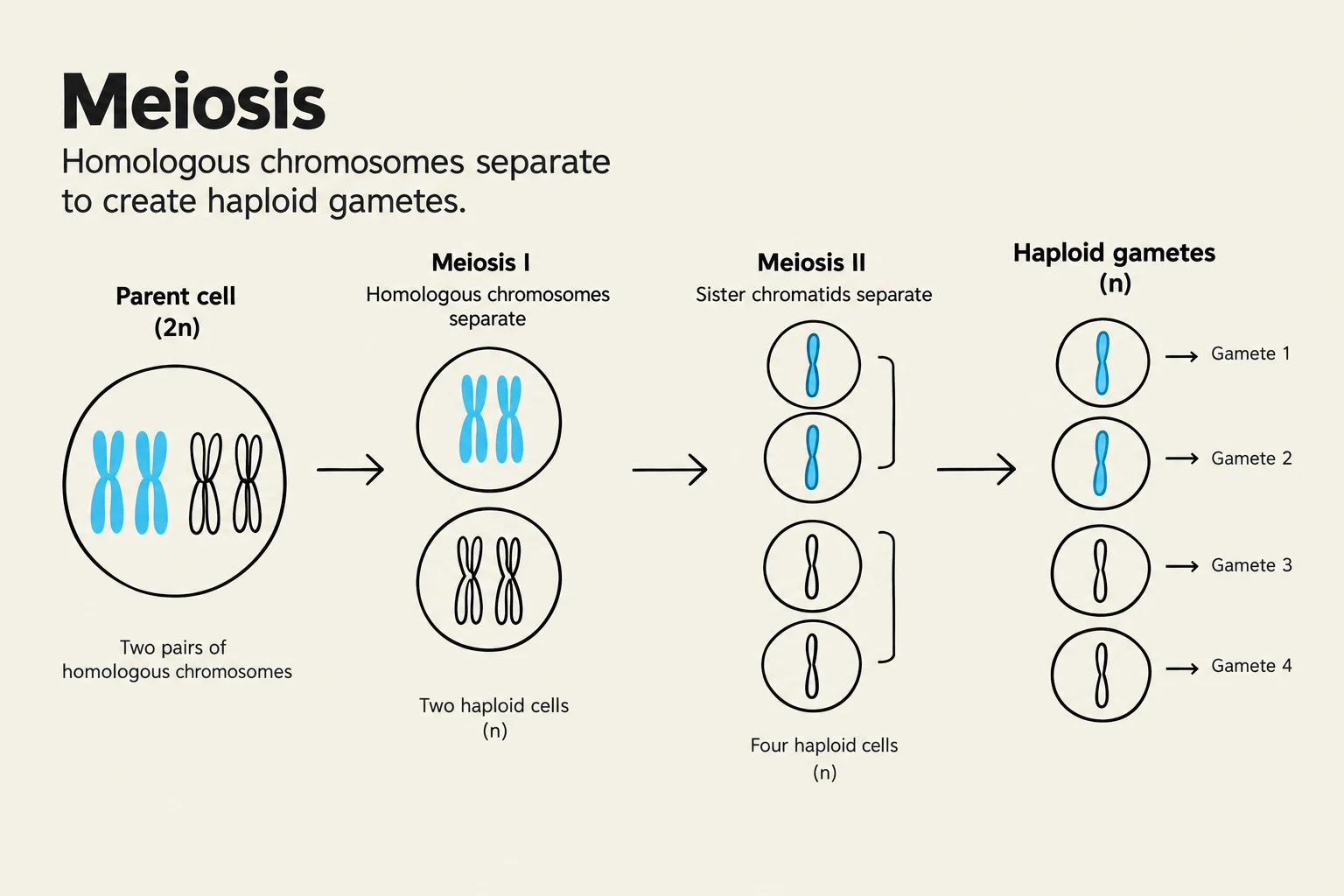
Diagram illustrating the process of meiosis, where a parent cell undergoes two divisions to produce four haploid gametes.
Summary Table: Key Genetic Terms
Term
Definition
Gene
A region of DNA containing functional information
Allele
An alternative version of a gene
Genotype
The specific combination of alleles an individual carries
Phenotype
The observable or measurable characteristic
Keep reading for free.
Create an account to finish this reading and make it part of your study routine.