Introduction to Physiology: Homeostasis and Feedback Mechanisms
Explore key physiological concepts including metabolic regulation (insulin and glucose homeostasis), thermoregulation (hypothalamic set point), positive feedback (oxytocin and labor), and renal pharmacology (prostaglandins and blood flow). This guide uses practice-based scenarios to deepen understanding of these essent
Physiology is the study of how biological systems function to maintain homeostasis. Understanding these mechanisms requires more than just memorizing definitions; it requires an ability to apply concepts of feedback loops, set points, and biochemical signaling to clinical or experimental scenarios. This article breaks down four key physiological themes—metabolic regulation, thermoregulation, reproductive feedback, and renal pharmacology—using practice-based scenarios to deepen your understanding.
Metabolic Regulation: Insulin and Glucose Homeostasis
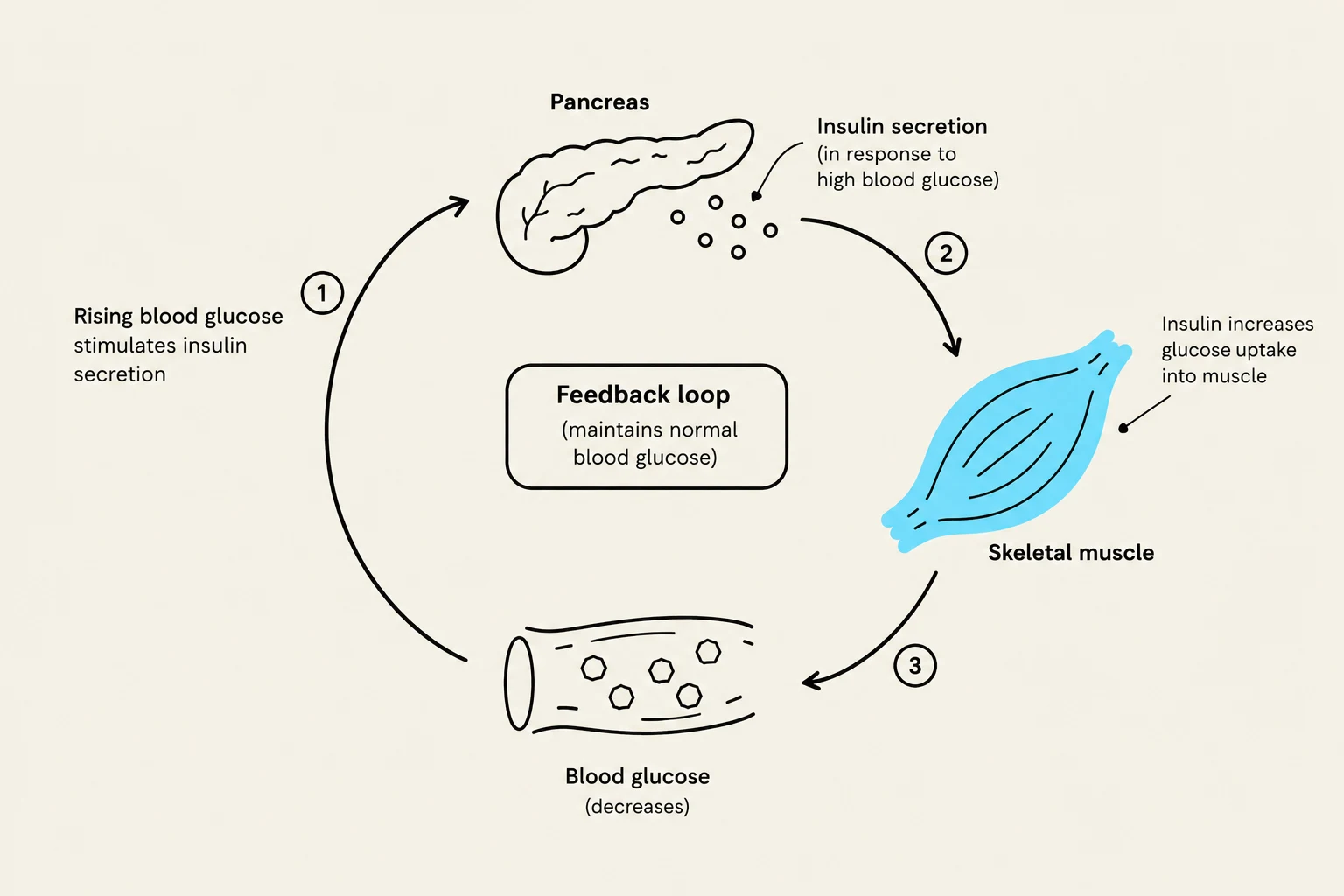
A common challenge in physiology is distinguishing between a change in a hormone's concentration and a change in a tissue's sensitivity to that hormone. Consider a scenario where skeletal muscle becomes less responsive to insulin. In this state, even though the muscle cells are not taking up glucose as efficiently, the body may maintain a normal fasting plasma glucose level through compensatory mechanisms.
If the pancreas is functioning correctly, it will detect the rising glucose levels (or the lack of glucose uptake) and increase the secretion of insulin. This results in a "new normal" where the plasma insulin concentration is higher than usual to overcome the resistance, effectively keeping the glucose levels stable.
Exam Tip: When you see a scenario where a physiological variable (like glucose) remains stable despite a change in a regulatory hormone's effectiveness, look for "compensation." The body often uses increased hormone output to offset decreased receptor sensitivity.
This diagram illustrates the feedback loop that maintains normal blood glucose levels. When blood glucose rises, the pancreas secretes insulin, which signals skeletal muscle to increase glucose uptake, thus lowering blood glucose.
Thermoregulation and the Hypothalamic Set Point
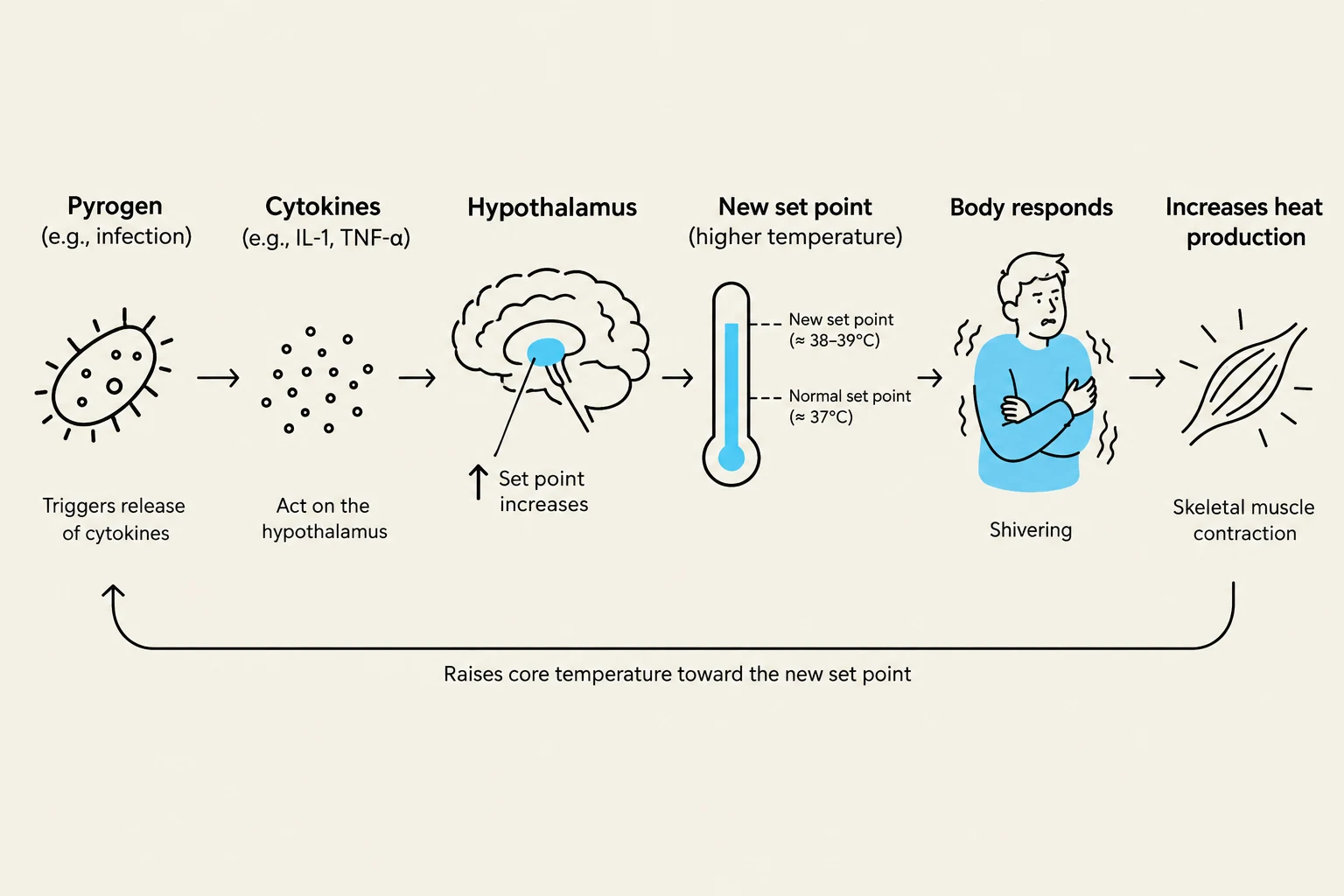
Thermoregulation is governed by the hypothalamus, which acts as the body's thermostat by establishing a "set point". When an individual has a fever, the hypothalamic set point is shifted upward. This means that even if the body temperature is technically "high" by normal standards (e.g., 39.0°C), the brain perceives this as being below the new set point.
If we intervene by using cooling pads to lower the core temperature to 38.5°C, we must consider whether we have changed the set point or merely the actual temperature. If the set point remains at 39.0°C, the body still "thinks" it is too cold. Consequently, the thermoregulatory responses will continue to act to raise the temperature, such as through shivering and vasoconstriction, despite the cooling intervention.
This diagram illustrates the physiological process of fever, starting with a pyrogen triggering cytokine release, which affects the hypothalamus to increase the body's temperature set point, leading to shivering and increased heat production through skeletal muscle contraction.
Positive Feedback: Oxytocin and Labor
While most physiological processes are governed by negative feedback (which stabilizes a system), certain biological events rely on positive feedback to drive a process to completion. A classic example is the release of oxytocin during childbirth.
The mechanism works as follows:
The baby's head pushes against the cervix, causing cervical stretch.
This stretch triggers the release of oxytocin from the posterior pituitary.
Oxytocin travels through the blood to the uterus, stimulating stronger uterine contractions.
Stronger contractions push the baby harder against the cervix, increasing the stretch.
This creates an amplification loop. For a positive feedback loop to be physiologically useful, it must have a definitive "off switch." In the case of labor, the loop is terminated not by a change in sensitivity, but by the removal of the stimulus: the delivery of the baby. Once the baby is born, the cervical stretch ceases, and the oxytocin-driven contraction cycle rapidly subsides.
Prostaglandins and Renal Blood Flow
Pharmacology often intersects with physiology when studying how drugs affect specific biochemical pathways. Prostaglandins are lipid compounds that play a vital role in various functions, including regulating renal (kidney) blood flow.
In patients who are volume-depleted (dehydrated), the kidneys rely heavily on prostaglandin synthesis to maintain adequate blood flow and prevent excessive vasoconstriction. When comparing different antipyretic (fever-reducing) drugs, we see different side-effect profiles based on their mechanism of action:
Acetaminophen: Primarily acts on the central nervous system to reduce fever with minimal impact on peripheral prostaglandin synthesis in the kidneys.
Ibuprofen: A non-selective inhibitor of cyclooxygenase (COX) enzymes, which are necessary for prostaglandin synthesis. Because it inhibits prostaglandin production systemically, it can lead to a significant reduction in renal blood flow in vulnerable patients.
Summary Table: Drug Comparison
Feature
Ibuprofen
Acetaminophen
Fever Reduction
Effective
Effective
Prostaglandin Inhibition
Strong (Systemic)
Weak (Peripheral)
Impact on Renal Blood Flow
Decreases flow in volume-depleted patients
Minimal impact
By understanding these fundamental principles—compensation in insulin signaling, set-point shifts in fever, the termination of positive feedback in labor, and the biochemical pathways of renal regulation—you can better approach complex physiological problems.
Keep reading for free.
Create an account to finish this reading and make it part of your study routine.