Introduction to Physiology and Homeostatic Control
This content explains how physiology connects molecular events to patient findings through homeostasis, negative feedback, positive feedback, and feedforward control. It covers mechanisms of control, clinical applications like fever vs. hyperthermia, and pharmacological considerations.
Physiology is the study of how biological systems function, serving as the vital bridge between microscopic molecular events and the clinical findings we observe in patients. To understand why a patient presents with a fever, why their heart rate spikes before a race, or why certain medications might damage their kidneys, we must first understand the fundamental principles of control: homeostasis, negative feedback, positive feedback, and feedforward control.
Homeostasis and Reference Intervals
At the heart of physiology is homeostasis, the active and dynamic regulation of the body's internal environment. Homeostasis ensures that vital variables—such as blood pH, glucose levels, and core temperature—remain within a narrow, functional range despite constant changes in the external environment.
When clinicians discuss "normal" values, they are referring to a reference interval, which describes the expected values within a specific, defined population and setting. However, it is crucial to remember that a result falling outside this interval is not automatically a "danger zone." We must distinguish between a reference range and a nonlethal limit. The risk posed by a deviation depends on several factors:
The severity of the deviation.
The speed at which the change occurred.
The duration of the imbalance.
The specific patient's physiological reserve.
Clinical Pearl: A laboratory value that is slightly abnormal but has been stable for weeks (e.g., a mild sodium imbalance) may be less clinically significant than a value that is only moderately abnormal but has changed rapidly (e.g., a sudden spike in potassium).
Mechanisms of Control
The body utilizes different "control loops" to manage physiological variables. These loops consist of a sensor (to detect change), an integrator (to process the information), and an effector (to carry out the response).
Negative Feedback: The Stabilizer
Negative feedback is the most common regulatory mechanism. In this loop, the response opposes the initiating change, bringing the regulated variable back toward its set point.
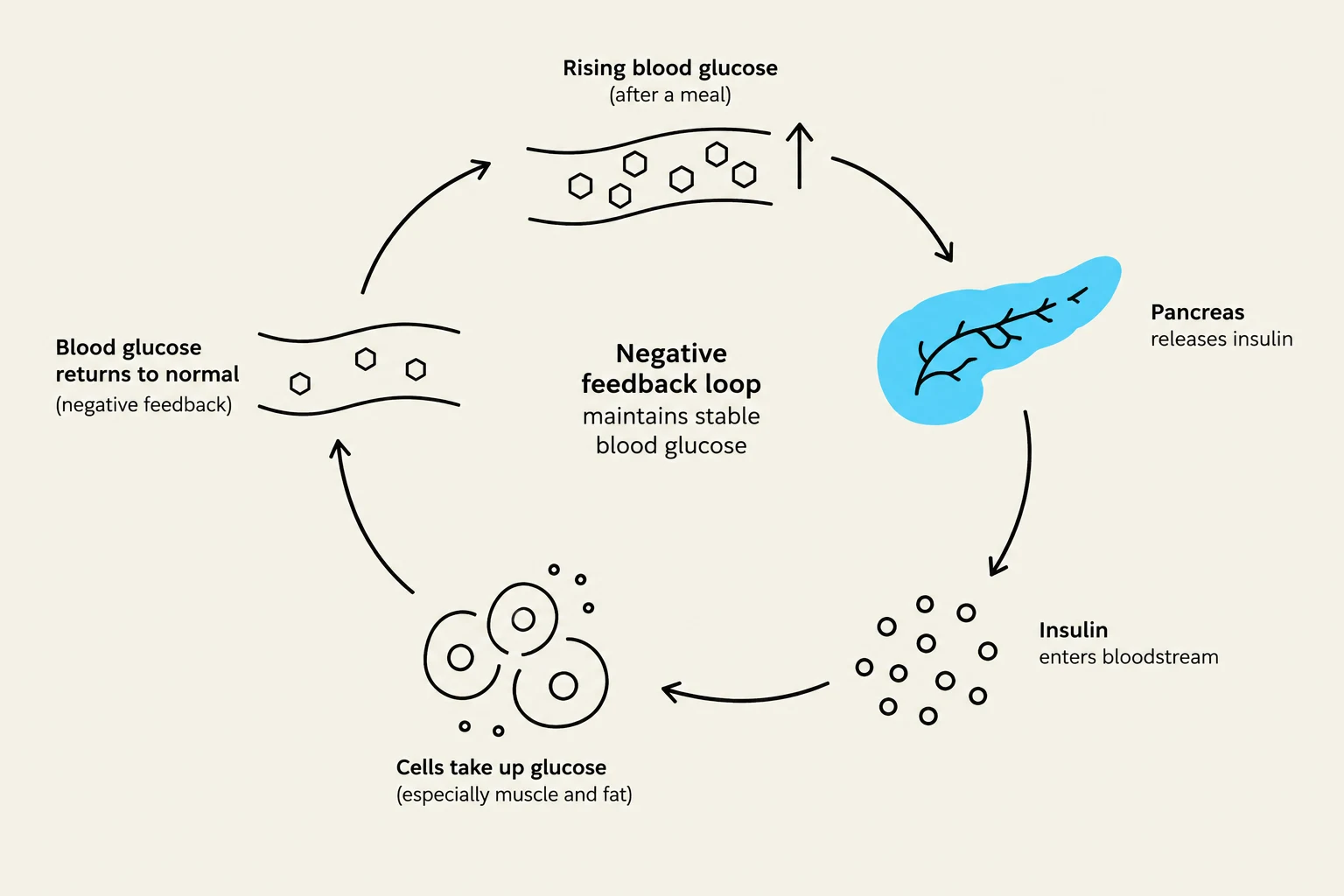
Glucose Regulation: When plasma glucose rises after a meal, pancreatic β cells sense the increase and secrete insulin. Insulin promotes glucose uptake by muscles and inhibits hepatic output, causing blood glucose to fall back toward the normal range. Conversely, when glucose falls, pancreatic α cells release glucagon to stimulate the liver to release glucose, opposing the initial drop.
Thermoregulation: If the core temperature rises, the hypothalamus triggers effectors like sweat glands and cutaneous vasodilation to increase heat loss, thereby lowering the temperature.
This diagram illustrates the negative feedback loop that maintains stable blood glucose levels. After a meal, blood glucose rises, prompting the pancreas to release insulin. Insulin enters the bloodstream and signals cells, particularly muscle and fat cells, to take up glucose. This process returns blood glucose levels to normal.
Positive Feedback: The Amplifier
Unlike negative feedback, positive feedback reinforces or amplifies the initiating change. Because this can lead to instability, positive feedback loops must have a built-in "stopping mechanism" to prevent them from running out of control.
Oxytocin and Childbirth: During labor, the descent of the fetus stretches the cervix. This stretch sends neural signals to the brain to release oxytocin, which triggers stronger uterine contractions. These stronger contractions push the fetus further down, increasing cervical stretch and leading to even more oxytocin release. The loop only breaks once the baby is delivered.
Feedforward Control: The Anticipator
Feedforward control is an anticipatory response. Instead of waiting for a variable to actually change, the body uses predictive cues to initiate a response before a disturbance occurs.
Examples: A sprinter’s heart rate and ventilation increase at the sound of the starting gun, even before blood gases have changed. Similarly, salivating while thinking about food or the kidneys beginning to excrete potassium immediately after a high-potassium meal are examples of the body preparing for an upcoming change.
This diagram illustrates three types of control systems: negative feedback, positive feedback, and no feedback. Negative feedback opposes change to stabilize a system, positive feedback amplifies change, and no feedback results in a fixed response without correction.
Clinical Application: Fever vs. Hyperthermia
A classic way to test your understanding of these concepts is to compare two patients who both present with a temperature of 40.0∘C (104∘F).
Case 1: Fever (The Defended Set Point)
Patient 1 has an infection (e.g., pyelonephritis). During infection, pyrogens (like IL-1) trigger the synthesis of Prostaglandin E2 (PGE2) in the hypothalamus. This PGE2 raises the hypothalamic set point.
Because the "target" temperature is now 40∘C, the patient's current temperature of 38∘C feels "too cold" to the brain. Consequently, the body uses negative feedback to reach the new set point by shivering and vasoconstricting. When the fever "breaks" (the set point falls), the patient will suddenly feel hot and begin to sweat.
Case 2: Hyperthermia (The Failed Control)
Patient 2 is a runner in high humidity. In this case, the hypothalamic set point is normal. However, the external heat gain exceeds the body's ability to lose heat (e.g., humidity prevents sweat evaporation). This is not a "defended" temperature; it is a failure of the cooling mechanisms. Antipyretics like acetaminophen will not work here because the set point hasn't changed; the problem is environmental and mechanical.
Pharmacological Note: COX and the Kidney
When treating a patient with fever, drug choice matters.
NSAIDs (e.g., Ibuprofen): These inhibit Cyclooxygenase (COX) enzymes, which reduces PGE2 to lower fever. However, in a dehydrated patient, inhibiting COX can also block the production of renal prostaglandins that keep the afferent arteriole open. This can lead to decreased renal blood flow and kidney injury.
Acetaminophen: This lowers PGE2 centrally but has little effect on peripheral prostaglandins, making it a safer choice for preserving renal perfusion in certain patients.
Exam Tip: If a patient has a high temperature and is shivering, they are likely in a fever state where the set point has risen. If they are hot and sweating, they may be in the "crisis" phase of a fever or experiencing hyperthermia.
Keep reading for free.
Create an account to finish this reading and make it part of your study routine.