Introduction to Photosynthesis and Chloroplast Structure
Explore the fundamental biological process of photosynthesis, its role in converting solar energy to chemical energy, and the structure of chloroplasts where this vital process occurs. Learn about autotrophs, heterotrophs, leaf anatomy, and the two main stages of photosynthesis: the light reactions and the Calvin cycle
Photosynthesis is the fundamental biological process that converts solar energy into chemical energy, providing the fuel that nourishes almost the entire living world, either directly or indirectly. By transforming light, water, and carbon dioxide into organic molecules and oxygen, photosynthesis serves as the primary bridge between the inorganic world and the biosphere.
The Producers of the Biosphere
To understand photosynthesis, we must first distinguish between different types of organisms based on how they obtain food. Organisms are categorized into two main groups:
Autotrophs: Known as "self-feeders," these are the producers of the biosphere. They sustain themselves by producing organic molecules from CO2 and other inorganic molecules.
Photoautotrophs: A specific subset of autotrophs that use light as their source of fuel.
In contrast, heterotrophs are the consumers of the biosphere, obtaining organic material by eating other organisms or decomposing dead organic matter. Because photoautotrophs produce the oxygen and organic molecules that heterotrophs require, almost all life on Earth depends on them.
The Site of Photosynthesis: Chloroplast Structure
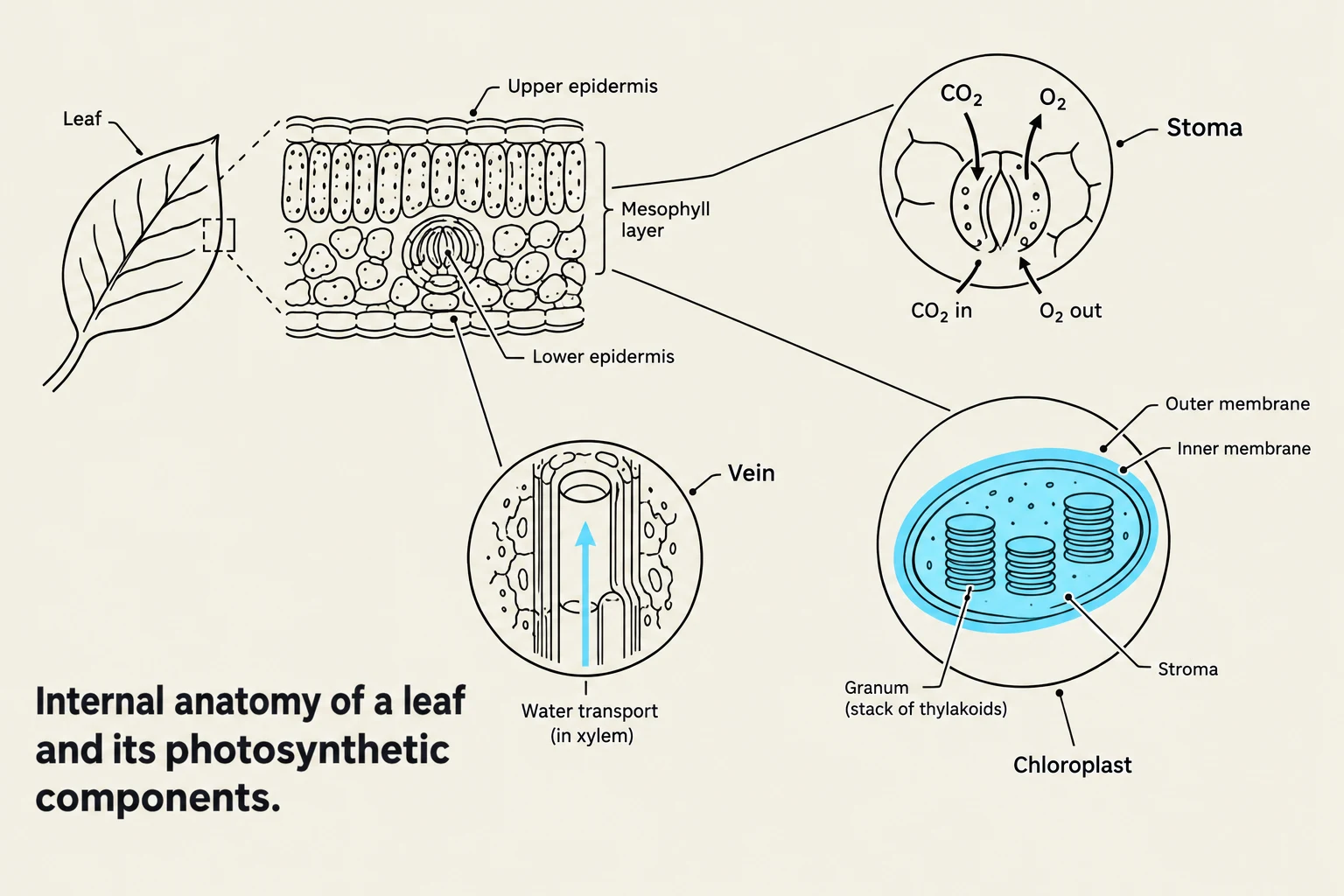
Diagram illustrating the internal anatomy of a leaf, including its epidermis, mesophyll layer, veins, stomata, and chloroplasts, with details on water transport and gas exchange during photosynthesis.
In plants, most photosynthesis occurs within the leaves. To understand how this happens, we must look at the specialized anatomy of the leaf and the organelles within its cells.
Leaf Anatomy
The interior tissue of the leaf is known as the mesophyll, where chloroplasts are primarily located. Gas exchange is managed by microscopic pores called stomata, through which CO2 enters and O2 exits the leaf. Meanwhile, veins transport water from the roots to the photosynthetic cells and export the resulting sugars to the rest of the plant.
Chloroplast Organization
The actual chemical work of photosynthesis takes place inside organelles called chloroplasts. A chloroplast is enclosed by an envelope of two membranes and contains a dense fluid called the stroma. Suspended within the stroma is a third membrane system composed of connected sacs called thylakoids. These thylakoids may be stacked in columns known as grana.
The most critical component within these membranes is chlorophyll, the pigment responsible for the green color of leaves. Chlorophyll absorbs specific wavelengths of light (primarily violet-blue and red) while reflecting green light, which is why plants appear green to our eyes.
The Chemistry of Photosynthesis
Photosynthesis is a complex series of reactions that can be summarized by the following chemical equation:
6CO2+12H2O+Light energy→C6H12O6+6O2+6H2O
Photosynthesis as a Redox Process
At its chemical core, photosynthesis is a redox (reduction-oxidation) process. In this reaction, water (H2O) is oxidized, and carbon dioxide (CO2) is reduced. Because it requires an input of energy to drive these reactions, photosynthesis is an endergonic process, with the necessary energy boost provided by sunlight.
Exam Tip: Remember that photosynthesis is essentially the reverse of cellular respiration in terms of electron flow and chemical reactants.
The Two Stages of Photosynthesis
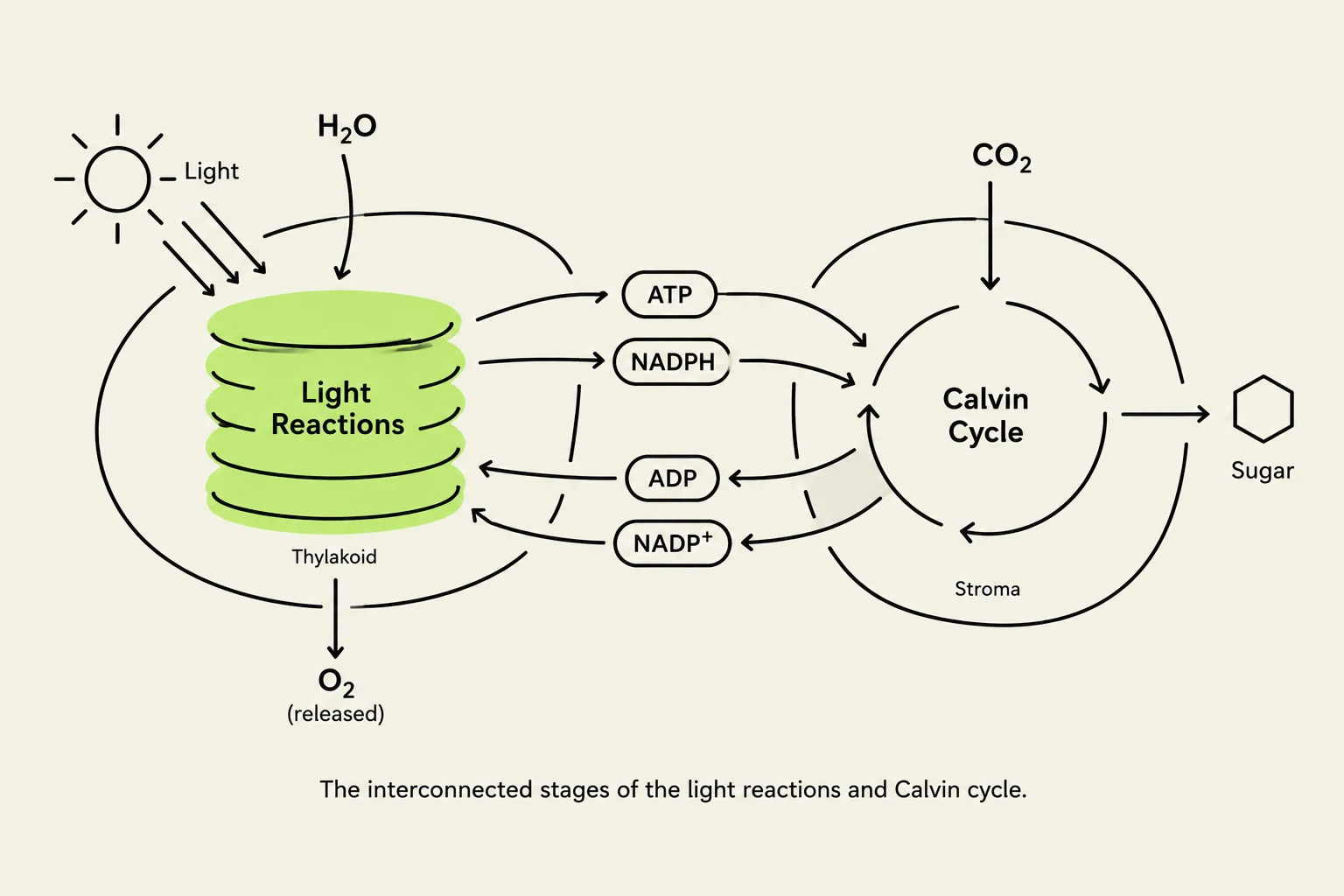
The interconnected stages of the light reactions and Calvin cycle.
Photosynthesis is divided into two distinct but cooperative stages: the light reactions and the Calvin cycle.
1. The Light Reactions (The "Photo" Part)
Occurring in the thylakoids, the light reactions use solar energy to split water molecules, which releases electrons, protons ($H^+$), and oxygen (O2) as a by-product. This stage serves two main purposes:
Reducing electron acceptors: It reduces NADP+ to NADPH.
Generating ATP: It produces ATP from ADP through a process called photophosphorylation.
The movement of electrons can follow two paths: linear electron flow, which produces both ATP and NADPH using both photosystems, or cyclic electron flow, which uses only Photosystem I to produce ATP without producing NADPH or oxygen.
2. The Calvin Cycle (The "Synthesis" Part)
Occurring in the stroma, the Calvin cycle uses the chemical energy (ATP) and the reducing power (NADPH) generated in the light reactions to build sugar from CO2. This anabolic process consists of three main phases:
Carbon Fixation: The enzyme rubisco catalyzes the binding of CO2 to a five-carbon sugar called ribulose bisphosphate (RuBP).
Reduction: The fixed carbon is altered through phosphorylation and reduction to produce a three-carbon sugar called glyceraldehyde 3-phosphate (G3P).
Regeneration: The remaining molecules are rearranged to regenerate the RuBP acceptor, allowing the cycle to continue.
Summary Table: Energy Requirements
For the net synthesis of just one G3P molecule, the Calvin cycle must consume nine molecules of ATP and six molecules of NADPH.
Evolutionary Adaptations: C4 and CAM Pathways
This diagram illustrates the differences between C4 and CAM photosynthesis, focusing on how carbon fixation occurs spatially in C4 plants and temporally in CAM plants.
In hot, arid climates, plants face the challenge of dehydration. If they keep their stomata open to take in CO2, they lose water; if they close them, they risk photorespiration, a wasteful process where rubisco binds with O2 instead of CO2. To combat this, some plants have evolved alternative mechanisms:
C4 Plants: These plants (like corn and sugarcane) structurally separate initial carbon fixation from the Calvin cycle. They fix CO2 into a four-carbon compound in the mesophyll cells before transporting it to bundle-sheath cells where the Calvin cycle occurs.
CAM Plants: These plants (like succulents) separate the processes in time. They open their stomata at night to fix CO2 into organic acids and close them during the day to conserve water, releasing the stored CO2 for the Calvin cycle while the sun is out.
Keep reading for free.
Create an account to finish this reading and make it part of your study routine.