Introduction to Phonetics, Phonology, and Morphology
This review covers the essential concepts of phonetics, phonology, and morphology, providing a comprehensive foundation for linguistic study. It explains the differences between phonetics and phonology, the use of the International Phonetic Alphabet (IPA), and the distinctions between phonemes and allophones. The mater
Understanding the building blocks of speech requires a dual approach: looking at the physical mechanics of sound production and the mental rules that organize those sounds into a language. This review covers the essential concepts of phonetics, phonology, and morphology to provide a comprehensive foundation for linguistic study.
Phonetics vs. Phonology
While often used interchangeably in casual conversation, phonetics and phonology represent two distinct levels of analysis.
Phonetics is the study of the acoustic and physiological aspects of speech production. It focuses on how sounds are physically made and perceived. This field is typically categorized into three branches:
Articulatory Phonetics: How the articulators (like the tongue and lips) move to produce sound.
Acoustic (Applied) Phonetics: The physical properties of the sound waves themselves.
Perceptual Phonetics: How the ear and brain receive and interpret those sounds.
Phonology, conversely, is the study of speech sound patterns and systems within a specific language. It is less about the physical sound and more about the "rules" of the language. A vital part of phonology is phonotactics, which refers to the rules governing permissible sound combinations. For example, English allows certain s clusters at the beginning of words (like "stay"), whereas Spanish phonotactic rules might prohibit them.
The International Phonetic Alphabet (IPA) and Transcription
Standard English orthography (spelling) is often inconsistent, making it a poor tool for scientific study. For instance, the sound /ʃ/ can be represented by different allographs (different spellings for the same sound, such as "shoe," "sugar," or "chef") or digraphs (two letters representing one sound, such as "th" in "thought").
To solve this, linguists use the International Phonetic Alphabet (IPA), which provides a 1:1 relationship between a speech sound and its symbol. There are two primary levels of transcription:
Broad Transcription: Uses slashes $/ / $ to represent phonemes, the mental representations of sounds.
Narrow Transcription: Uses brackets $[ ]$ and diacritical markers to represent allophones. This level captures minor phonetic variations caused by dialect, co-articulation, or speech disorders that do not change the word's meaning.
Exam Tip: If you see slashes $/ /$, the question is asking about phonemes (meaningful units). If you see brackets $[ ]$, it is asking about allophones (physical variations).
Phonemes and Allophones
The distinction between a phoneme and an allophone is central to phonology.
Phoneme: The smallest meaningful unit of sound. If you change one phoneme in a word, you create a minimal pair—two words that differ by only one sound and have different meanings (e.g., bat vs. cat or bat vs. bad).
Allophone: A phonetic variation of a phoneme that does not change the word's meaning. Think of allophones as different "shades" of the same color.
Allophones relate to one another in two ways:
Complementary Distribution: The variations are constrained by their phonetic environment (they appear in specific "neighborhoods" of sounds).
Free Variation: The variations are not constrained by the phonetic environment; a speaker can choose one or the other without changing the word.
Morphology: The Structure of Meaning
While phonology deals with sounds, morphology deals with morphemes, which are the smallest units of language that carry meaning. The study of how sounds combine to form these units is known as morphophonemics.
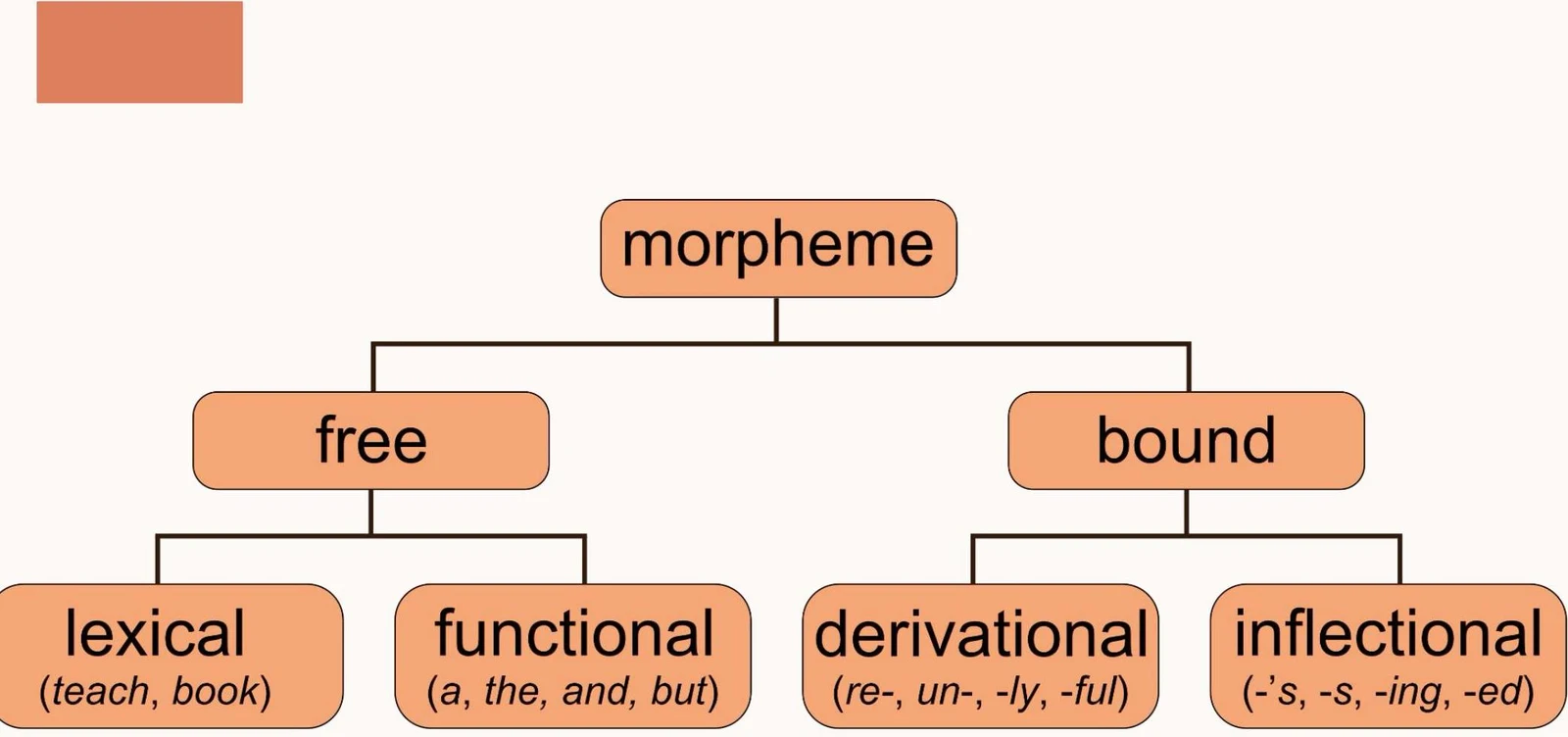
Morphemes are categorized into two main groups:
Free Morphemes
These can stand alone as independent words.
Lexical Morphemes: Content words that carry the primary meaning of a sentence, such as "book" or "teach".
Functional Morphemes: Grammar words that provide structure, such as "the," "and," or "but".
Bound Morphemes
These cannot stand alone and must be attached to other morphemes.
Derivational Morphemes: These change the word class or the fundamental meaning of the word (e.g., adding "-ly" to an adjective to make an adverb, or "un-" to change a meaning).
Inflectional Morphemes: These do not change the word class but indicate grammatical properties, such as pluralization ("-s") or tense ("-ed").
This diagram illustrates the classification of morphemes into free and bound types, with further subdivisions for each.
Consonants and Vowels
Speech sounds are divided into segments: consonants and vowels.
Consonants
Consonants are produced with some degree of constriction or blockage in the oral cavity. They are classified using three parameters:
Place: Where the constriction occurs (e.g., Bilabial, Alveolar, Velar).
Manner: How the air flows (e.g., Stops, Fricatives, Nasals, Liquids, Glides).
Voicing: Whether the vocal folds are vibrating (Voiced) or not (Voiceless).
Consonants can be further grouped into Obstruents (sounds with turbulent airflow, like stops and fricatives) and Sonorants (sounds with continuous, non-turbulent airflow, like nasals and liquids).
Vowels
Vowels are the most sonorant speech sounds, produced with little to no obstruction in the oral cavity. They typically serve as the nucleus of a syllable. Vowels are classified by four parameters:
Tongue Height: High, mid, or low.
Tongue Advancement: Front, central, or back.
Lip Rounding: Rounded or unrounded.
Muscle Tenseness: Tense or lax.
Special vowel types include Diphthongs (sounds that move from one vowel position to another, like /aɪ/ in "high") and R-colored vowels (vowels influenced by the "r" sound, like /ɚ/ in "teacher").
Syllables and Stress
A syllable is the smallest unit of speech production and must contain a vowel (the nucleus). A syllable can be broken down into:
Onset: The optional consonant(s) at the beginning.
Rhyme: The core of the syllable, consisting of the nucleus (required) and the coda (optional consonants).
Lexical Stress refers to the increased emphasis placed on a specific syllable within a word. A stressed syllable is typically longer in duration, louder in intensity, and higher in pitch. In English, stress patterns can be Trochaic (strong-weak, like "apple") or Iambic (weak-strong, like "reward").
Keep reading for free.
Create an account to finish this reading and make it part of your study routine.