An overview of pharmacology, covering drug nomenclature, pharmacokinetics (absorption, distribution, metabolism, excretion), and pharmacodynamics (receptor and enzyme interactions).
Pharmacology is the scientific study of medicines, specifically focusing on the biological effects of chemicals on the body. Derived from the Greek words pharmakon (drug) and logos (study), this field explores how substances interact with living systems to treat, prevent, or diagnose disease. To master pharmacology, one must distinguish between several core disciplines: pharmaceutics (how dosage forms influence drug effects), pharmacokinetics (what the body does to the drug), pharmacodynamics (what the drug does to the body), and pharmacotherapeutics (the clinical use of drugs).
Drug Nomenclature and Labeling
When studying medications, it is crucial to distinguish between the different names a drug may carry. A single medication can be identified by its chemical name, its generic name, and its trade name.
Chemical Name: Describes the drug's specific chemical composition and molecular structure.
Generic Name: Also known as the nonproprietary or official name. This is the name approved by regulatory bodies like Health Canada.
Trade Name: Also known as the proprietary name. This is a registered trademark owned by the manufacturer, and its use is legally restricted.
For example, a single medication might be labeled with its brand name, the company name, the generic name, the dosage, and the specific form (such as a tablet or capsule).
Figure 1.4 The basic content of a drug label includes the drug brand name, drug company name, generic names, dosage, and form of the medication.
Drugs are also organized into two primary classification systems:
Therapeutic Classification: Based on the drug's clinical indication or intended use (e.g., an antihypertensive used to treat high blood pressure).
Pharmacological Classification: Based on the drug's mechanism of action (MOA), or how it works within the body (e.g., beta-blockers).
Pharmacokinetics: What the Body Does to the Drug
Pharmacokinetics describes the movement of a drug through the body from the moment of administration until it is completely eliminated. This process is divided into four distinct phases: absorption, distribution, metabolism, and excretion.
1. Absorption
Absorption is the movement of a drug from its site of administration through body membranes and into the bloodstream. The route of administration significantly impacts how quickly a drug is absorbed:
Enteral (Oral): Drugs are absorbed through the mucosa of the GI tract. While safe and inexpensive, absorption can be variable due to stomach acid, food, or previous surgeries.
Sublingual/Buccal: Drugs placed under the tongue or against the cheek are rapidly absorbed via highly vascularized tissue, bypassing the liver's first-pass effect.
Parenteral (Injection):
Intravenous (IV): The fastest route, as the drug enters circulation directly. It avoids the first-pass effect but carries higher risks like infection or fluid overload.
Intramuscular (IM) & Subcutaneous (SC): These are slower than IV. SC injections allow for slow, sustained absorption, which is ideal for medications like insulin.
Topical: Applied to surfaces like skin or eyes. These often have a slower onset but a more prolonged duration of action.
The First-Pass Effect and Bioavailability
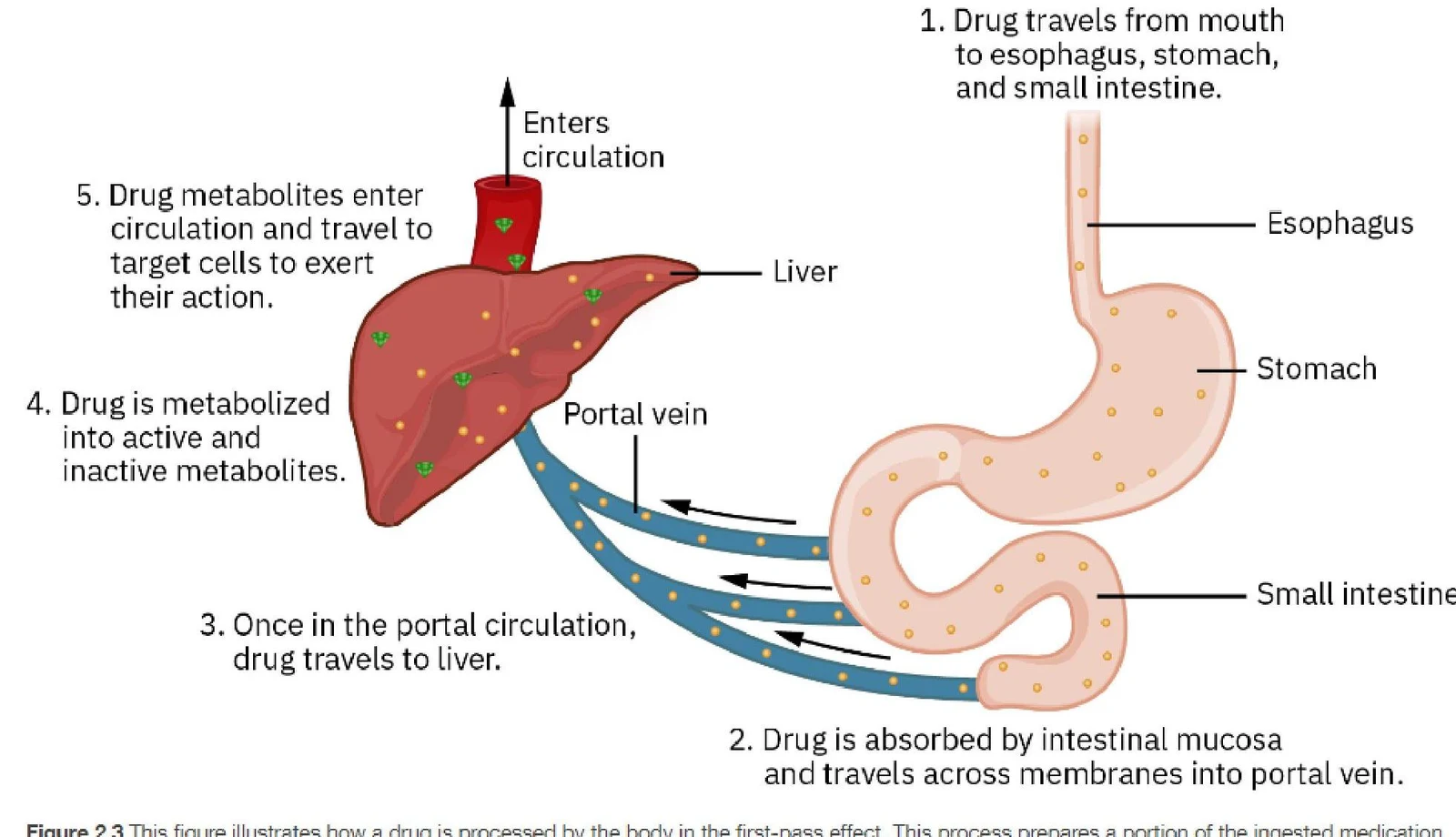
When drugs are taken orally, they are absorbed in the GI tract and transported to the liver via the portal vein. In the liver, many drugs are chemically transformed into inactive metabolites before they ever reach systemic circulation. This is known as the first-pass effect. Bioavailability refers to the percentage of the active drug that actually reaches the site of action. Because of the first-pass effect, oral doses often must be significantly higher than IV doses to achieve the same therapeutic effect.
This figure illustrates how a drug is processed by the body in the first-pass effect, detailing its journey from ingestion through absorption, metabolism in the liver, and eventual action on target cells.Figure 2.3 This figure illustrates how a drug is processed by the body in the first-pass effect.
2. Distribution
Once in the blood, the drug is distributed to its site of action. This is influenced by blood flow (tissues with high perfusion like the heart and brain receive drugs faster), membrane permeability, and protein binding.
Many drugs bind to plasma proteins, primarily albumin. Only the "unbound" or "free" portion of the drug is pharmacologically active and able to move into tissues.
Clinical Alert: Protein Binding
If a patient has low albumin levels (due to malnutrition or liver disease), there will be more "free" drug available in the blood, which can lead to toxicity. Similarly, if two highly protein-bound drugs are given together, they may compete for binding sites, increasing the free concentration of both and risking adverse effects.
3. Metabolism (Biotransformation)
Metabolism is the process of breaking down and transforming drugs into different substances. The liver is the primary organ for metabolism, utilizing a group of enzymes known as the Cytochrome P-450 (CYP450) system.
Metabolism can be influenced by other drugs:
Enzyme Inhibitors: These decrease metabolism, leading to drug accumulation and potential toxicity.
Enzyme Inducers: These increase metabolism, which can reduce the effectiveness of a medication.
4. Excretion
Excretion is the removal of drugs from the body. The kidney is the primary organ for excretion, filtering water-soluble drugs into the urine. Other routes include the lungs, skin, bile, and feces.
Nursing Tip: Monitoring Renal Function
Before administering medications, always check renal function tests, such as Blood Urea Nitrogen (BUN) and serum creatinine. In elderly patients or those with kidney disease, decreased excretion can lead to dangerous drug accumulation and toxicity.
Understanding Half-Life and Steady State
The half-life (t1/2) is the time required for 50% of a drug to be removed from the body.
Steady State: This occurs when the amount of drug being absorbed equals the amount being eliminated.
Example: If a 500mg tablet has a half-life of 4 hours:
At 0 hours: 500mg
At 4 hours: 250mg
At 8 hours: 125mg
At 12 hours: 62.5mg.
Pharmacodynamics: What the Drug Does to the Body
Pharmacodynamics focuses on the mechanism of action (MOA)—the specific way a drug interacts with the body to produce an effect. Drugs typically exert their actions through three ways: receptor interactions, enzyme interactions, or nonselective interactions.
Receptor Interactions
A receptor is a protein molecule located on a cell surface or inside a cell. When a drug binds to a receptor, it triggers a response. The strength of this binding is called affinity.
Drug Type
Action
Agonist
Binds to the receptor and elicits a physiological response.
Partial Agonist
Binds to the receptor but produces a diminished response.
Antagonist
Binds to the receptor but produces no response; it blocks agonists from binding.
Competitive Antagonist
Competes with the agonist for the same binding site.
Noncompetitive Antagonist
Binds to a different part of the receptor, inactivating it regardless of agonist concentration.
Enzyme Interactions
Drugs can also interact with enzymes, which are substances that catalyze biochemical reactions. A drug might act as an enzyme inhibitor (blocking activity) or an enzyme activator (enhancing activity) to alter physiological responses.
Pharmacotherapeutics and Safety
Pharmacotherapeutics involves using drugs to achieve desired outcomes, such as curing a disease, reducing symptoms, or preventing illness (prophylaxis).
The Therapeutic Index
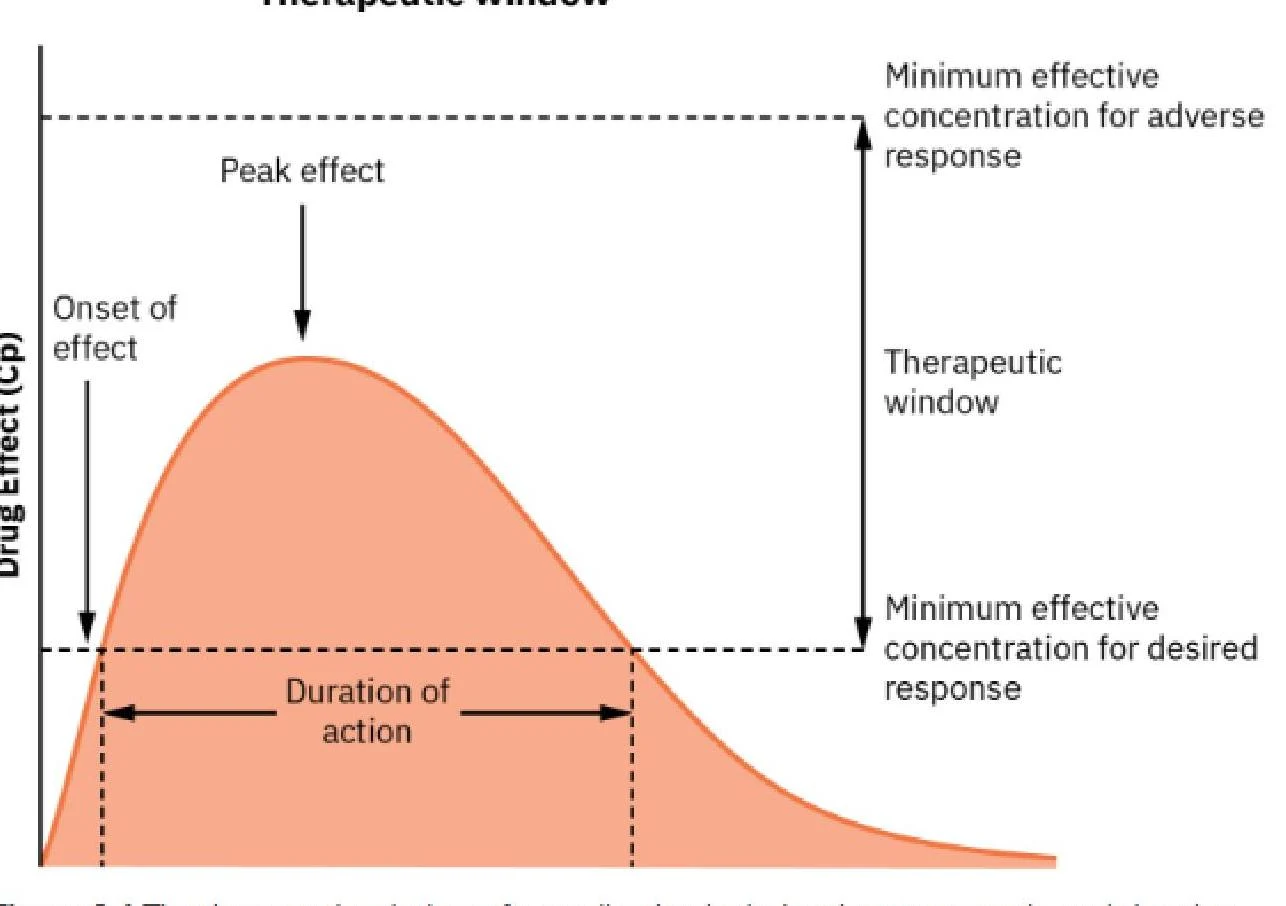
The therapeutic index is the range between a dose that is effective and a dose that is toxic.
Low Therapeutic Index: A small margin between the effective dose and the toxic dose; these drugs require very careful monitoring.
High Therapeutic Index: A wide margin of safety where toxicity is less likely.
This graph illustrates the concept of a therapeutic window, which represents the range of drug concentrations that produce the desired therapeutic effect without causing significant adverse effects.Figure 2.4 The therapeutic window of a medication includes the onset, peak, and duration of the medication.
Adverse Events and Errors
In clinical practice, it is vital to distinguish between different types of medication-related issues:
Adverse Drug Reaction (ADR): An unexpected and undesirable occurrence at therapeutic dosages.
Allergic Reaction: An immune response where the body perceives the drug as a danger.
Medication Error: A preventable situation involving a compromise in the "ten rights" of medication administration.
Adverse Drug Event (ADE): A broad term for any undesirable occurrence involving medications.
Keep reading for free.
Create an account to finish this reading and make it part of your study routine.