Introduction to Pathophysiology: Understanding Disease Mechanisms
This content introduces pathophysiology, defining health and disease, exploring the spectrum of normal physiological ranges, and differentiating between pathology and pathophysiology. It also covers the clinical application of medical history and the evolving landscape of medical research.
The study of medicine is more than just memorizing names of drugs or symptoms; it is the study of how the human body functions and, more importantly, how it fails. To understand why a patient feels pain or why an organ stops working, we must look at the intersection of biology and dysfunction. This intersection is known as pathophysiology.
Defining Health and Disease
At the most fundamental level, medical science seeks to define the boundary between being well and being ill. Health is not merely the absence of sickness; it is defined as a state of physical, mental, and social well-being.
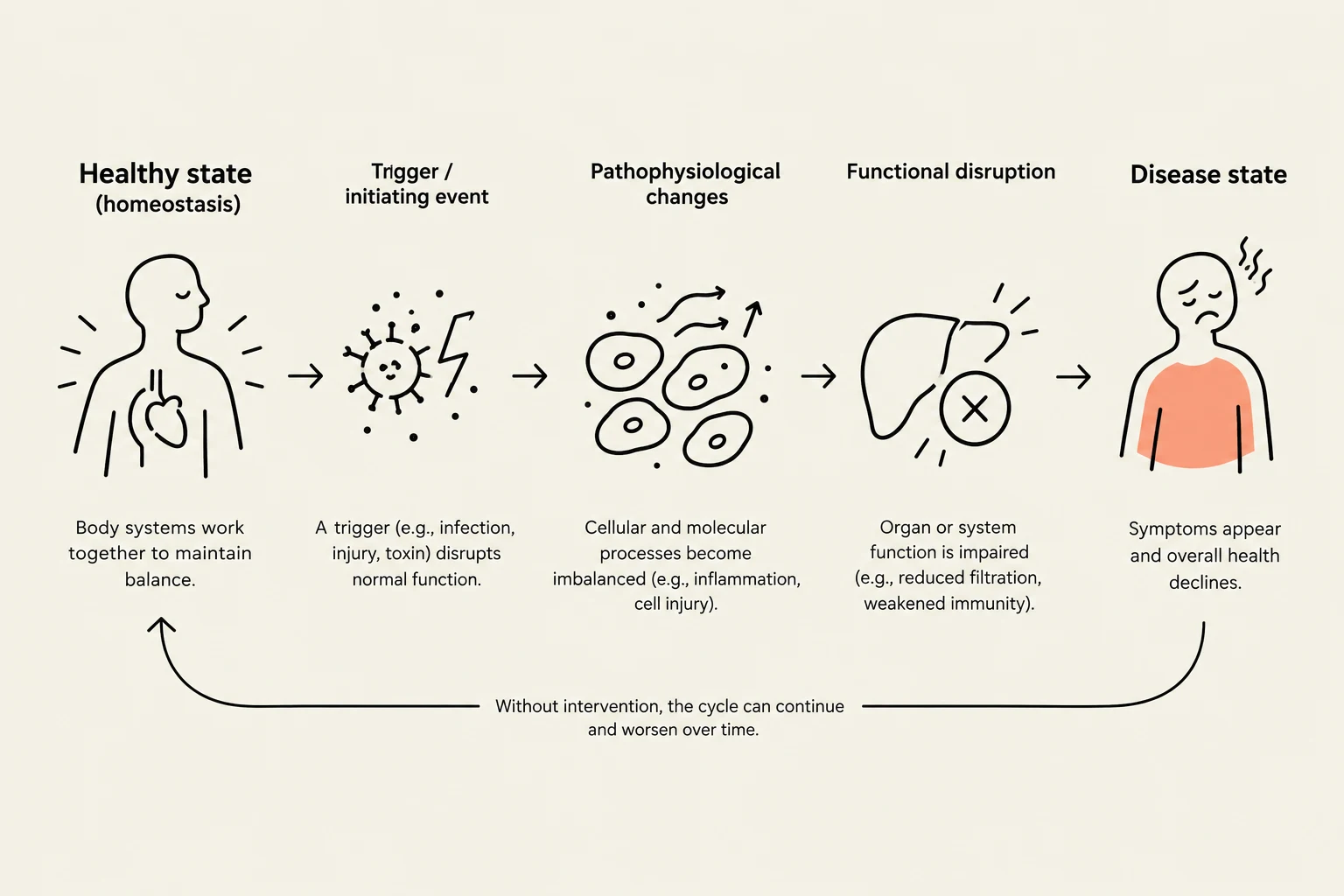
When this state of well-being is disrupted, we encounter disease. Disease is characterized as a deviation from the normal state of homeostasis. Homeostasis is the body's ability to maintain a stable, constant internal environment despite changes in the external world. When a disease process occurs, it disrupts these delicate balances, forcing the body to react to the imbalance.
Exam Tip: When studying for clinical exams, remember that "health" is a holistic concept. If a question asks about a patient's health, look beyond just their physical symptoms to include their mental and social status.
The Spectrum of "Normal"
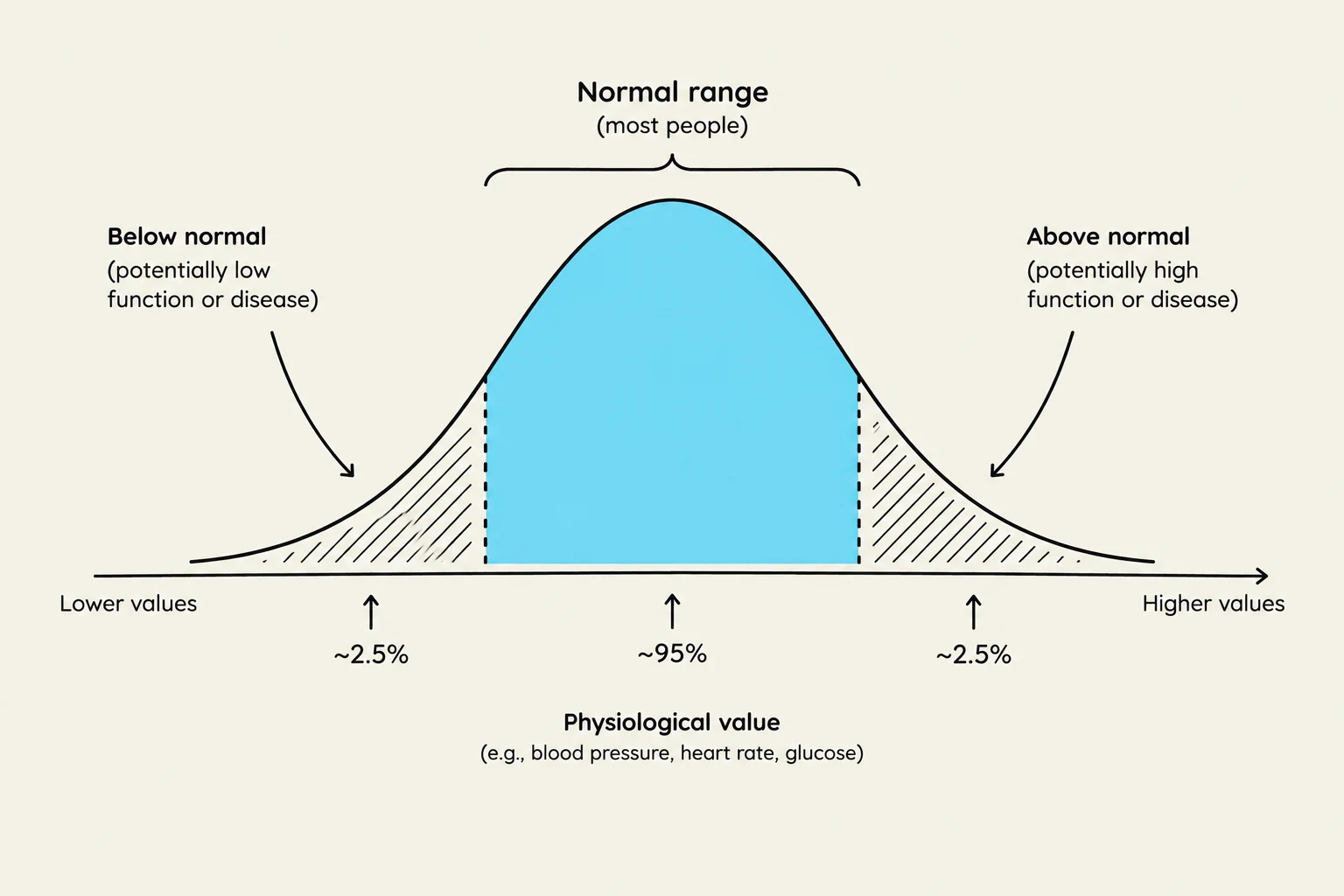
A common misconception is that "normal" is a single, fixed number. In reality, health indicators exist within a range of values. For example, a "normal" heart rate for an elite athlete is significantly different from that of a sedentary elderly person.
Establishing these ranges is complex because "normal" is a moving target influenced by several individual variables:
Age: Physiological needs and capacities change as we grow and age.
Gender: Hormonal and anatomical differences affect baseline values.
Genetics: Inherited traits set the biological "blueprint."
Environment: Temperature, altitude, and pollution can shift physiological baselines.
Activity level: Physical exertion immediately alters metabolic and cardiovascular indicators.
A bell curve illustrating normal physiological ranges, with deviations labeled as below normal and above normal, indicating potential implications for function or disease. The graph shows approximately 95% of values falling within the normal range, and 2.5% in each tail.
Pathophysiology vs. Pathology
While these terms are often used interchangeably in casual conversation, they represent different perspectives in medical science.
Pathology focuses on the structural changes in body tissues caused by disease. If a pathologist looks at a piece of lung tissue under a microscope and sees scarred, thickened cells, they are observing pathology.
Pathophysiology, however, focuses on the functional (physiologic) changes that occur as a result of that disease. Using the same example, a pathophysiologist would study how those scarred lung cells prevent the efficient exchange of oxygen, leading to shortness of breath.
Pathophysiology builds directly upon the foundational knowledge of anatomy (the structure) and physiology (the function) to establish cause-and-effect relationships. These relationships are identified through signs and symptoms, which guide the study of specific diseases.
Clinical Application: The Medical History
To understand the pathophysiology of a patient, a clinician must reconstruct the timeline of the patient's health. This is achieved through a comprehensive medical history. A thorough history is not just a list of current complaints; it must include:
Current and prior illnesses: To identify patterns of chronic or recurring disease.
Allergies: To prevent adverse reactions to treatments.
Hospitalizations: To understand the severity of past physiological disruptions.
Treatments and Therapies: This must be exhaustive, covering:
Prescription medications.
Nonprescription (over-the-counter) drugs.
Herbal items and food supplements.
By documenting these factors, clinicians can identify predisposing factors—the tendencies that promote the development of a disease in a specific individual.
The Evolving Landscape of Medicine
Pathophysiology is not a static field; it is characterized by constant evolution driven by extensive research. As we develop a deeper understanding of cellular adaptations and damage, our ability to intervene improves.
Modern trends in the field are focused on:
Improved diagnostic tests: Allowing for earlier detection of disease.
New technologies: Enhancing our ability to visualize and monitor physiological changes.
Drug development: Creating more effective medications to control or cure disorders.
This progress shifts the focus of healthcare toward disease prevention. By understanding the mechanisms of disease, society can implement routine vaccination programs, community health initiatives, and regular screening programs to catch deviations from homeostasis before they become life-threatening.
This diagram illustrates the progression from a healthy state to a disease state, detailing the role of triggers, pathophysiological changes, and functional disruption.
Summary Table: Key Terminology
Term
Definition
Pathogenesis
The development of a disease
Acute Disease
Develops quickly, marked signs, short term
Chronic Disease
Develops gradually, persists for a long time
Incidence
Number of new cases in a population over time
Prevalence
Total number of new and existing cases in a population
Keep reading for free.
Create an account to finish this reading and make it part of your study routine.