Introduction to Pathology and Etiology: Understanding Disease Causes
Explore the fundamental concepts of pathology, the study of disease, and etiology, the investigation of disease causes. This guide covers genetic, congenital, and acquired etiologies with examples.
In the medical field, understanding a patient's symptoms is only the first step. To truly treat a condition, one must understand why it occurred in the first place. This is where pathology becomes essential. Acting as the vital bridge between basic sciences and clinical practice, pathology allows clinicians to move from observing a symptom to understanding the underlying biological disruption.
What is Pathology?
The term pathology is derived from two Greek words: pathos, meaning "suffering," and logos, meaning "study". Therefore, at its most fundamental level, pathology is the study of suffering. It is the scientific discipline that investigates the causes, mechanisms, and effects of human disorders and diseases.
By studying pathology, medical professionals can identify how a specific agent—such as a virus or a chemical—interacts with human tissue to produce the signs and symptoms seen in a clinical setting.
The Concept of Etiology
Every phenomenon in nature has a cause, and the same principle applies to the human body. In medicine, the specific causative factor of a disorder or disease is known as the etiology or the etiological agent.
To understand etiology, it is helpful to look at specific clinical examples:
Influenza: In the case of influenzal pneumonia (an infectious inflammation of the lung tissue), the etiological agent is the influenza virus.
Acute Cystitis: This is an acute inflammation of the urinary bladder. While many factors can contribute, the most common etiological agent is the bacterium E. coli.
Exam Tip: When asked to identify an etiology, look for the "agent" (the virus, bacteria, or chemical) that initiates the disease process.
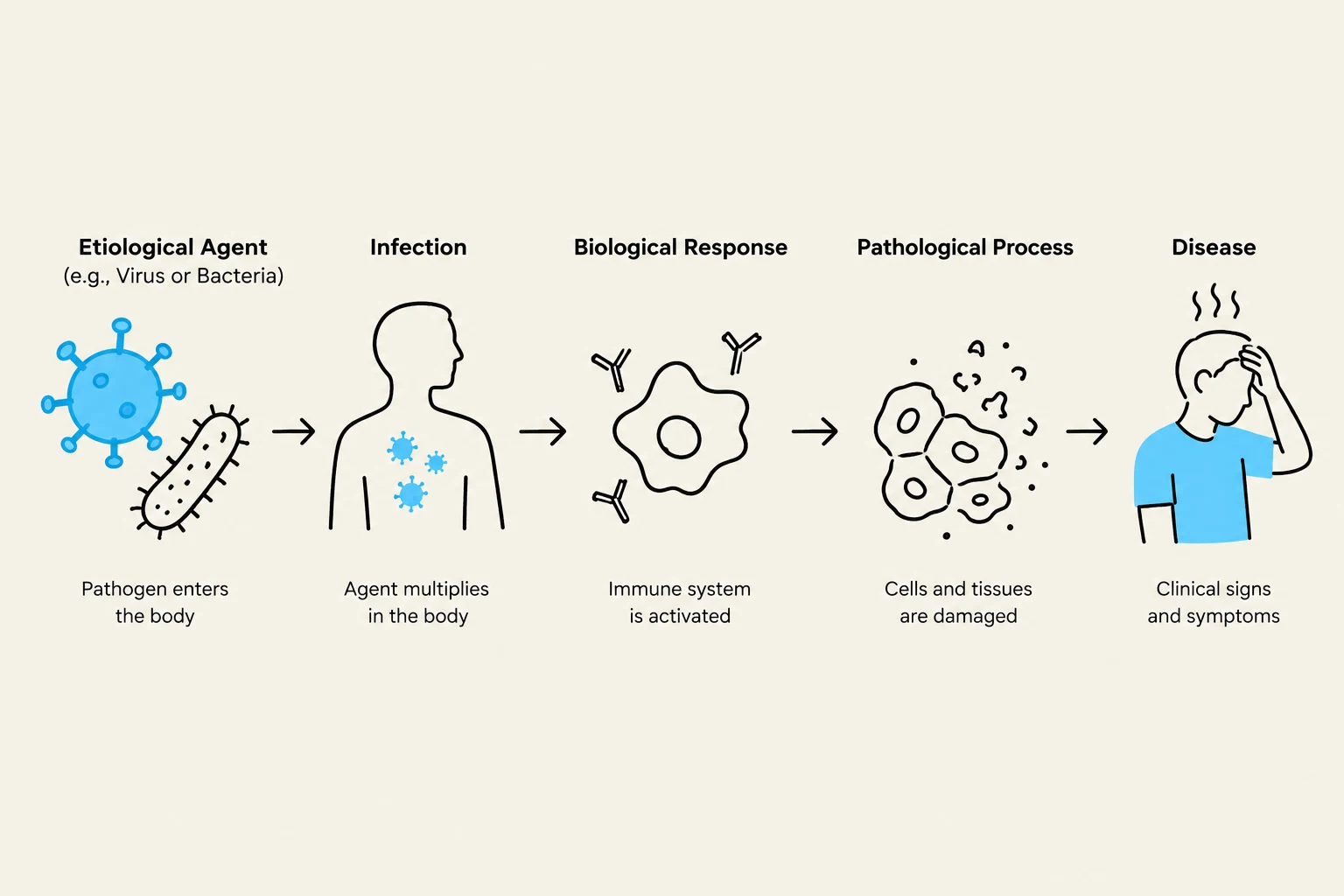
This diagram illustrates the progression of a disease, starting from an etiological agent entering the body, leading to infection, the body's biological response, a pathological process, and finally, the manifestation of disease with clinical signs and symptoms.
Idiopathic Diseases: When the Cause is Unknown
Despite our advancements in medical science, we do not know the cause of every ailment. Currently, it is estimated that we only know the etiologies of approximately 25% of all human diseases. When the cause of a disease remains undiscovered, it is classified as idiopathic.
Two notable examples of idiopathic conditions involve the spine:
Ankylosing Spondylitis: This is an inflammatory disease (not a degenerative one) of the vertebral synovial joints. It can lead to "ankylosis," which is the complete fusion of the joints, and the ossification of the ligaments of the spine.
Diffuse Idiopathic Skeletal Hyperostosis (DISH): Also known as Forestier’s disease, this condition is characterized by the ossification of the anterior longitudinal ligament. Unlike ankylosing spondylitis, DISH is not an inflammatory disease.
Because the underlying causes of both conditions are unknown, the term "idiopathic" is included in their names.
The Three Categories of Etiology
To organize our understanding of disease, etiologies are generally classified into three primary categories: genetic, congenital, and acquired.
1. Genetic Etiology
Genetic etiology occurs when an individual's own genes are responsible for structural or functional defects. The defect is "hard-coded" into the DNA.
Huntington’s Disease: This is a genetic disorder characterized by the atrophy of the striatal nuclei (including the putamen, caudate nucleus, and globus pallidus). Because these nuclei facilitate voluntary movement, their destruction leads to chorea—involuntary, jerky movements of the face and limbs.
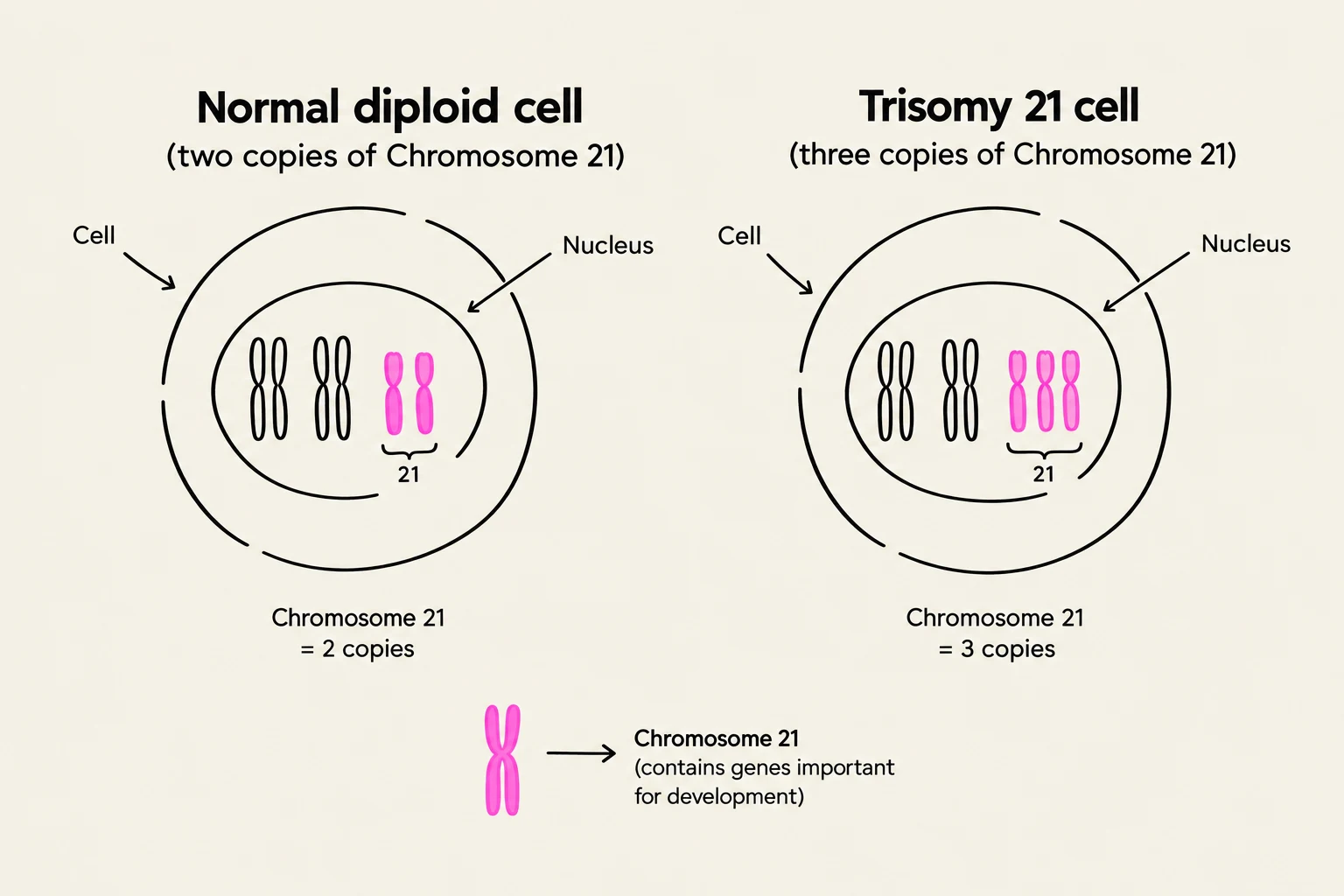
Down’s Syndrome (Trisomy 21): This condition is caused by the presence of three copies of chromosome 21 instead of the usual two. Medical research has noted a correlation between increased parental age and a higher risk of this genetic mutation.
This diagram illustrates the difference between a normal diploid cell and a Trisomy 21 cell. A normal cell has two copies of chromosome 21, while a Trisomy 21 cell has three copies. Chromosome 21 contains genes crucial for development.
2. Congenital Etiology
Congenital etiology refers to conditions that are present at birth. It is important to distinguish this from genetic etiology: in congenital cases, the genetic information may be perfectly intact, but the environment during fetal development interferes with normal growth.
Agents that cause these developmental abnormalities are called teratogens. Examples of congenital issues include:
Polydactyly: Having extra digits (fingers or toes).
Albinism: A lack of melanocytes.
Toxoplasmosis: An infection caused by the parasite Toxoplasma gondii, often spread by domestic animals like cats, which can disturb embryo development.
Fetal Alcohol Syndrome: Resulting from alcohol consumption during pregnancy, which can lead to abnormal appearance, low intelligence, and coordination problems.
Thalidomide Exposure: A historical example where a drug used in the 1960s acted as a potent teratogen, causing massive anatomical abnormalities (hypoplasia and aplasia).
Rubella: A viral infection that can cause miscarriage or serious birth defects if contracted during pregnancy.
3. Acquired Etiology
Acquired etiology encompasses any condition that develops after birth due to external factors. This category includes infections, lifestyle choices, and environmental exposures.
Infections: The Varicella zoster virus is the etiological agent for both chickenpox and shingles (an asymmetrical skin rash accompanied by pain).
Lifestyle/Environmental: Smoking is a known etiological agent for lung emphysema, a condition where the alveoli become significantly enlarged.
Bacterial Complications: A serious example of acquired pathology is a brain abscess. This can occur if bacteria from a local infection, such as acne vulgaris (suppurative inflammation of hair follicles), enter the venous blood. If the protective capsule of an acne lesion is compressed, the pus can leak into the veins of the face, which communicate directly with the brain, allowing bacteria to travel there.
Summary Table of Etiology
Category
Definition
Example
Genetic
Defect in the individual's genes
Huntington's Disease
Congenital
Present at birth due to intrauterine environment
Albinism, Thalidomide effects
Acquired
Developed after birth due to external factors
Emphysema (smoking), Shingles
Keep reading for free.
Create an account to finish this reading and make it part of your study routine.