An overview of fundamental principles in human nutrition, including the MyPlate guide and interpreting nutrition facts, alongside an introduction to the core concepts and mathematical formulations of quantum mechanics.
While the study of human nutrition and the study of quantum mechanics may seem worlds apart, both disciplines rely on fundamental principles to describe the behavior of complex systems. One focuses on the biological requirements for sustaining life through balanced chemical intake, while the other explores the mathematical laws governing the smallest building blocks of the universe. This article provides a comprehensive overview of both fields, offering essential guidelines for healthy living and a mathematical introduction to the quantum realm.
Principles of Human Nutrition
Nutrition is the study of how nutrients are handled by the body and how human behavior and the environment impact the process of nourishment. To maintain health, the body requires a balance of macronutrients (carbohydrates, fats, and proteins) and micronutrients (vitamins and minerals).
The MyPlate Guide
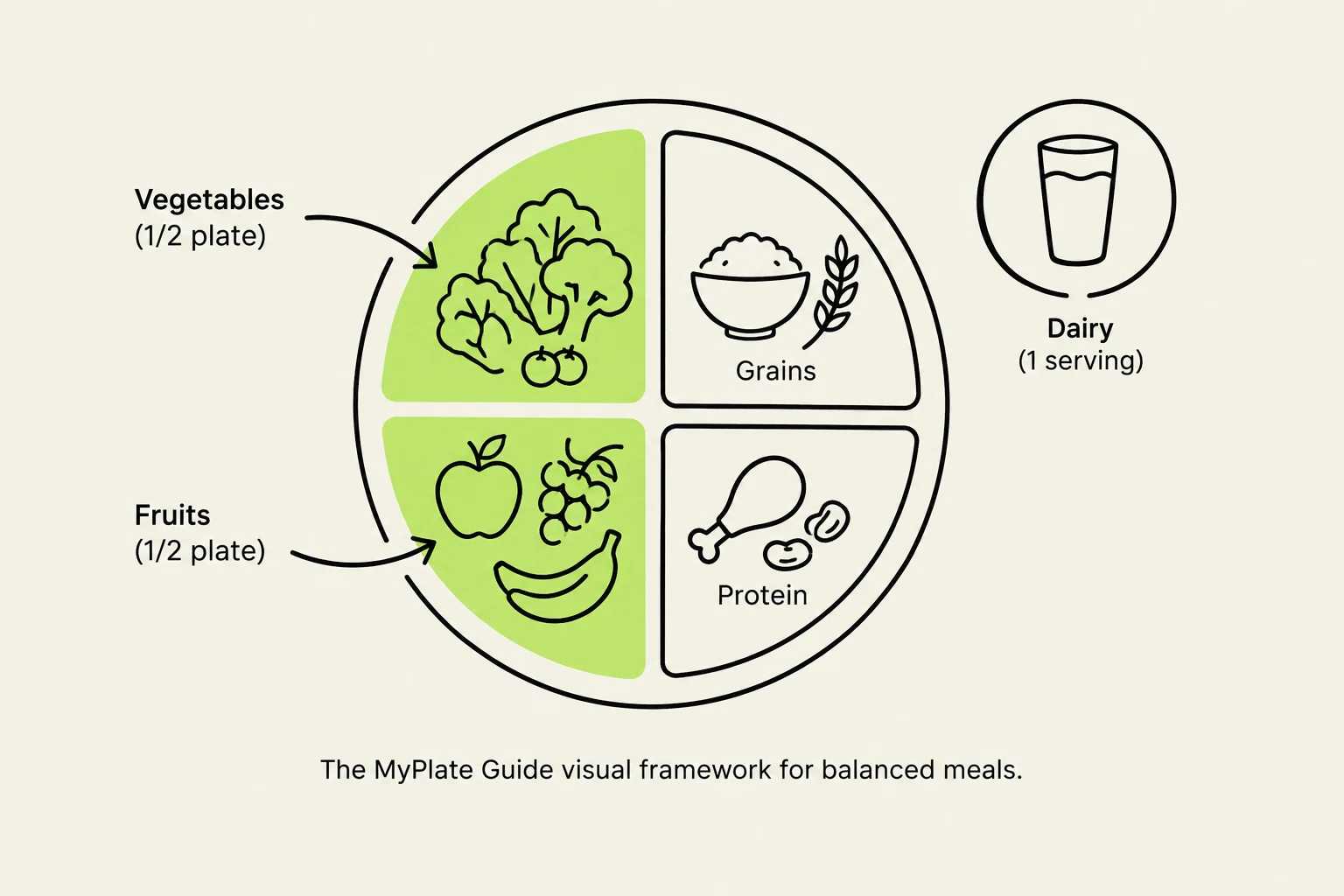
The MyPlate Guide visual framework for balanced meals, illustrating recommended proportions of vegetables, fruits, grains, protein, and dairy.
A practical way to manage nutritional intake is through the MyPlate framework, which visualizes a balanced meal. The core recommendations include:
Fruits and Vegetables: These should make up half of your plate. To maximize fiber and antioxidant intake, prioritize non-starchy vegetables and choose whole fruits over fruit juices.
Grains: Focus on whole grains to ensure adequate levels of fiber, iron, and B vitamins. Refined grains, such as white bread or white rice, offer significantly less nutritional value.
Protein: Aim for palm-sized portions at lunch and dinner. Lean choices like fish, chicken, beans, and nuts are ideal.
Dairy: Aim for approximately three servings per day to meet calcium requirements, preferably choosing low-fat options to minimize excess calories.
MyPlate Guide
Interpreting Nutrition Facts
Weight management is a matter of balancing calories consumed with calories used. When reviewing food labels, three components are critical for making informed decisions:
Serving Size: This defines the specific amount of food to which the nutritional data applies.
Percent Daily Value (%DV): This indicates how much a nutrient in one serving contributes to a total daily diet based on a standard 2,000-calorie intake. For example, if a label shows 18% for total fat, that serving provides 18% of the recommended daily limit.
Nutrient Limitation: To reduce the risk of chronic diseases such as heart disease, high blood pressure, or certain cancers, it is vital to limit the intake of total fat, saturated fat, cholesterol, and sodium.
Exam Tip: Nutritional Assessment
When evaluating a patient's nutritional status, clinicians look at biochemical data. For instance, a decrease in Albumin (normal: 3.5–5.2 g/dL) or Prealbumin (normal: 19–38 mg/dL) can be an indicator of malnutrition.
Fundamentals of Quantum Mechanics
While nutrition governs the macro-scale of human health, quantum mechanics provides the mathematical framework for understanding particle behavior at the smallest possible scales.
Core Principles of the Quantum World
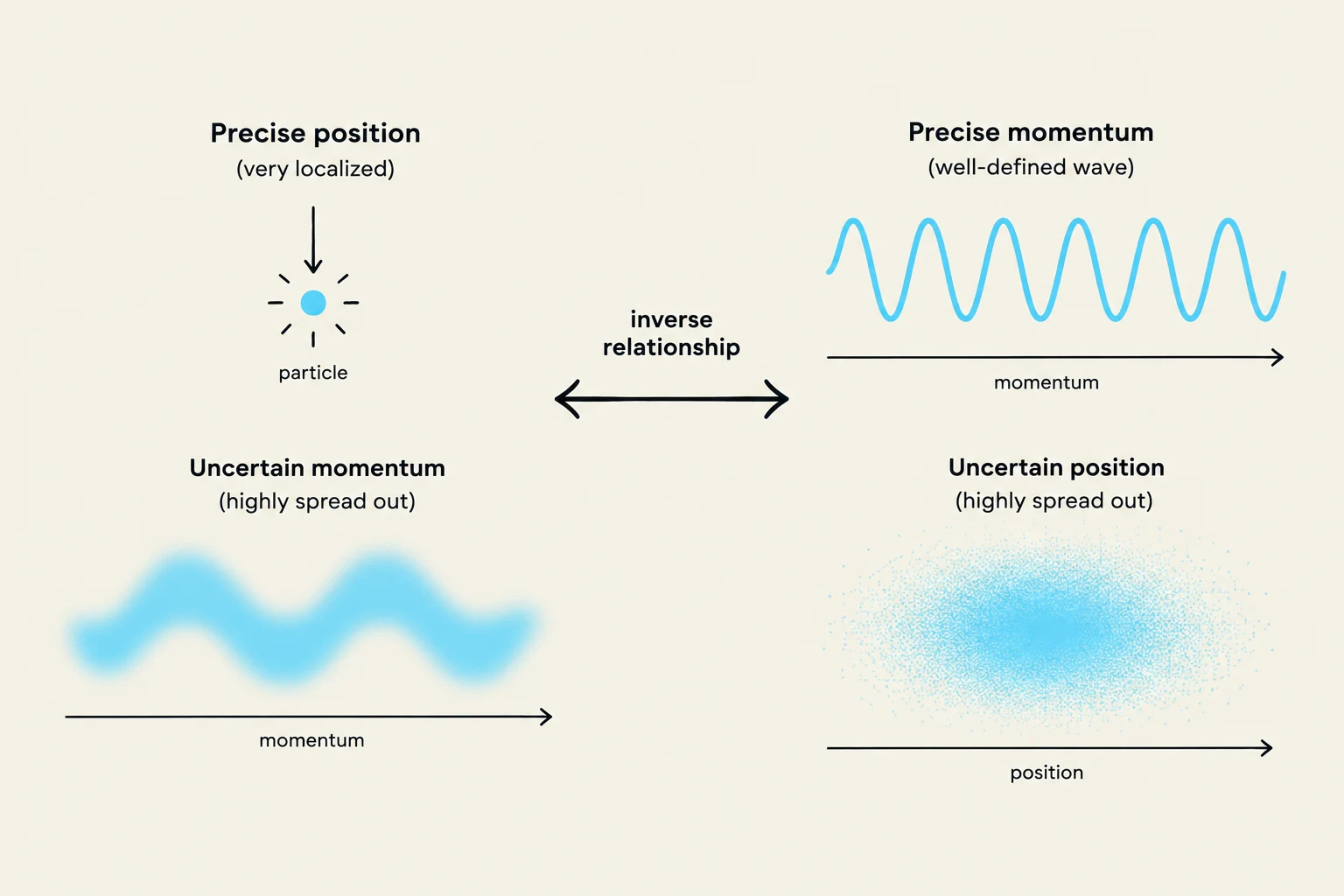
This diagram illustrates the Heisenberg Uncertainty Principle, showing the inverse relationship between the precision of a particle's position and its momentum. When position is precisely known, momentum is uncertain, and vice versa.
Quantum mechanics departs from classical physics through several unique phenomena:
Wave-Particle Duality: Entities such as electrons and photons do not behave strictly as particles or strictly as waves; instead, they exhibit both properties depending on how they are observed.
Superposition: A quantum system can exist in multiple states simultaneously until a measurement is performed. This state is mathematically represented by the wave function, denoted as:
∣ψ⟩
Heisenberg Uncertainty Principle: This principle establishes a fundamental limit on what can be known about a particle. It states that the position (Δx) and the momentum (Δp) of a particle cannot both be known with absolute precision. This is expressed mathematically as:
Δx⋅Δp≥2ℏ
where ℏ is the reduced Planck constant.
Mathematical Formulations
This diagram illustrates the time-dependent Schrödinger equation, a fundamental equation in quantum mechanics. It shows how the wave function, which describes the quantum state of a system, evolves over time under the influence of the Hamiltonian operator, representing the system's total energy.
The evolution of a quantum system is governed by the Schrödinger Equation. This equation describes how the quantum state of a physical system changes over time:
iℏ∂t∂Ψ(r,t)=H^Ψ(r,t)
In this formulation, Ψ(r,t) represents the wave function, and H^ represents the Hamiltonian operator.
Modern Applications
The principles of quantum mechanics are not merely theoretical; they drive cutting-edge technology. Quantum computing utilizes superposition and entanglement to perform calculations that are impossible for classical computers. Furthermore, Quantum Cryptography leverages these principles to secure communications, specifically through methods like Quantum Key Distribution (QKD).
Keep reading for free.
Create an account to finish this reading and make it part of your study routine.