This content explains metabolism as the network of chemical reactions in cells, differentiating between catabolic, anabolic, and amphibolic pathways. It details the role of enzymes as biological catalysts that lower activation energy and discusses thermodynamic principles like Gibbs free energy. The text also covers ce
Every living cell is a marvel of organization, functioning as a complex chemical factory that must constantly work to maintain order. While the universe has a natural tendency toward increasing disorder, known as entropy, living organisms use energy to fight this randomness and maintain the highly structured state necessary for life. This entire network of chemical reactions required to maintain the living state of cells and organisms is known as metabolism.
The Architecture of Metabolism: Pathways and Metabolites
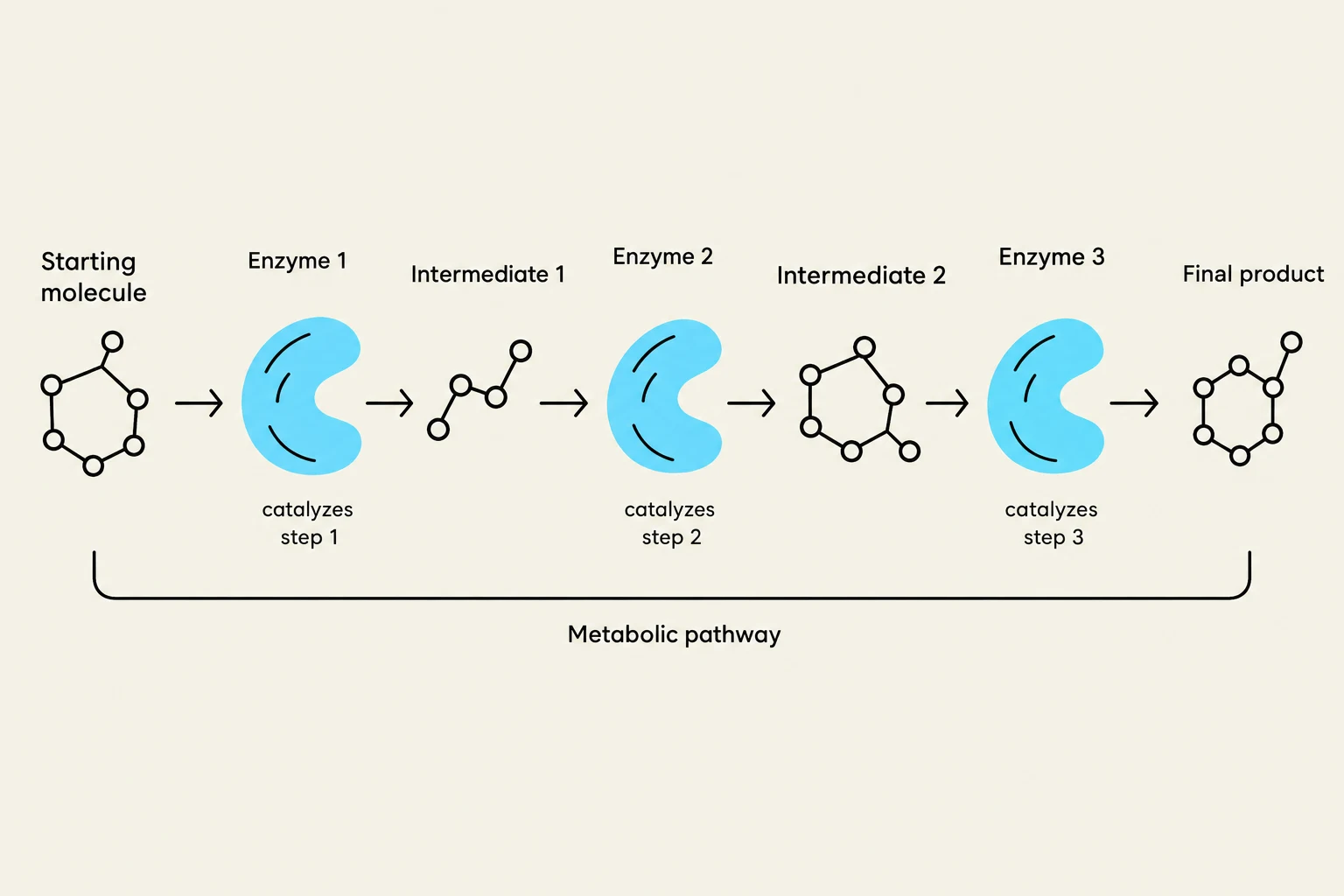
Metabolism does not occur as a single, chaotic explosion of reactions. Instead, it is organized into metabolic pathways. A metabolic pathway is a linked, organized series of reaction steps where the product of one reaction becomes the substrate for the next.
Within these pathways, we encounter two critical types of molecules:
Intermediates: These are the specific compounds produced in one step of a pathway that are immediately used in the subsequent step.
Metabolites: This term generally refers to the small molecules that act as the intermediates and products throughout the metabolic network.
Study Tip: Think of a metabolic pathway like an assembly line in a factory. The raw material enters at one end, undergoes several transformations (the intermediates), and eventually emerges as a finished product (the metabolite).
A metabolic pathway illustrates the sequential enzymatic conversion of a starting molecule into a final product through several intermediate steps.
Anabolism vs. Catabolism: The Two Sides of Energy
To maintain life, cells must balance the synthesis of new components with the breakdown of existing ones. This balance is achieved through two opposing but interconnected types of pathways:
Catabolism (Degradative Pathways)
Catabolic pathways focus on breaking down large, complex molecules into smaller, simpler ones. These reactions are typically exergonic, meaning they release energy. This released energy is often captured in the form of ATP, the cell's primary energy currency.
Anabolism (Synthetic Pathways)
Anabolic pathways are the reverse; they use small molecules to synthesize larger, complex macromolecules required for cell maintenance, growth, and reproduction. Because building complex structures requires effort, these reactions are endergonic, meaning they require an input of energy.
Amphibolic Pathways
Interestingly, some pathways are not strictly one or the other. An amphibolic pathway is a biochemical route that functions in both synthesis (anabolism) and degradation (catabolism).
Enzymes: The Biological Catalysts
If metabolism is the "what," enzymes are the "how". Enzymes are complex proteins produced by living cells that act as catalysts, meaning they speed up chemical reactions without being consumed in the process.
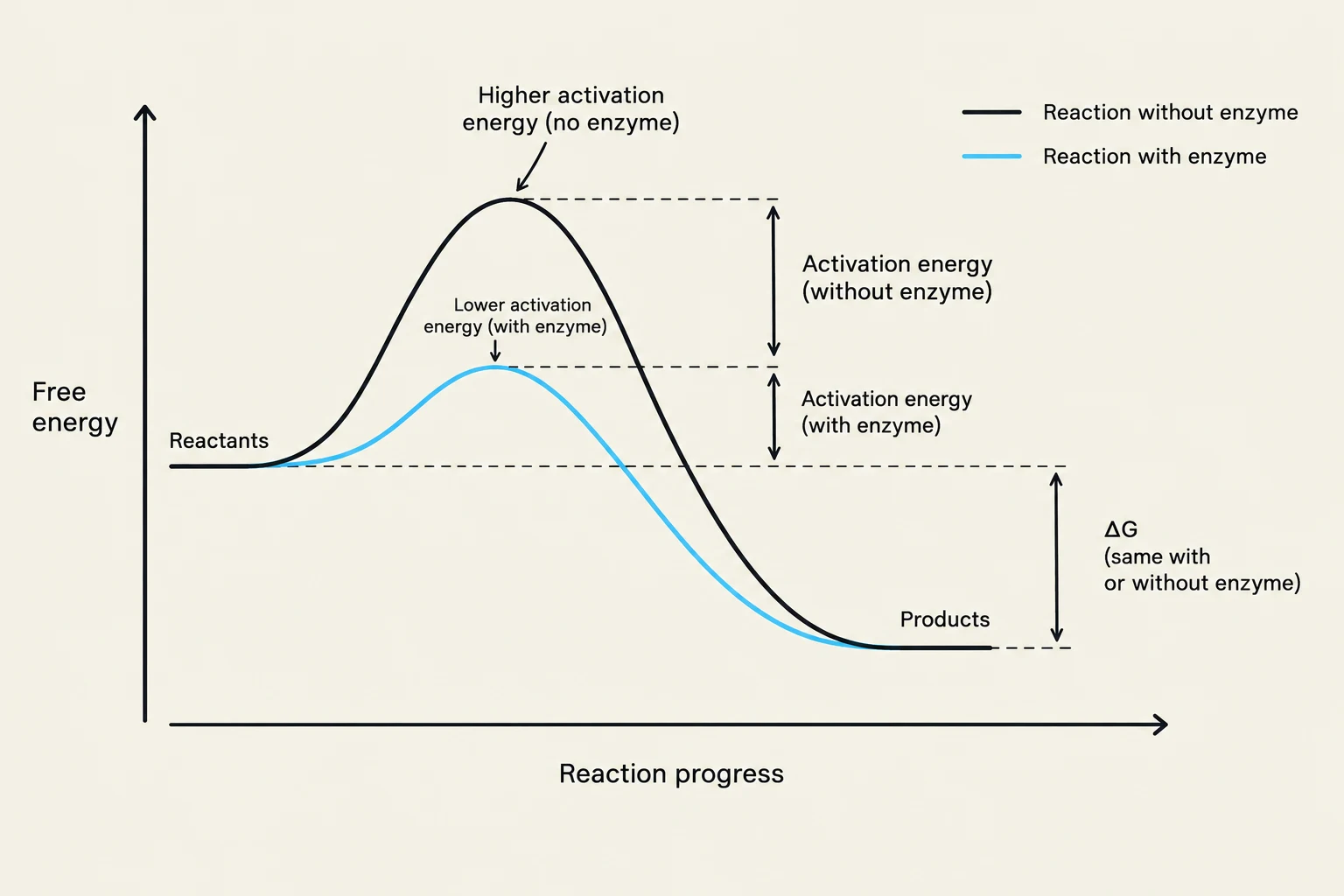
The primary role of an enzyme is to lower the activation energy. Activation energy is the initial energy barrier that must be overcome for a chemical reaction to proceed. Even if a reaction is thermodynamically favorable (meaning it releases energy), it might occur too slowly to sustain life if the activation energy is too high. Enzymes lower this barrier, allowing reactions to occur rapidly at body temperature (approximately 36.5–37.5 °C).
This graph illustrates the effect of enzymes on activation energy. Enzymes lower the activation energy required for a reaction to proceed, thus increasing the reaction rate. The overall change in free energy (ΔG) remains the same, regardless of whether an enzyme is present.
Thermodynamics and Reaction Favorability
To understand why reactions move in certain directions, we look at Gibbs free energy (G), which represents the usable energy available to do work. The change in free energy during a reaction is denoted as ΔG.
The value of ΔG tells us if a reaction is energetically favorable:
Exergonic Reactions (ΔG<0): These reactions release energy and are spontaneous/favorable. They are often irreversible in the cellular environment.
Endergonic Reactions (ΔG>0): These reactions require an input of energy and are non-spontaneous/unfavorable.
Equilibrium (ΔG=0): The forward and reverse reactions occur at the same rate, resulting in no net change.
Cellular Organization and Regulation
Cells prevent "futile cycles"—where two opposing reactions run simultaneously and waste energy without producing a net effect—through rigorous organization. This organization happens at several levels:
Compartmentation: Enzymes and pathways are often restricted to specific areas. For example, enzymes for fatty acid synthesis are in the cytoplasm, while those for fatty acid degradation are in the mitochondria. This allows the cell to run opposing pathways (anabolism and catabolism) at the same time in different "rooms".
Enzyme Regulation: The cell controls the amount of enzyme (through synthesis and degradation) and the activity of the enzyme (through allosteric control, covalent modification, or proteolytic activation).
Substrate Availability: If the necessary starting materials (substrates) are not present, the reaction cannot proceed.
Product Removal: By quickly converting or removing the products of a reaction, the cell maintains a "flow" that keeps the pathway moving forward.
Through these sophisticated mechanisms, the cell achieves metabolic plasticity, allowing it to reprogram its pathways in response to changing environments, such as nutrient availability or oxygen levels.
Keep reading for free.
Create an account to finish this reading and make it part of your study routine.