An overview of materials science and engineering, covering the fundamental relationship between structure and properties, classification of materials (metals, ceramics, polymers, composites, electronic materials), and future trends like smart and nanomaterials, along with sustainability considerations.
From the massive structures of the Mars Rovers to the microscopic circuits in your smartphone, every piece of modern technology relies on the intelligent selection and application of materials. While we often take the objects around us for granted, the substances that compose them—whether they are mined from the Earth's crust or synthesized in a laboratory—are the foundation of all engineering progress.
Defining the Field: Science vs. Engineering
To understand this discipline, we must distinguish between two closely related but distinct fields: materials science and materials engineering.
Materials Science focuses on the fundamental relationship between the internal structure of a material and its macroscopic properties. It seeks to answer why a material behaves the way it does by investigating its atomic and molecular arrangements.
Materials Engineering takes that scientific knowledge and applies it to create specific products. The engineer's goal is to design or select a material that meets the requirements of a particular application, such as making an aircraft engine lighter or a car frame more corrosion-resistant.
This diagram illustrates the relationship between Materials Science and Materials Engineering, showing how scientific understanding of material structure and properties informs the engineering process of design, processing, and performance to create better materials for real-world applications.
Study Tip: Think of the scientist as the person discovering the "rules" of a material, and the engineer as the person using those "rules" to build something useful.
The Fundamental Classes of Materials
Materials are generally classified into three primary groups based on their chemical composition and volume, along with two specialized application classes.
1. Metals
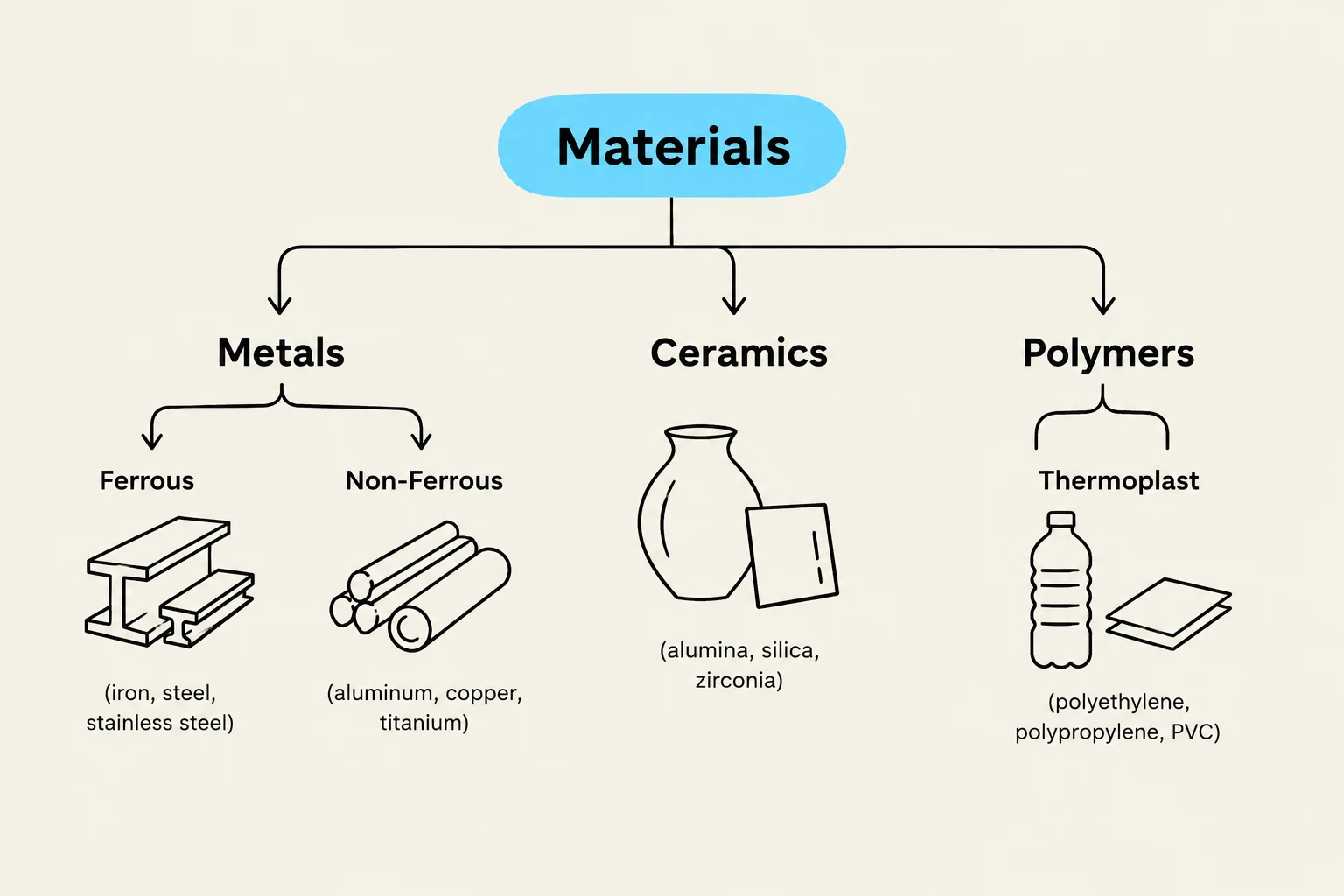
Metals are inorganic substances composed of one or more metallic elements, such as Iron (Fe), Aluminum (Al), or Copper (Cu). They are characterized by a crystalline structure in their solid form and are known for being excellent conductors of both heat and electricity.
Metals are typically strong, stiff, and dense. A key property of many metals is their malleability, meaning they can be shaped or cast into various forms. Within this category, we distinguish between two major types:
Ferrous alloys: These contain iron as the major element (e.g., steel and cast iron).
Non-Ferrous alloys: These contain little to no iron (e.g., aluminum or nickel-based superalloys).
2. Ceramics
Ceramics are inorganic materials consisting of metallic and nonmetallic elements chemically bonded together. They can be crystalline (like alumina) or non-crystalline (like clay). Ceramics are prized for their high hardness, strength, and wear resistance. They also serve as excellent insulators for heat and electricity and can withstand very high temperatures.
3. Polymers
Polymers are organic materials where carbon serves as the main building block. Most are synthetic (man-made) and consist of long molecular chains or networks. Compared to metals and ceramics, polymers generally have low density and are poor conductors of heat and electricity.
Polymers are further subdivided into two major classes:
Plastics: These can be molded into shapes. They are split into thermoplastics (which can be reheated and reshaped, like polycarbonate) and thermosets (which cannot be reshaped once set).
Elastomers: These possess outstanding elastic properties, allowing them to undergo significant elongation and return to their original shape (e.g., rubber).
This diagram illustrates a classification of materials, categorizing them into metals, ceramics, and polymers, with examples provided for each.
Advanced Material Classes
Beyond the three fundamental groups, two other classes are vital to modern technology:
Composite Materials
A composite is a mixture of two or more different materials (phases) that are integrated to form a new material. Crucially, the constituents do not dissolve into one another; they maintain a clear interface and keep their original properties. Composites are typically composed of a reinforcing filler and a binding material (matrix).
There are two primary types of composites:
Fibrous composites: Fibers embedded in a matrix (e.g., fiberglass, which uses glass fibers in an epoxy matrix).
Particulate composites: Particles embedded in a matrix (e.g., concrete, which uses gravel or steel rods in cement).
Electronic Materials
While not the largest class by volume, electronic materials are essential for modern life. These materials, such as Silicon (Si) or Gallium (Ga), have electrical characteristics that can be precisely modified by adding impurities. They are the backbone of integrated circuits, computers, and satellite electronics.
The Future: Smart and Nano Materials
As engineering demands evolve, so do the materials. We are currently seeing the rise of:
Smart Materials: These can sense external stimuli—such as temperature, light, or magnetic fields—and respond by changing their properties or functions. An example is Shape Memory Alloys, which are used in medical artery stents to expand and clear blockages.
Nanomaterials: Materials with a characteristic length scale (like particle diameter) smaller than 100 nm. Examples include carbon nanotubes and nanoscale graphite.
Sustainability and Life Cycle Analysis (LCA)
Engineers today do not just consider performance and cost; they must also consider environmental impact. Materials are categorized as renewable (organic/nature-made, like wood) or nonrenewable (inorganic, like metals and ceramics).
To ensure sustainable development, engineers utilize Life Cycle Analysis (LCA), which evaluates a product through six distinct stages:
Raw material availability and selection
Materials processing
Component manufacturing
Transportation
Utilization
Recycling
By understanding the entire life cycle, engineers can design products that minimize environmental harm while maximizing utility and economic growth.
Keep reading for free.
Create an account to finish this reading and make it part of your study routine.