This content provides a comprehensive overview of lipids and cholesterol, covering their classification, fundamental roles in the human body, and the structure and function of various lipid types including fatty acids, triglycerides, phospholipids, and cholesterol. It also details lipoprotein transport mechanisms and i
Lipids are a diverse group of organic substances that play a fundamental role in human biology. Unlike carbohydrates or proteins, which are classified by their specific chemical structures, lipids are primarily classified based on their similarity in solubility. They are characterized by being soluble in organic solvents and insoluble in water. This unique chemical property allows them to serve as efficient energy reservoirs, structural building blocks, and signaling molecules within the body.
Lipid Classification and Roles
Lipids are primarily composed of carbon and hydrogen bonds. Because of their chemical nature, they serve several critical physiological functions:
Energy Management: They act as a primary source of energy and a major site for long-term energy storage.
Structural Integrity: They are essential structural components of cell membranes.
Hormonal Regulation: Lipids serve as precursors for various hormones.
Biological Signaling: They are involved in the production of lipid mediators.
Absorption: They aid in the absorption of certain vitamins and nutrients.
Fatty Acids: The Building Blocks
Fatty acids are long chains of carbon-hydrogen bonds that terminate in a carboxyl group. They serve as the fundamental building blocks for more complex molecules, such as triglycerides and phospholipids.
Classification by Length
Fatty acids are categorized by the number of carbon atoms in their chain:
Short-chain: Fewer than 6 carbon atoms.
Medium-chain: 6 to 12 carbon atoms.
Long-chain: 13 or more carbon atoms.
Classification by Saturation
The degree of saturation refers to the presence or absence of double bonds between carbon atoms, which significantly affects the physical properties of the lipid:
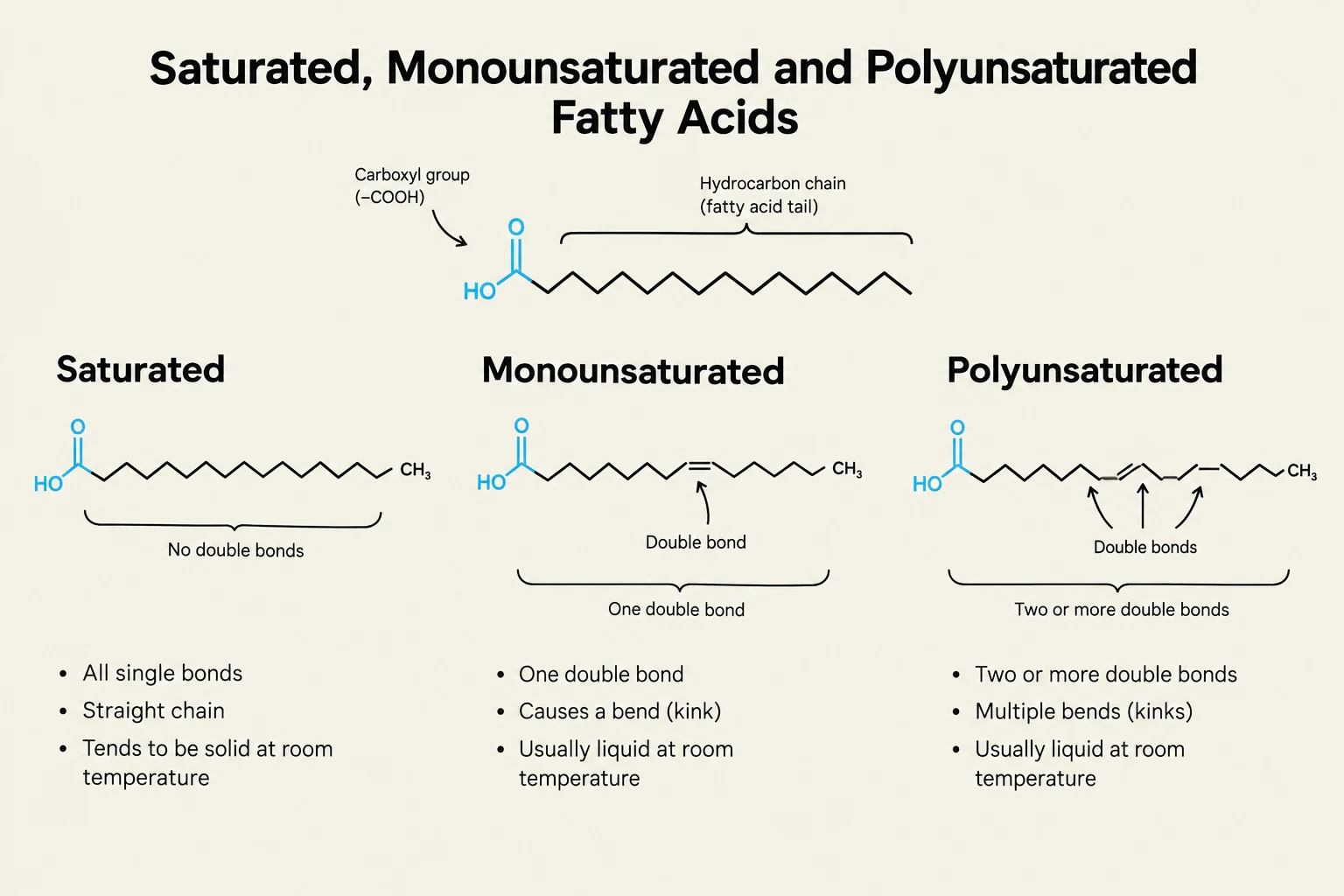
Saturated Fatty Acids: These contain no double bonds. Because their chains are straight, they can pack tightly together, making them typically solid at room temperature.
Monounsaturated Fatty Acids (MUFAs): These contain exactly one double bond.
Polyunsaturated Fatty Acids (PUFAs): These contain two or more double bonds. Due to the "kinks" created by these bonds, they cannot pack tightly and are typically liquid (oils) at room temperature.
Exam Tip: Omega-3 fatty acids are a specific type of polyunsaturated fatty acid that are considered heart-healthy and help reduce the risk of cardiovascular disease.
This illustration compares saturated, monounsaturated, and polyunsaturated fatty acids, detailing their chemical structures, the presence or absence of double bonds, and their typical physical states at room temperature.
Triglycerides and Phospholipids
Triglycerides
Triglycerides are the most common form of stored fat in the body, constituting approximately 85% of stored body fat. A triglyceride molecule is formed when three fatty acids are attached to a single molecule of glycerol via ester bonds. Because they lack polar groups, triglycerides are extremely hydrophobic.
Phospholipids
While structurally similar to triglycerides, phospholipids differ in one key way: they contain only two fatty acids. The third position on the glycerol backbone is occupied by a phosphate head group. This makes them amphipathic (containing both hydrophilic and hydrophobic portions), which is essential for their role in forming the cell membrane.
Cholesterol: Structure and Function
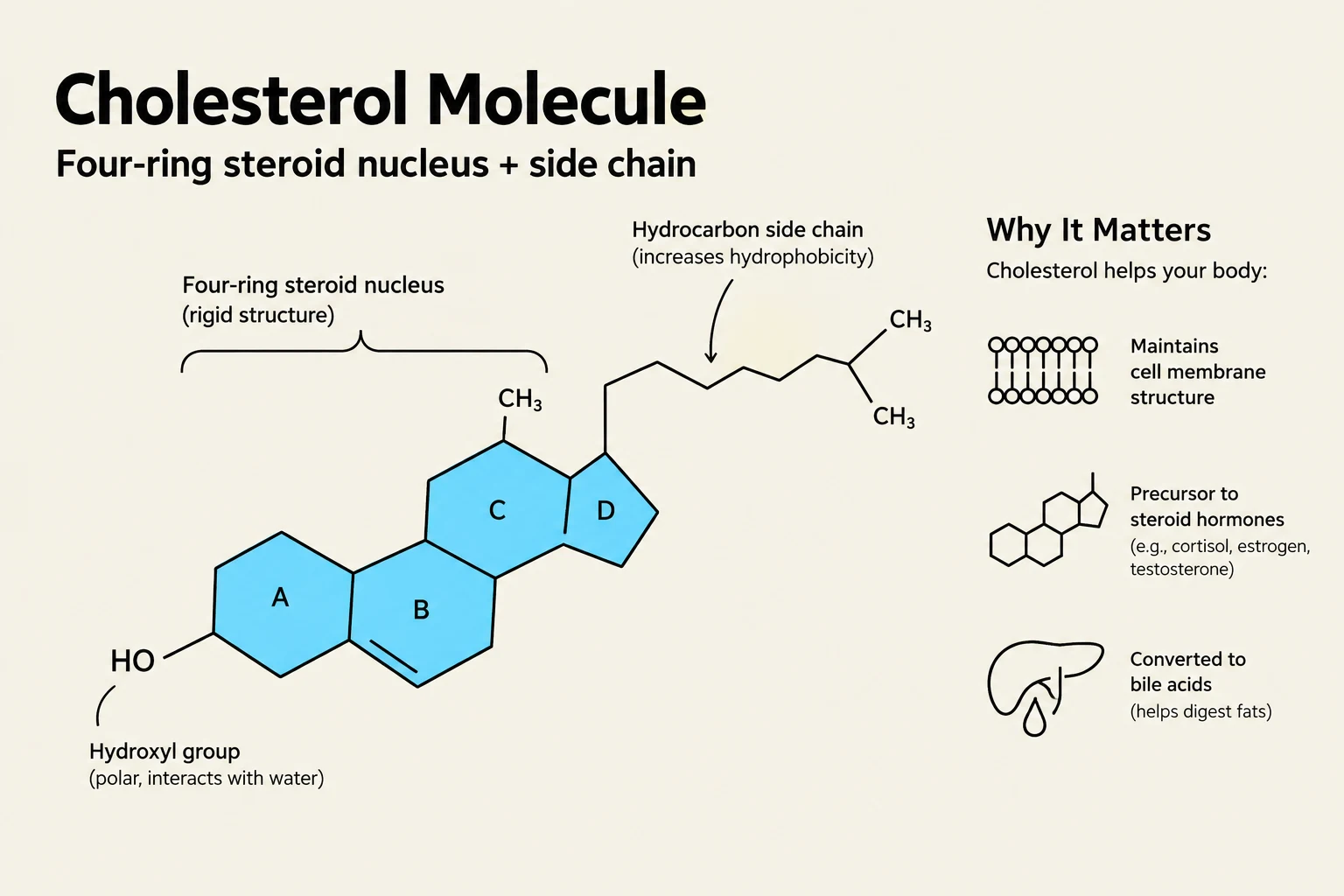
Cholesterol is a unique, amphipathic steroid alcohol. Its structure consists of four fused rings and a single side chain. Unlike triglycerides, cholesterol is not used as a fuel source.
Key Functions of Cholesterol
Cholesterol is vital for maintaining homeostasis in several ways:
Membrane Stability: It maintains the normal fluidity and integrity of cell membranes.
Hormone Synthesis: It serves as a precursor for steroid hormone synthesis.
Digestion: It is converted in the liver to bile acids, which aid in fat digestion.
Transport: It helps facilitate the transport of lipids through the bloodstream.
Diagram illustrating the structure of a cholesterol molecule and its functions in the human body, including maintaining cell membrane structure, acting as a precursor to steroid hormones, and being converted to bile acids.
Lipoproteins and Lipid Transport
Because lipids are insoluble in water, they must be transported through the bloodstream within complexes of lipids and proteins called lipoproteins.
The Major Lipoproteins
The different types of lipoproteins are distinguished by their density, which is determined by their lipid-to-protein ratio:
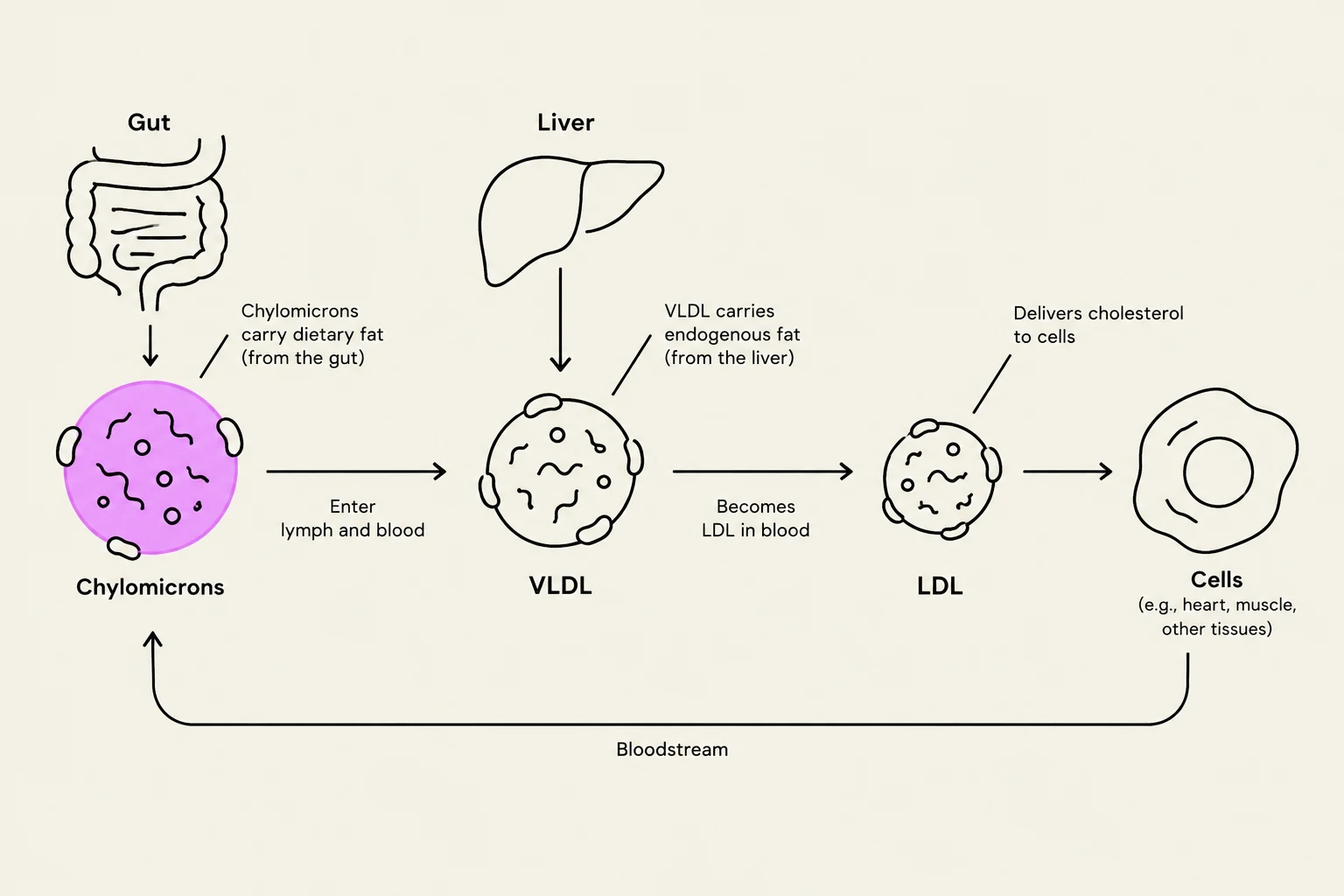
Chylomicrons: The largest and least dense lipoproteins. They transport dietary triglycerides from the intestines to peripheral tissues.
VLDL (Very Low Density Lipoproteins): These transport endogenous (body-synthesized) triglycerides from the liver to tissues.
LDL (Low Density Lipoproteins): Formed from VLDL remnants, LDL delivers cholesterol to peripheral cells and the liver. High levels of LDL are strongly associated with an increased risk of cardiovascular disease.
HDL (High Density Lipoproteins): The smallest and most dense lipoprotein. HDL performs "reverse cholesterol transport" by removing excess cholesterol from tissues and returning it to the liver. It is often called "good" cholesterol.
Exam Tip: LDL is strongly associated with an increased risk of cardiovascular disease.
Clinical Calculations: The Friedewald Equation
In clinical settings, LDL cholesterol is often estimated rather than measured directly using the Friedewald equation:
LDL=Total Cholesterol−HDL−VLDL
Where VLDL is typically estimated as:
VLDL=5Triglycerides
Important Limitation: This equation cannot be used accurately if the patient's triglyceride levels are greater than 400 mg/dL.
Worked Example
If a patient has the following lipid profile:
Total Cholesterol = 220 mg/dL
HDL = 50 mg/dL
Triglycerides = 150 mg/dL
Step 1: Estimate VLDLVLDL=5150=30 mg/dL
Step 2: Calculate LDLLDL=220−50−30=140 mg/dL
Diagram illustrating the transport of dietary and endogenous fats in the bloodstream, from the gut and liver to cells.
Lipid Disorders
Abnormal concentrations of lipids in the blood are known as dyslipidemia. This can lead to atherosclerosis, where lipids are deposited in arterial walls, forming plaques that can block blood flow.
Hypercholesterolemia: Defined as cholesterol levels greater than 200 mg/dL.
Hypertriglyceridemia: High triglyceride levels, which can be caused by genetic abnormalities or metabolic imbalances like diabetes mellitus.
Specific Genetic Disorders: Conditions such as Tangier disease (mutation of the ABCA1 gene) or Gaucher disease (affecting enzyme function) represent rare lipid metabolism disorders.
Keep reading for free.
Create an account to finish this reading and make it part of your study routine.