This guide explains the fundamental concepts of kinematics, including distance, displacement, speed, velocity, and acceleration. It also covers kinetic energy, its relationship with mass and velocity, and practical unit conversions.
Understanding how objects move and the energy they carry is a cornerstone of physics. To study these phenomena, we divide our focus into two main areas: Kinematics, which describes the geometry of motion, and Kinetic Energy, which describes the energy an object possesses because of that motion.
Understanding Kinematics
Kinematics is the branch of physics that describes how things move without investigating the forces that cause the motion. Every kinematic quantity is derived from two fundamental measurements: position and time.
To describe motion accurately, we must distinguish between two types of measurements: scalar quantities and vector quantities. A scalar quantity only has magnitude (size), such as temperature or mass. A vector quantity, however, has both magnitude and direction.
Distance vs. Displacement
One of the most common points of confusion is the difference between how far an object has traveled and how far it is from its starting point.
Distance (d): A scalar quantity representing the total length of the path traveled.
Displacement (s): A vector quantity representing the straight-line change in position from the start to the finish.
Example: The Track Runner
Imagine a runner completing one 400 m lap of a circular track. The distance traveled is 400 m, but because the runner ends exactly where they started, their displacement is zero.
Speed vs. Velocity
Because distance and displacement are different, the ways we measure "how fast" an object moves are also different.
Speed (v): A scalar quantity defined as the rate of change of distance. It is calculated as:
v=td
Velocity (v): A vector quantity defined as the rate of change of displacement. It is calculated as:
v=ΔtΔs
Both are typically measured in meters per second (m/s).
Acceleration
Acceleration (a) is a vector quantity that represents the rate of change of velocity. It is calculated as:
a=ΔtΔv
Acceleration does not just mean "speeding up." In physics, acceleration occurs whenever there is a change in velocity, which includes speeding up, slowing down (deceleration), or changing direction. The relationship between the direction of velocity and acceleration determines the type of motion:
Speeding up: Velocity and acceleration are in the same direction.
Slowing down: Velocity and acceleration are in opposite directions.
Changing direction: Acceleration is perpendicular to velocity, allowing the object to change direction while maintaining a constant speed.
Visualizing Motion: Distance-Time Graphs
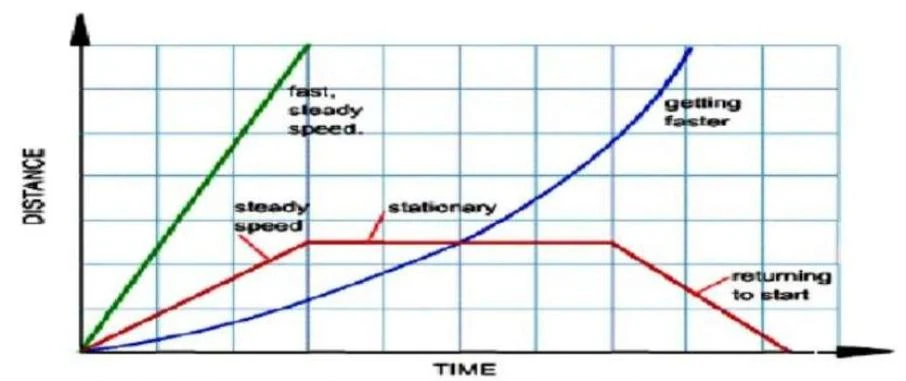
We can use graphs to visualize how an object's distance from a point changes over time.
This graph illustrates different types of motion over time, including steady speed, stationary periods, acceleration, and returning to the starting point.
By looking at the slope (gradient) of the line, we can determine the object's state of motion:
Horizontal line: The object is stationary.
Straight diagonal line: The object is moving at a constant speed.
Increasing gradient: The object is speeding up (accelerating).
Decreasing gradient: The object is slowing down (decelerating).
Downward line: The object is moving backwards.
Kinetic Energy
While kinematics describes the "how" of motion, Kinetic Energy (Ek) describes the "what"—specifically, the energy an object possesses due to its motion. Kinetic energy is a scalar quantity measured in Joules (J).
The formula for kinetic energy is:
Ek=21mv2
Where:
m is the mass of the object in kilograms (kg).
v is the velocity of the object in meters per second (m/s).
The Effects of Mass and Velocity
The relationship between an object's physical properties and its kinetic energy is not always linear. It is vital to understand how changing one variable affects the total energy.
1. The Effect of Mass
Kinetic energy is directly proportional to mass (Ek∝m). This means if you increase the mass while keeping the velocity the same, the energy increases by the same factor.
If mass doubles (×2), kinetic energy doubles (×2).
If mass triples (×3), kinetic energy triples (×3).
2. The Effect of Velocity
Kinetic energy is proportional to the square of the velocity (Ek∝v2). This makes velocity a much more powerful factor in determining energy than mass.
If velocity doubles (×2), kinetic energy increases by 22, which is four times greater (×4).
If velocity triples (×3), kinetic energy increases by 32, which is nine times greater (×9).
IBT Quick Rules Summary
Change
Effect on Kinetic Energy
Mass ×2
KE ×2
Velocity ×2
KE ×4
Mass ×3
KE ×3
Velocity ×3
KE ×9
Practical Applications and Conversions
In real-world scenarios, such as comparing aircraft to land transport, we often encounter different units of speed. While m/s is the standard SI unit, km/h is frequently used for vehicles.
Transport Type
Example
Typical Speed Range
Aircraft
Passenger jet
800–950 km/h
Land
High-speed train
200–350 km/h
Land
Car
40–120 km/h
Water
Fast passenger boat
30–80 km/h
To perform calculations involving kinetic energy, you must often convert these units to ensure they match the SI standard (m/s).
Conversion Formulas:
To convert km/h→m/s: Multiply by 185
To convert m/s→km/h: Multiply by 518 (or 3.6)
Worked Example: Unit Conversion
Question: Convert 72 km/h into m/s.
Solution:
Using the conversion factor 185:
72×185=4×5=20 m/s
Keep reading for free.
Create an account to finish this reading and make it part of your study routine.