This content provides an overview of international relations theory, covering paradigms like Realism, levels of analysis, and models of decision-making, including rational choice, expected utility, and prospect theory.
International relations (IR) is the study of interactions that cross state borders. While some scholars focus strictly on the interactions between sovereign states, others argue that the field encompasses a much broader spectrum, including the activities of transnational companies, terrorist organizations, and even tourists. Because the world of international politics can often appear as a chaotic sequence of random events, theorists use different lenses, known as paradigms, to find regularities and make sense of the complexity.
The Realist Paradigm and the International System
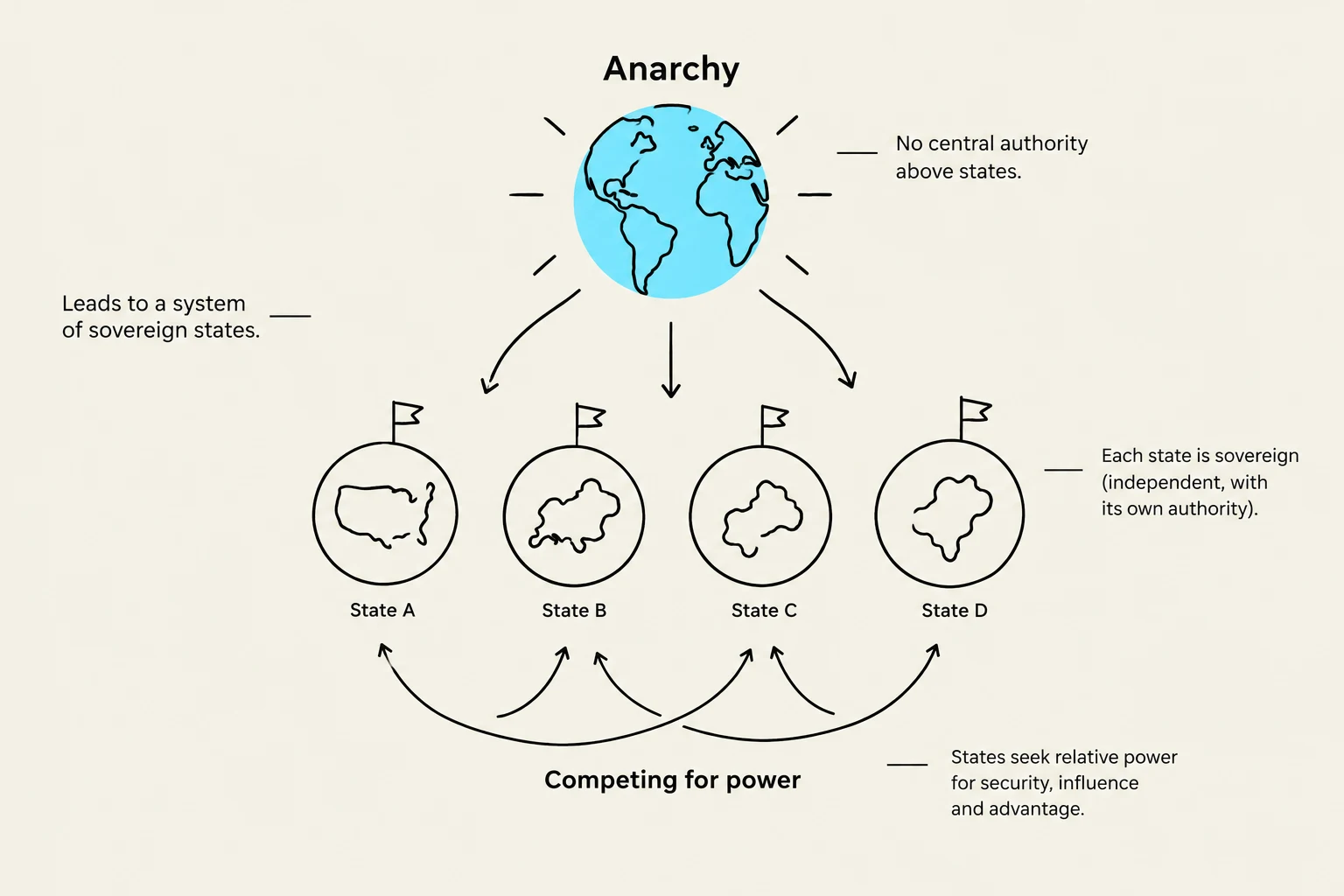
One of the most influential frameworks in the discipline is the realist paradigm. Realism traditionally views the world through the lens of state-centric politics, where the primary actors are sovereign states. A central concept in realism is anarchy, which refers to the absence of a central global authority to enforce rules or protect states.
In this anarchic environment, the international system is defined by the distribution of power among states. Because there is no "world government" to ensure their survival, states must prioritize their own national interest, which is often synonymous with the pursuit of security. This often leads to a "security dilemma," where one state's attempt to increase its own security through military buildup is perceived as a threat by others, triggering a cycle of competition.
This diagram illustrates the concept of anarchy in international relations, where sovereign states compete for power in the absence of a central global authority.
Exam Tip: When discussing Realism, always link "Anarchy" to the necessity of "Self-help." Because there is no higher authority, states are forced to rely on their own capabilities to survive.
Levels of Analysis
To avoid "academic chaos" when explaining why an event—such as a war—occurs, scholars use levels of analysis to categorize the causes of international phenomena. Instead of listing every possible factor, these levels help researchers focus on the most decisive drivers.
The Personal Level: This focuses on the individual decision-makers, such as presidents, monarchs, or dictators. It examines how their personal attributes, psychology, or even health might influence a specific historical moment.
The State Level: This level looks at the characteristics of the state itself. It examines how domestic politics, economic structures, or "national interests" drive foreign policy.
The System Level: This level ignores individual leaders or specific domestic politics to look at the broader structure of the international system, such as how power is distributed (e.g., unipolar vs. multipolar).
This diagram illustrates the three levels of analysis in political science: personal, state, and international. It shows how these levels interact and influence each other.
Models of Decision-Making and Rationality
A major debate in IR is the extent to which actors behave rationally. Rational choice theory assumes that actors aim to achieve their goals by picking the most effective means available. For an actor to be considered truly rational in a mathematical sense, their preferences must meet two criteria:
Complete Preferences: The actor can always rank all available options (e.g., "I prefer A to B, or B to A, or they are equal").
Transitivity: If an actor prefers A to B, and B to C, they must also prefer A to C.
While these assumptions are useful for building middle-range theories—theories that address specific, narrow issues with precision—real-world politics is often messy. To explain why states often deviate from "perfect" rationality, scholars use Graham Allison's three models:
Rational Actor Model (RAM): The state is viewed as a single, unitary actor that calculates costs and benefits to maximize national interest.
Organizational Process Model (OPM): Decisions are not "chosen" so much as they are the result of standard operating procedures and routines within different government agencies.
Bureaucratic Politics Model (BPM): Foreign policy is the outcome of intense bargaining and competition between various domestic players and agencies.
Expected Utility and Prospect Theory
When states make decisions under uncertainty, they often rely on concepts of "expected value." In a simple rational framework, an actor might calculate the expected utility of an action by multiplying the probability of an outcome by the value of that outcome.
For example, if a state considers going to war, a simplified mathematical model for the expected utility U(w) might look like this:
U(w)=pv⋅V−(1−pv)⋅L−c
Where:
pv is the probability of victory.
V is the volume of the prize (the gain).
L is the volume of possible loss.
c is the cost of the war.
However, humans (and by extension, states) do not always follow these mathematical prescriptions. Prospect theory suggests that people's perceptions of risk change depending on whether they are facing a potential gain or a potential loss. This behavioral insight helps explain why leaders might take highly irrational risks to avoid a loss, even when the mathematical "expected utility" suggests they should retreat.
Summary Note: While "grand theories" attempt to explain everything about the world, "middle-range theories" are often more useful for practical research because they provide more precise definitions and testable hypotheses.
Keep reading for free.
Create an account to finish this reading and make it part of your study routine.