Introduction to Industrial-Organizational Psychology
This content provides an overview of Industrial-Organizational (IO) psychology, defining the field, explaining the scientist-practitioner model, and differentiating between the industrial and organizational sides. It also distinguishes IO psychology from clinical psychology and business degrees, and touches upon its hi
What do you think of when you hear the term "psychology"? Most people immediately envision a therapist sitting in a chair, helping a patient navigate personal struggles. However, there is a massive, highly scientific branch of psychology that operates not in a clinic, but in the office, the factory, and the boardroom: Industrial-Organizational (IO) psychology.
IO psychology is defined as the application of psychological principles to the workplace. It is a field dedicated to understanding how people behave at work and how organizations can better support their employees while achieving their goals.
The Scientist-Practitioner Model
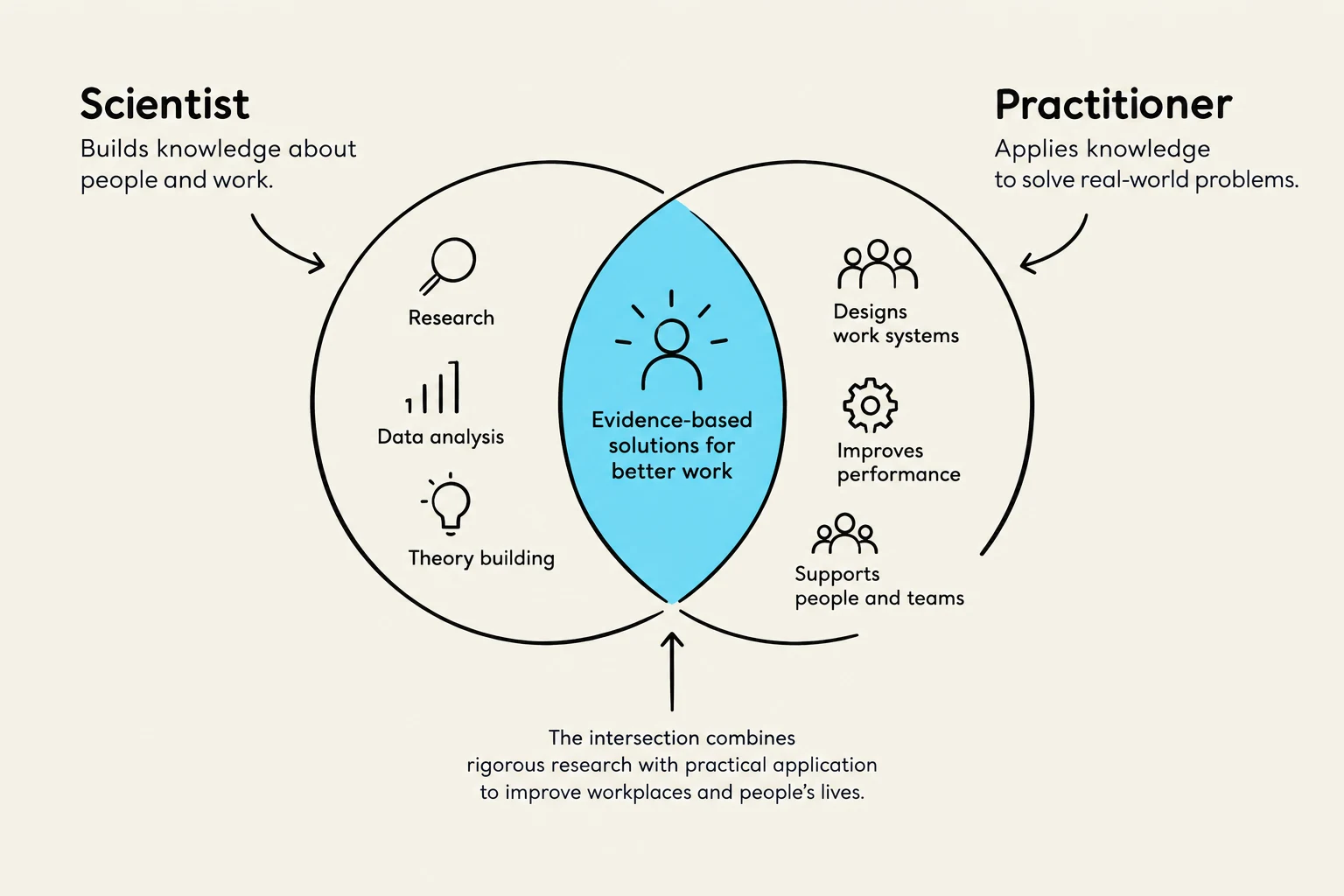
Unlike many other social sciences that may lean heavily toward either pure theory or pure application, IO psychology follows a unique "scientist-practitioner" training model. This means that professionals in the field are trained to wear two hats simultaneously:
The Scientist: They conduct rigorous research, design studies, and analyze data to discover new truths about human behavior in work settings.
The Practitioner: They take those scientific findings and apply them to real-world challenges, working directly with organizations to solve problems like low morale or inefficient hiring processes.
By combining these roles, IO psychologists ensure that the solutions they provide to companies are not just "gut feelings," but are backed by empirical evidence.
This diagram illustrates the relationship between scientific research and practical application in the workplace, highlighting how evidence-based solutions improve work systems, performance, and people's lives.
The Two Sides of IO: Industrial vs. Organizational
While IO psychology is a single field and a single degree, it is traditionally divided into two distinct areas of focus: the "I" side and the "O" side.
The Industrial Side (Personnel Psychology)
The Industrial side, often called personnel psychology, is primarily concerned with the individual and the mechanics of employment. It focuses on the selection and evaluation of employees to ensure the right people are in the right roles. Key activities on this side include:
Job Analysis: Systematically studying a job to determine the specific tasks and requirements involved.
Recruitment and Selection: Developing fair and valid selection tests to hire the best candidates.
Training: Creating programs to improve employee skills.
Performance Appraisal: Developing instruments to evaluate how well employees are performing their duties.
The Organizational Side
The Organizational side takes a broader view, looking at the "big picture" of how people behave within a social structure. Rather than focusing on individual tasks, it examines the psychological climate of the workplace. Key topics include:
Organizational Culture: The shared values, beliefs, and norms within a company.
Leadership: How different management styles affect employee behavior.
Motivation and Job Satisfaction: What drives employees to work hard and how they feel about their roles.
Group Processes: How teams interact and function together.
An example of an "O" activity might be conducting a company-wide survey to assess employee attitudes or the overall health of the organizational culture.
This diagram illustrates the two main branches of Industrial-Organizational Psychology: Industrial, focusing on individual work, and Organizational, focusing on the broader workplace system. It outlines key areas within each branch, such as selection, training, job analysis, structure, culture, and change, and emphasizes their combined role in improving organizational performance.
Distinguishing IO from Other Disciplines
Because the term "psychology" is so broad, it is easy to confuse IO with other fields. It is crucial to understand where the boundaries lie.
IO vs. Clinical Psychology
While IO psychologists are interested in employee well-being and creating work conditions that foster mental health, they are not clinical psychologists. They do not conduct therapy, diagnose mental health disorders, or provide clinical mental health services to employees.
IO vs. Business (MBA)
It is also important to distinguish IO from a traditional business degree or an MBA. While both fields operate in the corporate world, their objectives differ:
Business Degrees: Focus on finance, marketing, accounting, and economics to maximize profits and ensure the business runs efficiently.
IO Psychology: Focuses on the people within that business—how they behave, how they are motivated, and how they interact with the organization.
Exam Tip: If a question asks about maximizing profit through financial strategy, it is likely a business question. If it asks about how to improve employee performance through psychological principles, it is an IO question.
A Brief History and the Future of the Field
The origins of IO psychology can be traced back to the early 1900s, but the field saw massive practical impacts during World War I, when psychologists helped develop intelligence tests (Alpha and Beta tests) to assign soldiers to appropriate units.
In the late 1930s, the field underwent a major shift due to the Hawthorne Studies, which revealed that employees' productivity was significantly affected by the social aspect of being observed and feeling valued, rather than just physical conditions like lighting or temperature.
Today, the field continues to evolve. Modern IO psychology addresses technological advances like online recruitment, changing workplace demographics, and the psychological impacts of remote or flexible work schedules. Whether working in academia (research and teaching) or industry (consulting and private sector), IO psychologists remain essential in navigating the complex relationship between humans and work.
Keep reading for free.
Create an account to finish this reading and make it part of your study routine.