


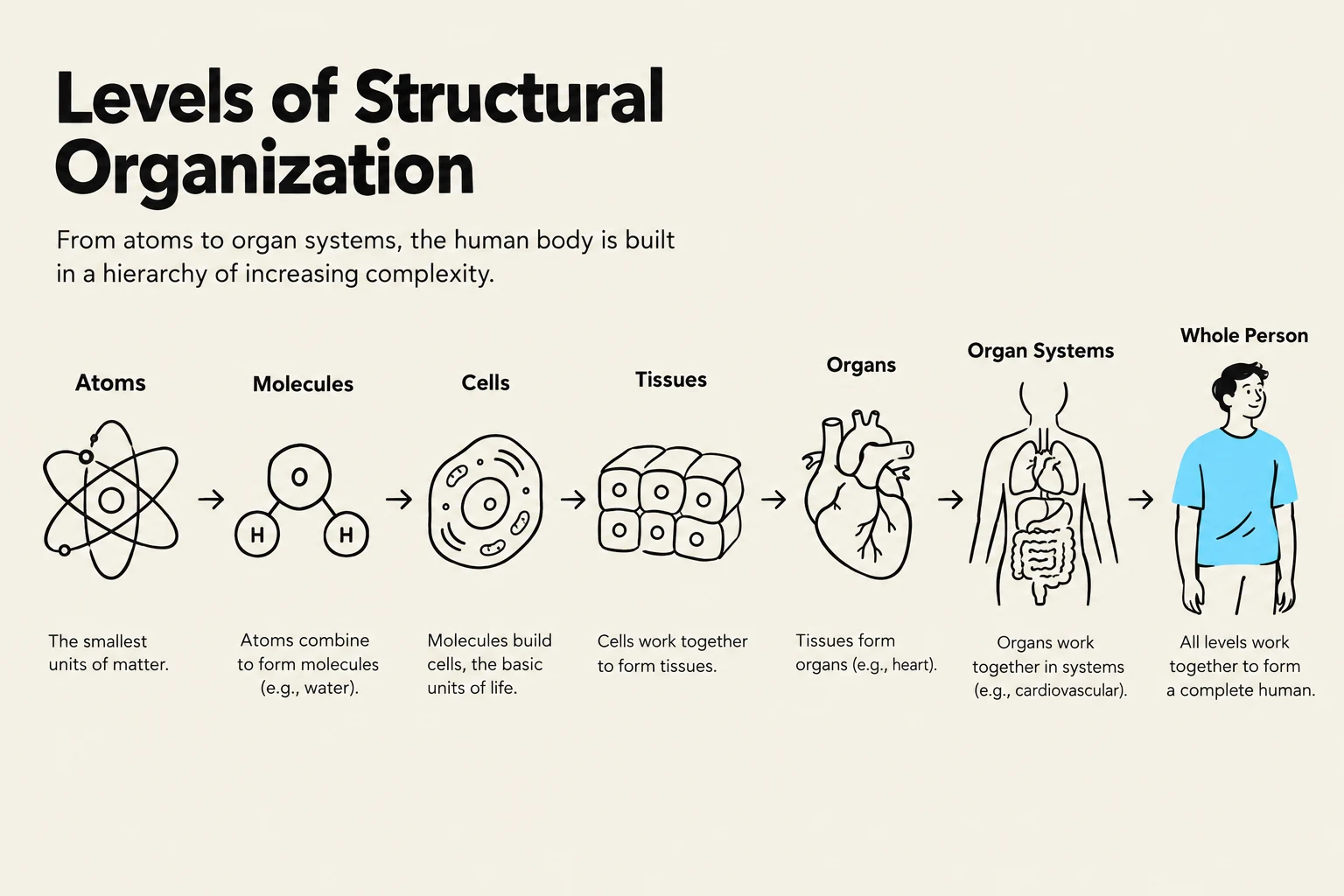
Understanding the human body requires two distinct but inseparable perspectives: what the body is made of and how it works. To study the human body is to study a complex, living machine where structure and function are intimately linked. This article provides an overview of the fundamental principles of anatomy and physiology, the levels of structural organization, and the vital mechanisms that maintain life.
Defining Anatomy and Physiology
At the core of biological science are two foundational disciplines: Anatomy and Physiology.
Anatomy is the study of the structure of body parts and the relationships between them. It answers the question, "Where is it, and what does it look like?" Anatomy can be categorized into several approaches:
- Gross Anatomy: The study of large, visible structures (macroscopic).
- Microscopic Anatomy: The study of structures that require magnification, such as cells and tissues.
- Developmental Anatomy: The study of structural changes that occur throughout a lifetime.
Physiology is the study of the function of the body’s structural machinery. It focuses on how specific organ systems operate, often at the cellular or molecular level. For example, while anatomy might describe the structure of the heart, physiology explains how the heart pumps blood through the cardiovascular system.
Study Tip: Remember that structure determines function. You cannot fully understand how an organ works (physiology) without knowing its shape and composition (anatomy).
Specialized Branches of Anatomy
Because the human body is so complex, anatomy is often divided into specialized branches to allow for more focused study:
- Regional Anatomy: Examining all structures in a specific area, such as the abdomen or a leg.
- Surface Anatomy: Studying internal structures as they relate to the overlying skin.
- Systemic Anatomy: Studying the body by organ systems (e.g., the skeletal system).
- Cytology: The study of individual cells.
- Histology: The study of tissues.
- Embryology: The study of developmental changes occurring before birth.
- Pathological Anatomy: The study of structural changes caused by disease.
- Radiographic Anatomy: The study of internal structures visualized via X-rays or other imaging.
- Molecular Biology: The study of anatomical structures at a subcellular level.
Keep reading for free.
Create an account to finish this reading and make it part of your study routine.
Continue reading freeAlready have an account? Log in
Updated