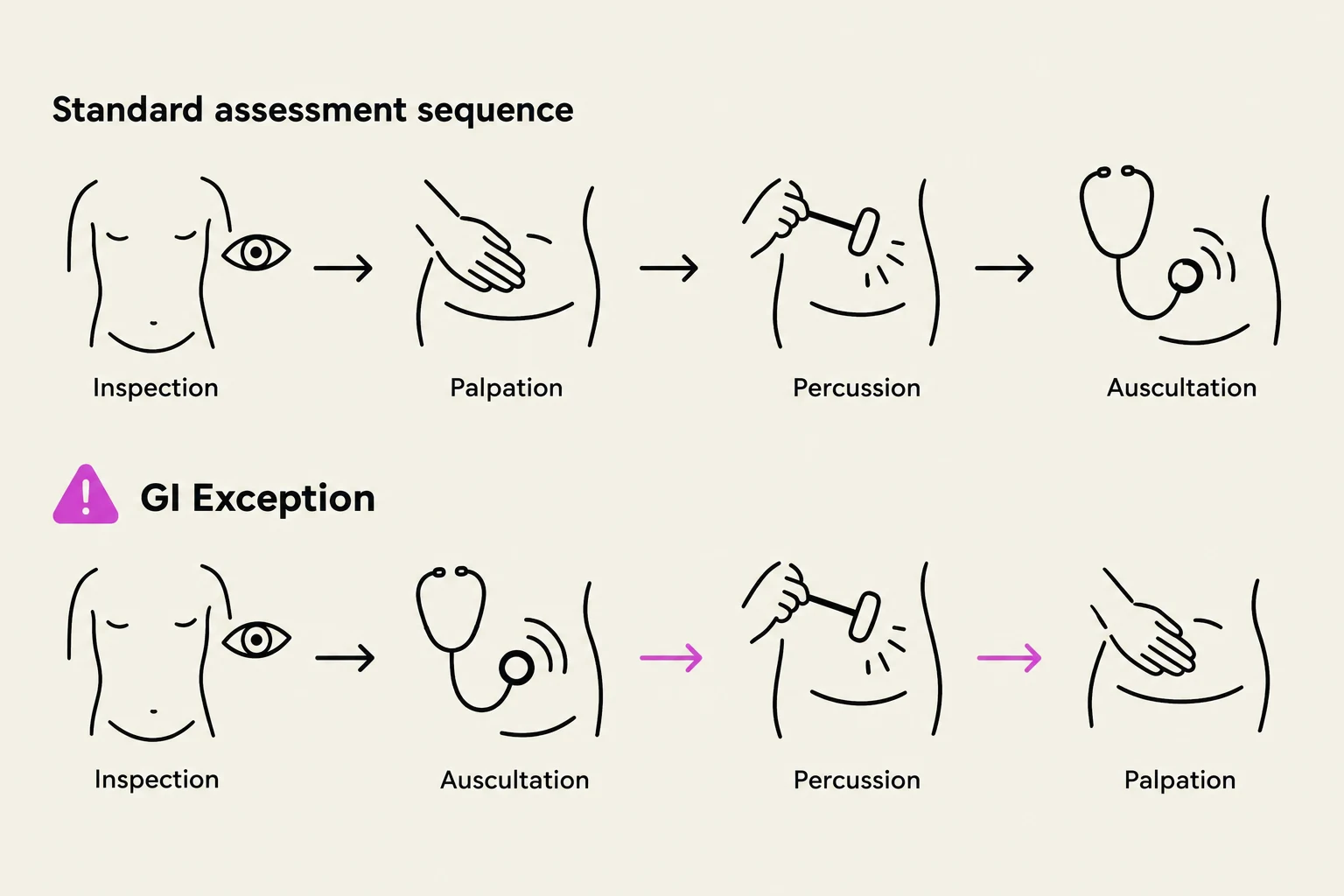
2. Palpation
Palpation involves using the hands to examine the body. It is used to detect temperature, moisture, texture, and the consistency of various structures. Nurses may use light or deep palpation and must always use clean, warmed hands when possible to ensure client comfort.
3. Percussion
Percussion is an advanced technique where a clinician taps on a body part to determine if the underlying organ or cavity is air-filled, fluid-filled, or dense (solid tissue). While important for advanced practitioners like Nurse Practitioners or Physicians, it is not a primary focus for most general nursing assessments.
4. Auscultation
Auscultation is the act of listening to body sounds, typically using a stethoscope. Nurses auscultate for breath, heart, and bowel sounds, as well as blood pressure.
Clinical Note: The GI Exception
While the standard order is Inspection → Palpation → Percussion → Auscultation, the order changes during a gastrointestinal (GI) assessment. In this case, auscultation must come BEFORE palpation to avoid altering bowel sounds through physical manipulation.
| Stethoscope Part | Best Used For... |
|---|
| Diaphragm | Breath, heart, bowel sounds, and blood pressure |
| Bell | Extra or abnormal heart sounds (e.g., bruits, murmurs) |
Health Promotion and Prevention
Nurses play a vital role in health promotion, which involves exploring a client's activities related to diet, activity, stress, and safety. Because health promotion must be relevant to a client's specific life situation, nurses focus on areas where the client has expressed an interest in making a change.
This work is deeply intertwined with the social determinants of health—the social and economic conditions that influence individual health outcomes. To address these, nurses utilize three distinct levels of prevention:
- Primary Prevention: Strategies aimed at true prevention before an illness occurs. Examples include immunizations, health teaching, and nutritional counseling.
- Secondary Prevention: Focused on early identification and prompt intervention to prevent complications. This often involves screening, such as PAP tests or early pregnancy screenings.
- Tertiary Prevention: Aimed at optimizing health and managing an established illness. Examples include rehabilitation programs after a heart attack or dietary education for someone living with diabetes.
Data Gathering: Subjective vs. Objective
A complete clinical picture requires both subjective and objective data.
- Subjective Data (Symptoms): This is information collected from the client's perspective, such as their feelings, experiences, and reasons for seeking care. Because these are personal experiences, they cannot be independently verified by the nurse.
- Objective Data (Signs): These are facts that the nurse can observe, measure, validate, and prove. Examples include blood pressure readings, skin color, or a visible wound.
The OLDCARTSS Framework
When assessing a specific symptom like pain, nurses use the OLDCARTSS mnemonic to ensure a thorough history is taken:
- Onset: When did it start?
- Location: Where is it, and does it radiate?
- Duration: How long does it last?
- Characteristics: What does it feel like?
- Aggravating Factors: What makes it worse?
- Relieving Factors: What makes it better?
- Timing: Is there a specific time of day it occurs?
- Severity: On a scale of 0–10, how bad is it?
- Self-Perception: What are your thoughts on this?
Privacy, Confidentiality, and Ethics
In nursing, privacy refers to the protection of the person (e.g., closing curtains during a bath), while confidentiality refers to the protection of information.
Personal health information belongs to the client, but the healthcare facility is responsible for safeguarding it. Nurses have a legal and professional obligation to protect this data, which includes everything from a client's name to their mental health history.
Exam Tip: Breaching Confidentiality
While confidentiality is a strict rule, there are exceptions. Nurses are legally required to breach confidentiality if there is a serious threat to the safety of the client or others, such as expressed thoughts of suicide or homicide.
Professionalism in the Digital Age
With the rise of social media, nurses must adhere to the "6 Ps" to protect their professional reputation and client privacy:
- Professional: Act professionally at all times.
- Positive: Keep posts about your job positive.
- Person/Patient-free: Never reference patients or their procedures.
- Protect Yourself: Do not post things that could harm your reputation.
- Privacy: Keep your own professional and personal life private.
- Pause: Always pause and think before you post.