Introduction to Healthcare Research and Evidence-Based Practice
A foundational overview of research literacy for nursing professionals, covering the core pillars of research, scholarship, and knowledge translation, methodologies, and evaluating credible sources for evidence-based practice.
In the rapidly evolving landscape of modern medicine, nursing professionals are no longer just implementers of care; they are critical consumers of information. To ensure safe, high-quality patient care, nurses must develop research literacy—the ability to identify, critique, and apply scientific evidence to clinical practice. This article provides a foundational overview of how research, scholarship, and knowledge translation form the backbone of professional nursing practice.
Defining the Core Pillars: Research, Scholarship, and KT
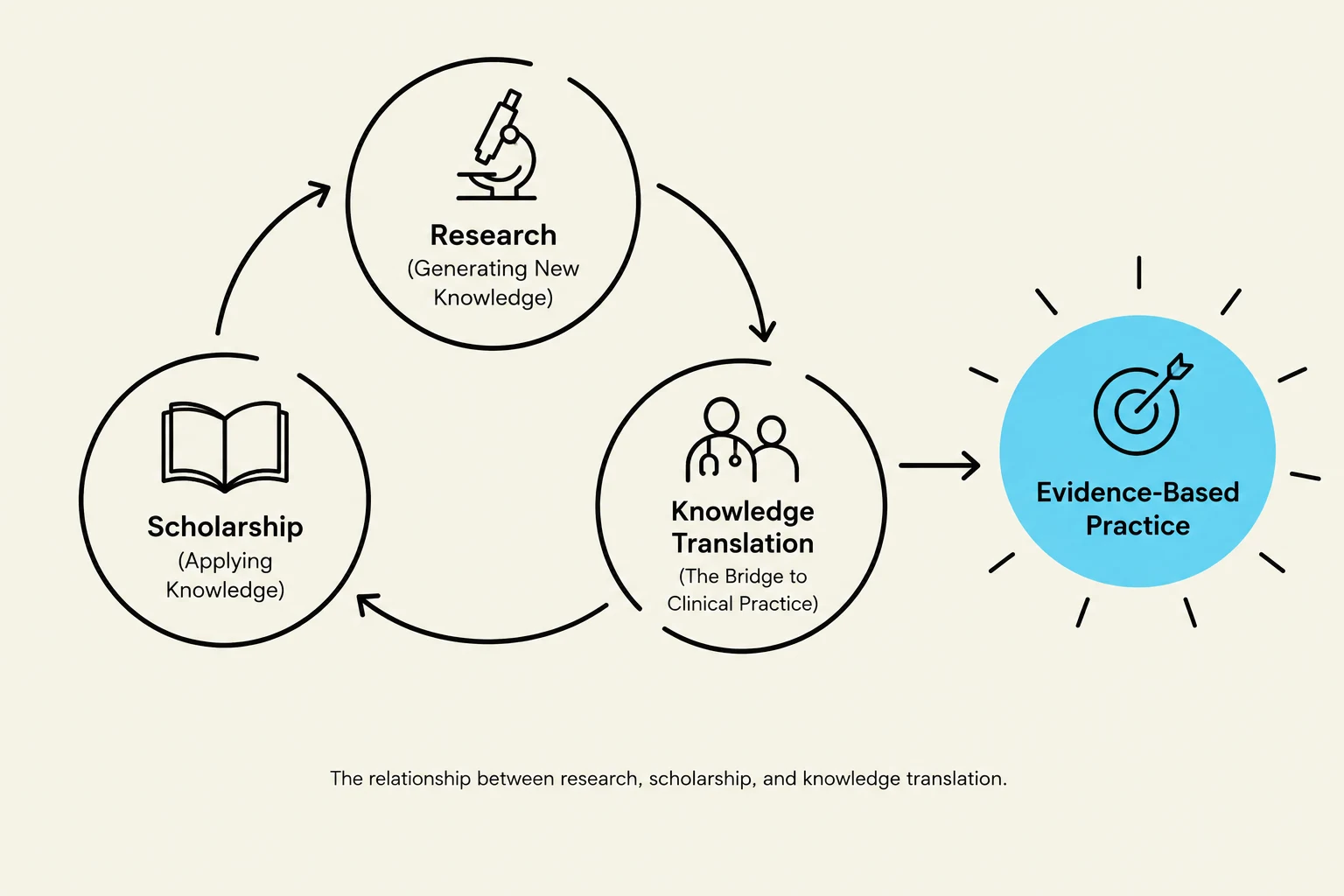
The relationship between research, scholarship, and knowledge translation.
To navigate the world of healthcare literature, one must first distinguish between three closely related but distinct concepts: research, scholarship, and knowledge translation.
Research: This is the systematic investigation used to generate entirely new knowledge or to correct existing misunderstandings.
Health Scholarship: This is a broader concept than research alone. It involves the professional engagement within a discipline, including the application of existing knowledge to advance the field.
Knowledge Translation (KT): Often described as the "bridge," KT is the active process of moving research findings out of the laboratory or academic setting and into clinical settings to influence real-world practice and policy.
The ultimate goal of integrating these concepts is Evidence-Based Practice (EBP). EBP allows clinicians to bridge the gap between theoretical discovery and bedside application, ensuring that patient care is grounded in the best available evidence rather than tradition or intuition alone.
The Evolution of Nursing Research
Nursing research is not a modern invention; it is deeply rooted in the history of the profession. The pioneer of nursing research was Florence Nightingale in the 1850s. During the Crimean War, Nightingale utilized data collection on sanitation and mortality rates to demonstrate the link between environment and health, effectively pioneering the fields of health promotion and disease prevention.
In the Canadian context, the discipline has seen steady academic growth:
1918: Establishment of university-based nursing programs.
1950s–1970s: The introduction of Master's degree programs.
1990s–2000s: The development of doctoral-level training and dedicated research funding.
Methodologies: Qualitative vs. Quantitative
This illustration contrasts qualitative research, focusing on meaning and themes with tools like a magnifying glass and speech bubbles, and quantitative research, focusing on numerical data and statistics with a bar graph, checklist, and calculator.
When engaging with research, you will encounter two primary methodological approaches. Understanding the difference is essential for critiquing the validity of a study's findings:
Qualitative Research: Focuses on understanding human experiences, social processes, and meanings. It often uses thematic analysis to interpret non-numerical data.
Quantitative Research: Focuses on objective measurements and the statistical, mathematical, or numerical analysis of data collected through polls, questionnaires, or experimental studies.
Study Tip: In many nursing curricula, the focus shifts from Qualitative methods in the first half of the term to Quantitative methods in the second half. Pay close attention to the specific strengths and limitations of each when preparing for exams.
Evaluating Credibility: High-Impact Journals and Peer Review
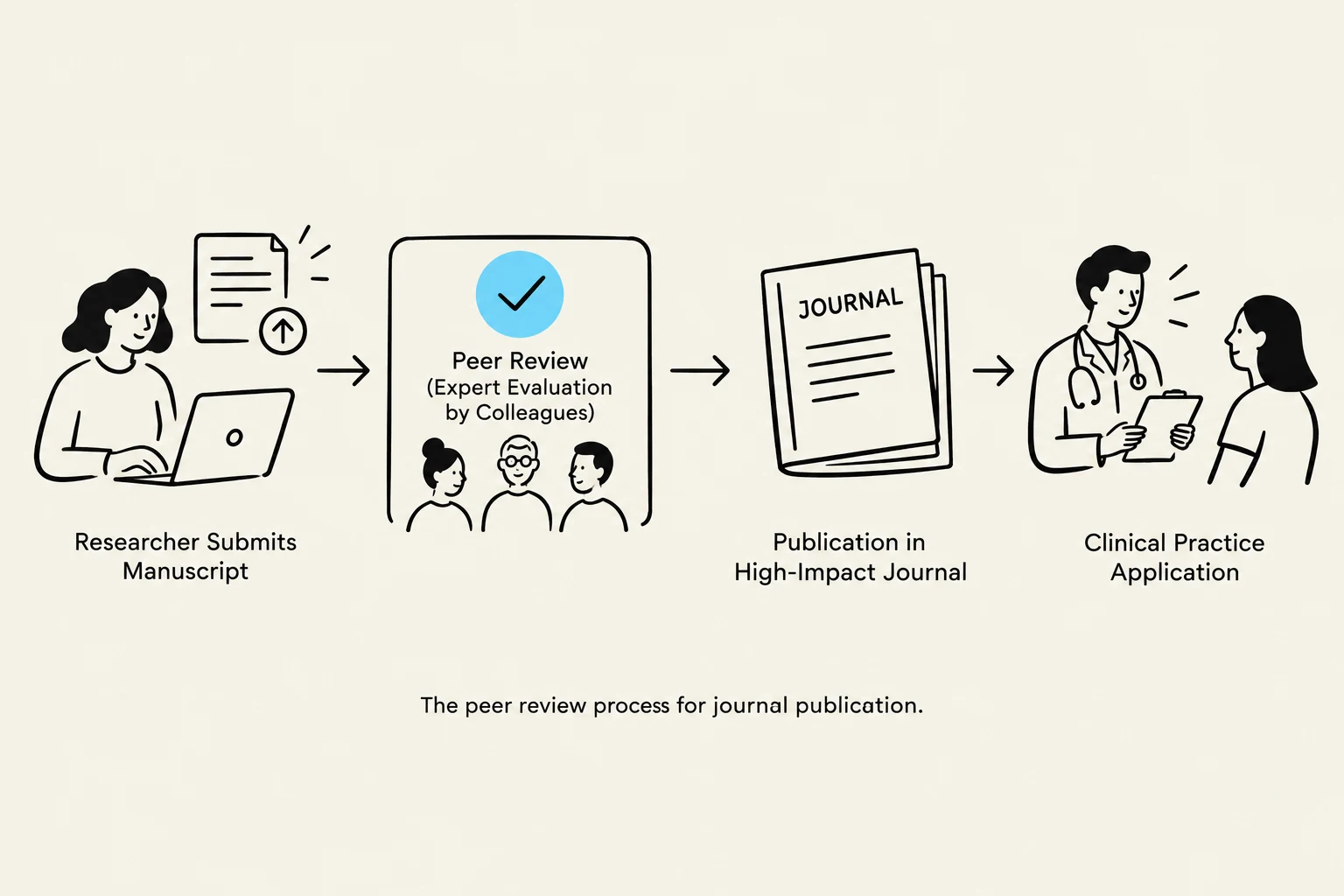
The peer review process for journal publication, illustrating the steps from manuscript submission to clinical practice application.
Not all published information carries the same weight. To practice safely, nurses must be able to identify high-impact publications.
A high-impact journal is a reputable, peer-reviewed publication that significantly influences clinical practice or policy. "Peer review" means that before an article is published, it is critically evaluated by other experts in the same field to ensure its methodology and conclusions are sound.
How to Measure Journal Impact
When searching for evidence, use these indicators to assess the prestige and influence of a journal:
Indicator
Meaning
Journal Impact Factor (JIF)
The average citation influence of recent articles published by the journal.
Quartile Ranking (Q1–Q4)
Categorizes journals by prestige; Q1 represents the top 25% in a subject category.
CiteScore
A Scopus-based measure of the citations received by a journal.
SJR (SCImago Journal Rank)
Weights citations based on the prestige of the journals providing the citations.
Indexing
Inclusion in major databases like MEDLINE/PubMed or Scopus.
Examples of High-Impact Nursing Journals:International Journal of Nursing Studies, Journal of Advanced Nursing, and Worldviews on Evidence-Based Nursing.
Research Ethics and Professional Standards
Nurses have a professional and ethical responsibility to ensure that research is conducted with integrity. This involves adhering to strict professional research standards to protect human participants and ensure that the findings are reliable. Utilizing research is not just a skill; it is an ethical obligation to improve patient outcomes and advance the nursing profession.
Global and Regional Research Priorities
Research focus is not static; it shifts based on regional needs and global trends.
British Columbia (BC): Current priorities include population aging, climate change and health, health human resources challenges, and public health emergencies.
Canada (National): Focuses heavily on population health, equity, and health systems.
Global Trends:
USA: Chronic illness, disease treatment, and AI/innovation.
China: Basic science, major disease burden, and translational medicine.
Clinical Application Example: If you are working in a facility in BC, you might find that recent research guidelines regarding "Population Aging" directly impact your daily care protocols for geriatric patients.
Summary for Practice
To be an effective nurse, you must move beyond simply reading research to actively retrieving, critiquing, and applying it. By understanding the history, the methodologies, and the metrics of high-quality scholarship, you can help correct clinical misunderstandings and pave the way for improved patient treatments.
Keep reading for free.
Create an account to finish this reading and make it part of your study routine.